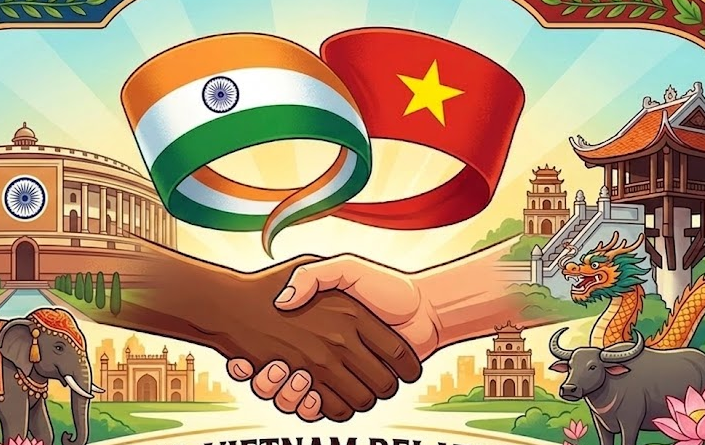
Recently, the President of the Socialist Republic of Vietnam, To Lam, arrived in India for a three-day State Visit (May 5–7, 2026). This marks his first visit to India since assuming office and coincides with the 10th anniversary of the elevation of bilateral ties to a Comprehensive Strategic Partnership.
Key Highlights of the Visit
- Cultural & Spiritual Start: The visit commenced in Gaya, Bihar, where President Lam prayed at the Mahabodhi Temple and meditated under the sacred Bodhi Tree. This underscores the shared Buddhist heritage that acts as a bridge between the two nations.
- High-Level Engagements: The President is scheduled to meet with Prime Minister Narendra Modi and President Droupadi Murmu in New Delhi to discuss trade, maritime security, and critical technologies.
- Economic Hub: The itinerary also includes a visit to Mumbai, highlighting the growing economic and investment ties.
Pillars of India-Vietnam Cooperation
- Strategic & Defense Partnership:
- Indo-Pacific Convergence: Both nations share a vision for a “free, open, and rules-based Indo-Pacific.”
- Maritime Security: Cooperation is particularly strong in the South China Sea, where India has oil exploration projects (ONGC Videsh) and provides defense equipment (e.g., BrahMos missiles, patrol boats) to Vietnam.
- Economic & Trade Relations:
- Trade Growth: Bilateral trade reached nearly $15 billion in 2025, with a target of $20 billion in the near future. In Q1 2026 alone, trade grew by 28%.
- Investment: Notable projects include Vietnam’s Vingroup setting up an Electric Vehicle (EV) factory in Tamil Nadu.
- Digital & Critical Technology:
- Collaboration is expanding into semiconductors, Artificial Intelligence (AI), and green energy.
- Cultural Diplomacy (Buddhist Bridge):
- Bodh Gaya remains a central site for Vietnamese pilgrims. This “Soft Power” aspect is a key component of India’s “Act East Policy.”
Evolution of Ties
- 1972: Establishment of formal diplomatic relations.
- 2007: Elevation to “Strategic Partnership.”
- 2016: Elevation to “Comprehensive Strategic Partnership” during PM Modi’s visit to Hanoi.
PRACTICE QUESTIONS
Q1. Consider the following statements regarding India-Vietnam relations:
- Vietnam is a member of the ASEAN (Association of Southeast Asian Nations).
- The Mahabodhi Temple in Gaya, visited by the Vietnamese President, is a UNESCO World Heritage Site.
- India and Vietnam marked the 10th anniversary of their “Comprehensive Strategic Partnership” in 2026.
Which of the statements given above is/are correct?
A) 1 and 2 only
B) 2 and 3 only
C) 1 and 3 only
D) 1, 2, and 3
Q2. With reference to the geography of Vietnam, which of the following is correct?
A) It shares a land border with Thailand.
B) It has a long coastline along the South China Sea.
C) The Mekong River does not pass through Vietnam.
D) It is a landlocked country in Southeast Asia.
ANSWERS AND EXPLANATIONS
Ans 1: D (1, 2, and 3)
- Statement 1 is correct: Vietnam joined ASEAN in 1995 and is one of its most active members.
- Statement 2 is correct: The Mahabodhi Temple Complex was designated a UNESCO World Heritage Site in 2002.
- Statement 3 is correct: The partnership was upgraded in 2016, making 2026 the 10th anniversary.
Ans 2: B
- Explanation: Vietnam has an extensive coastline along the South China Sea (East Sea). It shares land borders with China, Laos, and Cambodia, but not Thailand. The Mekong River forms a vast delta in southern Vietnam before emptying into the sea.
MAINS PRACTICE QUESTION
“Vietnam is a crucial pillar of India’s ‘Act East Policy’ and a key partner in the Indo-Pacific region.” In light of the recent visit of the Vietnamese President, discuss the strategic and economic significance of this partnership for India. (250 words)