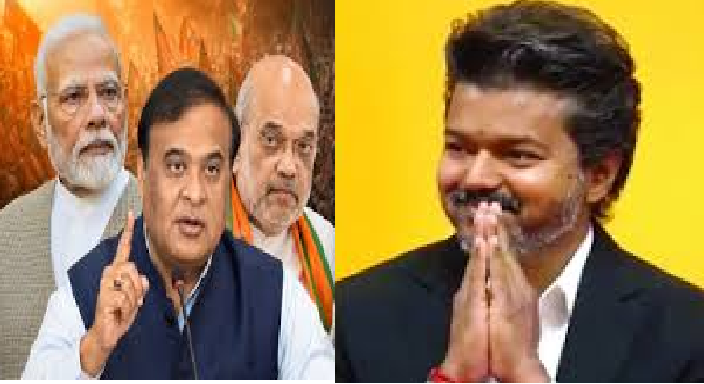
Actor-turned-politician C. Joseph Vijay (Tamilaga Vettri Kazhagam) was sworn in as the Chief Minister of Tamil Nadu, signaling a potential shift in the State’s long-standing bipolar political landscape (DMK vs. AIADMK) dominant since 1967.
Key Highlights:
- First Minority CM: Mr. Vijay becomes the first member of a minority religious denomination (Christian) to hold the post in Tamil Nadu.
- Coalition Potential: The Ministry is expected to evolve into the State’s first coalition government following a floor test scheduled for May 13.
- Initial Governance Decisions:
- Energy Subsidy: Provision of 200 units of free electricity for domestic consumers (bimonthly consumption $\leq$ 500 units).
- Women’s Safety: Formation of “Singa Pen” (Lioness) Special Force with stations across 37 districts.
- Internal Security: Establishment of an Anti-Narcotic Task Force to address the rising drug menace.
- Fiscal Transparency: The CM announced the release of a “White Paper” on the State’s finances, citing a debt of ₹10-lakh-crore.
Continuity in Assam: Second Term for Himanta Biswa Sarma
Himanta Biswa Sarma was elected as the leader of the NDA legislature party, securing a second consecutive term as the Chief Minister of Assam.
Key Highlights:
- Alliance Dynamics: The BJP-led NDA includes regional partners like the Asom Gana Parishad (AGP) and Bodoland People’s Front (BPF).
- Constitutional Process: The Governor (Lakshman Prasad Acharya) invited the leader to form the government under Article 164 of the Constitution.
- Governance Culture: Emphasis on a “new culture” of being proactive, responsive, and accountable.
Analysis: Constitutional and Governance Implications
| Feature | Details |
| Appointment of CM | Per Article 164, the CM is appointed by the Governor. Other ministers are appointed by the Governor on the advice of the CM. |
| Collective Responsibility | The Council of Ministers is collectively responsible to the Legislative Assembly of the State. |
| Coalition Governments | Often lead to a “Common Minimum Programme” (CMP) to align diverse party ideologies. In TN, this marks a departure from single-party dominance. |
| Fiscal Federalism | The use of a “White Paper” is a standard tool for a new government to communicate the inherited economic status to the public, ensuring transparency in public debt management. |
Questions for Practice
Practice Questions for Prelims (PT)
Q1. Consider the following statements regarding the appointment of a Chief Minister in India:
- The Constitution requires that a person must prove their majority on the floor of the House before being appointed as the Chief Minister.
- A person who is not a member of the State Legislature can be appointed as Chief Minister for a maximum period of six months.
- The Governor has the discretionary power to appoint a Chief Minister when no single party has a clear majority.
Which of the statements given above is/are correct?
(a) 1 and 2 only
(b) 2 and 3 only
(c) 3 only
(d) 1, 2, and 3
Q2. The “Singa Pen” Special Force, recently seen in the news, is an initiative primarily aimed at:
(a) Wildlife conservation in the Western Ghats.
(b) Combating insurgency in Northeast India.
(c) Enhancing women’s safety and protection in Tamil Nadu.
(d) Special forces for maritime security.
Answers
Q1: (b) – Statement 1 is incorrect because the Governor usually asks the CM to prove the majority after appointment (Chauhan vs. Union of India). Statements 2 and 3 are correct.
Q2: (c) – As per the Tamil Nadu CM’s recent announcement.
Practice Question for Mains
Q1. “The transition from a bipolar political system to a coalition-based government reflects a deepening of democratic pluralism but poses significant challenges for administrative stability.” Discuss this statement in the context of recent political developments in Indian States. (150 words, 10 Marks)
Q2. Evaluate the role of “White Papers” on state finances as a tool for fiscal transparency and accountability. How does a high debt-to-GSDP ratio impact a State’s ability to implement social welfare schemes? (250 words, 15 Marks)