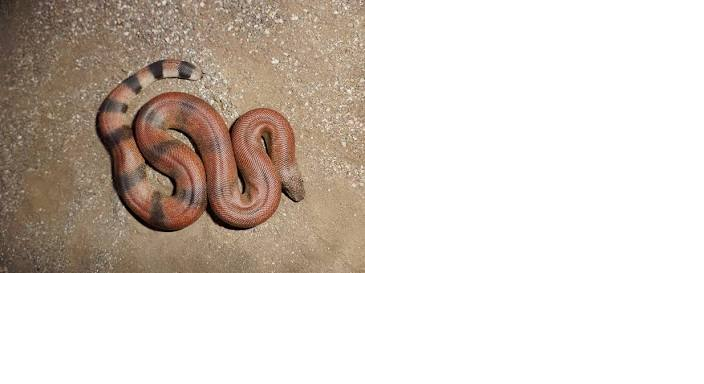
The Directorate of Revenue Intelligence (DRI) recently seized two live Indian Red Sand Boas during an undercover decoy operation in Telangana, highlighting the persistent challenge of illegal wildlife trafficking in India’s grey market.
About the Indian Red Sand Boa (Eryx johnii)
- Physical Characteristics: It is a rare, non-venomous boa species endemic to the Indian subcontinent. It is characterized by a thick, blunt tail that looks very similar to its head, leading to the widespread misconception that it is a “two-headed” snake.
- Habitat and Distribution: Primarily found in dry, semi-desert scrublands, arid regions, and dry foothill forests of India, Pakistan, and Iran.
- Ecological Significance: It is an efficient burrower and plays a vital role in the ecosystem by controlling rodent populations, indirectly benefiting agriculture.
- Conservation Status:
- IUCN Red List: Near Threatened
- CITES: Appendix II (Trade must be controlled to avoid utilization incompatible with their survival)
- Wildlife (Protection) Act, 1972: Schedule IV (affords protection against hunting and trade)
Drivers of Illegal Poaching and Trade
- Superstition and Black Magic: The primary driver for its massive demand in the grey market is irrational beliefs. Superstitions suggest that the snake brings immense wealth, good luck, and prosperity.
- Medicinal Myths: False claims regarding its use in traditional medicines, aphrodisiacs, and supposed cures for chronic diseases.
- High Market Value: Because of these myths, the snake fetches enormous sums in domestic and international black markets, incentivizing organized smuggling networks.
About Directorate of Revenue Intelligence (DRI)
- Nodal Agency: It is the apex anti-smuggling intelligence and investigation agency functioning under the Central Board of Indirect Taxes and Customs (CBIC), Ministry of Finance.
- Mandate: While its primary role is to combat commercial frauds and tax evasion, it actively enforces the provisions of the Customs Act to prevent the smuggling of contraband, including narcotics, gold, arms, and wildlife species protected under CITES and the WPA, 1972.
Practice Questions
Prelims (PT) Questions
Q1. Consider the following statements regarding the Indian Red Sand Boa:
- It is a highly venomous snake found primarily in the evergreen rainforests of the Western Ghats.
- It is listed under Appendix II of the Convention on International Trade in Endangered Species of Wild Fauna and Flora (CITES).
Which of the statements given above is/are correct?
A) 1 only
B) 2 only
C) Both 1 and 2
D) Neither 1 nor 2
Answer: B Explanation: Statement 1 is incorrect. It is a non-venomous snake found primarily in dry, arid, and semi-desert regions, not evergreen rainforests. Statement 2 is correct.
Q2. The Directorate of Revenue Intelligence (DRI), frequently seen in the news for intercepting illegal wildlife trade, operates under the administrative control of which of the following ministries? A) Ministry of Environment, Forest and Climate Change B) Ministry of Home Affairs C) Ministry of Finance D) Ministry of Commerce and Industry
Answer: C Explanation: The DRI is the apex anti-smuggling agency functioning under the Central Board of Indirect Taxes and Customs (CBIC), which comes under the Ministry of Finance.
Mains Question
Q. Despite stringent legal frameworks, the illegal trafficking of rare and endemic wildlife species remains a critical challenge in India. Discuss the socio-cultural and economic factors driving this illicit trade, and evaluate the role of intelligence agencies like the DRI in curbing it. (15 Marks, 250 words)