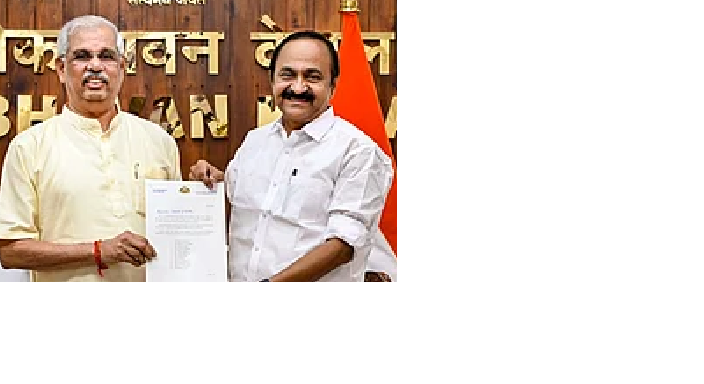
Congress leader V.D. Satheesan was recently sworn in as the 13th Chief Minister of Kerala following the landslide victory of the United Democratic Front (UDF) in the 2026 State Legislative Assembly elections.
Key Highlights of the Event
- Decisive Mandate: The UDF secured 102 out of 140 seats in the Kerala Legislative Assembly, ending the decade-long rule of the Left Democratic Front (LDF).
- Swearing-In Ceremony: The oath of office and secrecy was administered by the Governor of Kerala, Rajendra Vishwanath Arlekar, at Thiruvananthapuram.
- Council of Ministers: The Chief Minister took the oath along with a 20-member cabinet.
Constitutional Provisions Related to the Executive (State Level)
- Appointment of the Chief Minister (Article 164(1)): The Chief Minister is appointed by the Governor. The other Ministers are appointed by the Governor on the advice of the Chief Minister.
- Collective Responsibility (Article 164(2)): The Council of Ministers shall be collectively responsible to the Legislative Assembly of the State. This ensures accountability of the executive to the legislature.
- Oath of Office and Secrecy (Article 164(3)): Before a Minister enters upon his office, the Governor administers the oaths of office and of secrecy according to the forms set out for the purpose in the Third Schedule of the Constitution.
- Size of the Council of Ministers (Article 164(1A)): Inserted by the 91st Constitutional Amendment Act of 2003, it mandates that the total number of Ministers, including the Chief Minister, in a State shall not exceed 15% of the total number of members of the Legislative Assembly of that State.
- Note on Kerala: The Kerala Assembly has 140 members. 15% of 140 is exactly 21. Therefore, the 21-member cabinet (CM + 20 Ministers) utilizes the maximum permissible constitutional limit.
Role of the Governor in Government Formation
- Following a general election, the Governor invites the leader of the majority party or a pre-poll/post-poll coalition that commands a majority in the Legislative Assembly to form the government.
- The Governor’s role is largely formal when a party has a clear majority, but exercises discretionary powers (Situational Discretion) when there is a hung assembly.
Practice Questions
Prelims (PT) Questions
Q1. Consider the following statements with reference to the Council of Ministers in a State:
- The total number of Ministers, including the Chief Minister, in the Council of Ministers in a State shall not exceed 15% of the total strength of the Legislative Assembly of that State.
- The oath of office and secrecy to the state ministers is administered by the Chief Justice of the High Court of the respective state.
Which of the statements given above is/are correct?
A) 1 only
B) 2 only
C) Both 1 and 2
D) Neither 1 nor 2
Answer: A
Explanation: Statement 1 is correct as per the 91st Constitutional Amendment Act, 2003 (Article 164(1A)). Statement 2 is incorrect because the oath of office and secrecy to the ministers is administered by the Governor of the State, not the Chief Justice of the High Court.
Mains Question
Q. The 91st Constitutional Amendment Act, 2003, brought significant changes regarding the size of the Council of Ministers at both the Union and State levels. Discuss its significance in ensuring administrative efficiency and curbing political defections. (10 Marks, 150 words)