Recently, a delegation of Indian space-tech startups led by IN-SPACe signed multiple strategic partnerships at the Space Meetings Veneto 2026 in Italy. This comes against the backdrop of India’s rapid transition from a state-dominated space model to a commercially driven ecosystem.
Space Sector in India: Current Situation and Future
- Current Market Share: India’s space economy is currently valued at approximately $8.4 billion, accounting for roughly 2% of the global space market.
- Future Projections: According to government estimates and IN-SPACe, the sector is projected to expand nearly fivefold to $44 billion over the next decade. India aims to capture 8-10% of the estimated $1.8 trillion global space economy by 2035.
- Budgetary Push: The space budget has seen significant growth over the last decade, reaching ₹13,416 crore in 2025-2026.
- Export Success: India has established itself as a reliable commercial launch hub, launching over 400 foreign satellites for more than 30 countries and generating substantial revenue in Euros and US Dollars.
Privatization of the Space Sector in India
The structural shift from an ISRO-monopolized ecosystem to a liberalized market is termed the “NewSpace” phase.
- Institutional Reforms: The Space Sector Reforms of 2020 and the Indian Space Policy 2023 unlocked the sector. IN-SPACe (Indian National Space Promotion and Authorisation Centre) was created as a single-window autonomous nodal agency to authorize and regulate private entities.
- NewSpace India Limited (NSIL): Acting as the commercial arm of ISRO, NSIL focuses on scaling up industry participation and monetizing launch services and technology transfers.
- Liberalized FDI: The government now permits up to 100% Foreign Direct Investment (FDI) via the automatic route in less sensitive categories (like component manufacturing), with graded caps for satellite operations and launch vehicles.
- Financial Support: The Cabinet recently approved a ₹1,000 crore venture capital fund and a ₹500 crore Technology Adoption Fund to accelerate private R&D.
Space Startups in the Indian Space Sector
The ecosystem has witnessed the emergence of over 390 registered space startups.
- Major Milestones:
- PPP Constellation: A consortium of four leading startups (Pixxel, SatSure, PierSight, and Dhruva Space) won India’s first major Public-Private Partnership (PPP) bid to build a 12-satellite indigenous earth observation constellation at a cost of ~₹1,200 crore.
- Launch Vehicles & Propulsion: Companies like Agnikul Cosmos (3D-printed semi-cryogenic engines) and Skyroot Aerospace have successfully conducted sub-orbital launches and motor tests.
- Space Situational Awareness (SSA): Startups like Digantara are deploying satellites (e.g., the SCOT mission) to track objects and debris in space.
- Funding Surge: Indian space-tech startups have seen year-on-year equity funding growth exceeding 140%, backed by domestic deep-tech investors and international funds.
Benefits of Privatization
- Cost-Effective Innovation: Private startups operate with agility, introducing innovations like reusable micro-launchers and miniaturized CubeSats at a fraction of traditional costs.
- Socio-Economic Applications: Expanding satellite data access accelerates downstream applications in agriculture, urban planning, and disaster management (e.g., integrating satellite mapping into the SVAMITVA land-record scheme).
- Global Supply Chain Integration: Collaborations like the recent India-Italy agreements (Ground Station as a Service, launch sharing) allow Indian firms to integrate into the global high-tech manufacturing supply chain.
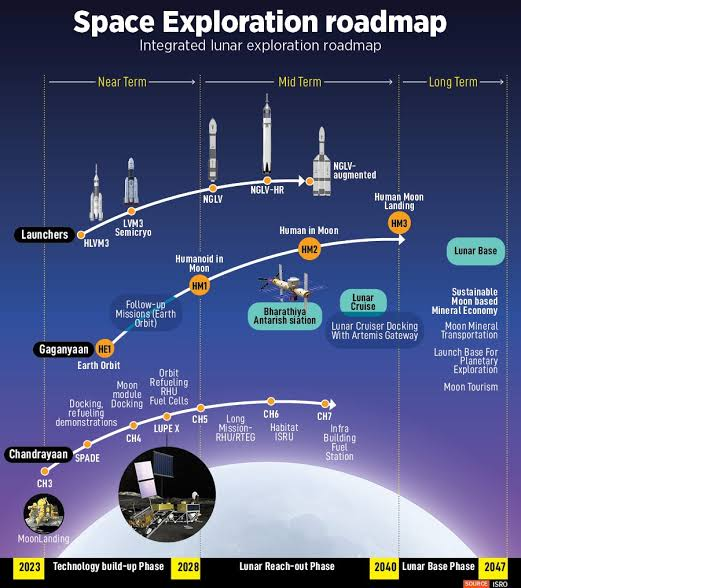
- Frees up ISRO: Relieving ISRO of routine commercial launches allows the space agency to focus strictly on deep space exploration (Gaganyaan, Chandrayaan-4, Venus missions) and advanced R&D.
Concerns & Challenges
- Capital Expenditure Stagnation: The Economic Survey 2025-26 highlighted that while revenue expenditure has risen, core capital expenditure (crucial for new launch infrastructure and R&D) has faced budgetary stagnation when adjusted for inflation.
- Execution and Valuation Risks: Surging market optimism has led to high valuations for space-tech companies. Profitability remains a challenge for many, posing risks if execution falters.
- Supply Chain & Quality Vulnerabilities: The push for a higher launch cadence to meet commercial demand has occasionally exposed vulnerabilities in manufacturing quality control and domestic supply chains.
- Intense Global Competition: Indian startups face steep competition from heavily funded global giants like SpaceX and Blue Origin, who benefit from massive domestic government contracts.
Way Forward
- Procurement-Driven Model: The government should act as an “anchor customer” by directly purchasing services and data from domestic space startups, providing them with predictable revenue to scale up.
- Infrastructure Expansion: Timely completion of new infrastructure, such as the dedicated launchpad at Kulasekarapattinam in Tamil Nadu, is vital to accommodate the rising frequency of private launches.
- Strengthening Quality Assurance: As highlighted by the Economic Survey, fixing supply chain weaknesses and establishing strict quality control standards is crucial to maintaining India’s reputation as a reliable space power.
- Synergized Ecosystem: Fostering deeper collaboration between academia, the armed forces, ISRO, and private NGEs (Non-Governmental Entities) will ensure India not only participates in the global space race but leads it by 2047.
Key Terminologies
- Ground Station as a Service (GSaaS): A cloud-based or shared infrastructure model where space companies pay for access to ground station antennas to communicate with their satellites (for data downlink and telemetry), rather than building and maintaining their own physical ground stations.
- CubeSats: A class of miniaturized satellites based on a standardized form factor (consisting of 10x10x10 cm units) used primarily for space research, earth observation, and communication.
About IN-SPACe (Indian National Space Promotion and Authorisation Centre)
- Establishment: Created as an autonomous, single-window nodal agency functioning under the Department of Space (DoS).
- Mandate: It acts as an autonomous body to promote, enable, authorize, and supervise the space activities of Non-Governmental Entities (NGEs) in India.
- Significance: IN-SPACe is the cornerstone of India’s space sector privatization, bridging the gap between ISRO (Indian Space Research Organisation) and private startups by allowing them to utilize ISRO’s infrastructure, facilities, and scientific data.
Practice Questions
Prelims (PT) Questions
Q1. Consider the following statements regarding the institutional framework of the Indian space sector:
- IN-SPACe acts as a single-window agency under the Ministry of Science and Technology for all space sector activities of private entities.
- NewSpace India Limited (NSIL) serves as the commercial arm of the Indian Space Research Organisation (ISRO).
Which of the statements given above is/are correct?
A) 1 only
B) 2 only
C) Both 1 and 2
D) Neither 1 nor 2
Answer: B Explanation: Statement 1 is incorrect because IN-SPACe functions under the Department of Space (DoS), not the Ministry of Science and Technology. Statement 2 is correct; NSIL is a Central Public Sector Enterprise under the DoS and acts as the commercial arm of ISRO.
Mains Question
Q. Discuss the role of Non-Governmental Entities (NGEs) in unlocking the true potential of India’s space economy. How do recent institutional reforms and international collaborations facilitate their integration into the global space market? (15 Marks, 250 words)