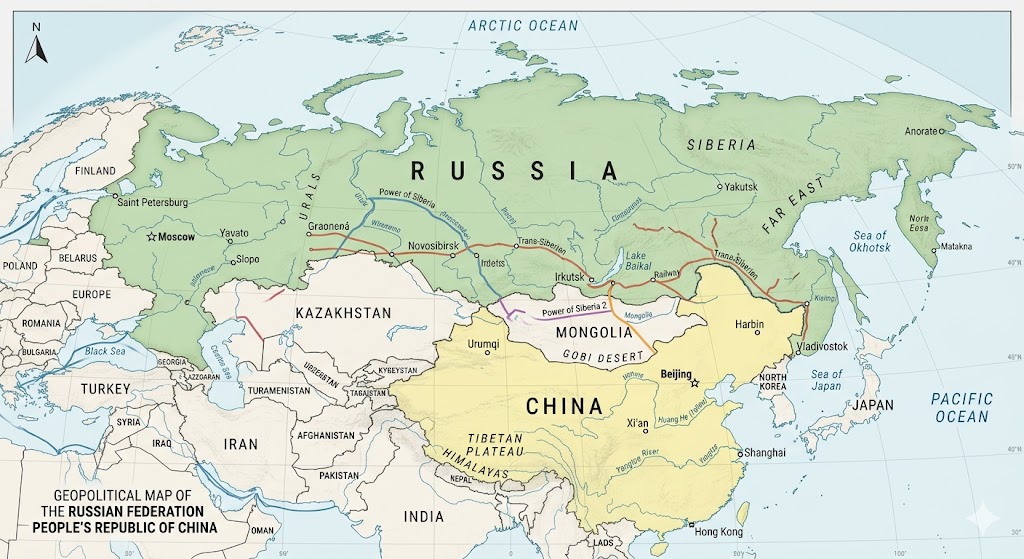
Russian President Vladimir Putin recently visited Beijing to hold talks with Chinese President Xi Jinping. The visit is highly significant as it immediately followed a high-profile visit by U.S. President Donald Trump, and marks the 30th anniversary of the strategic partnership between Russia and China.
Context and Strategic Timing (The “Trump Factor”)
- Back-to-Back Diplomacy: Putin’s visit was timed just days after U.S. President Donald Trump concluded his trip to China (the first by a U.S. President in nearly a decade). While the U.S.-China summit aimed to stabilize turbulent bilateral relations, the Russia-China summit was designed to project that Moscow and Beijing’s ties remain “unshakeable.”
- Diplomatic Isolation of Russia: Since the invasion of Ukraine in 2022, Russia has faced severe diplomatic and economic isolation from the West. As a result, Putin has made it a point to visit Beijing annually, relying on China as a critical geopolitical and economic lifeline.
- Personal Diplomacy: The use of terms like “long-time good friend” by both leaders underscores the heavy reliance on personalized diplomacy to cement the bilateral axis against Western hegemony.
Core Agenda of the Bilateral Meet
- Strengthening the Axis: Further deepening the “comprehensive strategic partnership of coordination” between the two nations.
- Joint Declaration: The summit is expected to culminate in a joint declaration outlining their shared stance on key international and regional issues.
- Energy Security Architecture: Central to the discussions is the Power of Siberia 2 natural gas pipeline.
Key Project: “Power of Siberia 2” Pipeline
- What is it? A proposed mega-pipeline to transport natural gas from Russia’s Altai region to northeastern China, transiting through Mongolia.
- Geostrategic Importance for Russia: With European markets largely closed off due to sanctions, Moscow is desperate to pivot its energy exports eastward to sustain its economy.
- Geostrategic Importance for China: It provides China with a secure, overland energy supply route, serving as a critical alternative to crude oil imported by sea from West Asia (which is vulnerable to naval blockades, especially in the Strait of Malacca).
The Reality of the Alliance: An “Unequal Relationship”
Despite the optics of an enduring friendship, experts and analysts note that the partnership is increasingly lopsided:
- Economic Asymmetry: Russia is heavily dependent on China, essentially becoming a junior partner. China’s economy is vastly larger and more diversified.
- Sanctions and Oil: China has become the primary buyer of sanctioned Russian oil, purchasing it at discounted rates. This dictates that Beijing holds significant leverage over Moscow’s economic survival.
- Technological Dependence: With Western tech firms exiting Russia, Moscow is increasingly reliant on Chinese technology, from smartphones to industrial machinery and automobiles.
Implications for India
- Complicated Balancing Act: India maintains a strong historical and defense partnership with Russia, while facing intense border friction with China. A Russia that is heavily dependent on China may be less capable of balancing Beijing’s aggression in the Indo-Pacific.
- Energy Markets: China absorbing cheap Russian oil impacts global energy supply chains. India, too, has been a major buyer of discounted Russian crude, and must navigate this dynamic while managing its own relations with the U.S.
PRACTICE QUESTIONS
1. Prelims (PT) Practice Question
Q. Consider the following statements regarding the proposed “Power of Siberia 2” pipeline:
- It is designed to supply natural gas from Russia directly to Western Europe via the Baltic Sea.
- The pipeline’s proposed route transits through the landlocked nation of Mongolia.
- For China, it serves as a strategic overland alternative to seaborne energy imports from West Asia.
Which of the statements given above is/are correct?
(a) 1 and 2 only
(b) 2 and 3 only
(c) 3 only
(d) 1, 2, and 3
Answer: (b) 2 and 3 only
- Statement 1 is incorrect: The Power of Siberia 2 is designed to transport natural gas from Russia to China, not Europe. (The Nord Stream pipelines were meant for Europe via the Baltic Sea).
- Statement 2 is correct: The pipeline is planned to pass through Mongolia to reach northern China.
- Statement 3 is correct: Overland pipelines help China mitigate the “Malacca Dilemma” by reducing its reliance on vulnerable maritime choke points for energy imports from West Asia.
2. Mains Practice Question
Q. “The optics of an unshakeable Russia-China strategic partnership mask an increasingly unequal relationship driven by geopolitical necessity.” Analyze this statement in the context of recent global developments. How does this deepening axis impact India’s strategic autonomy? (250 Words, 15 Marks)