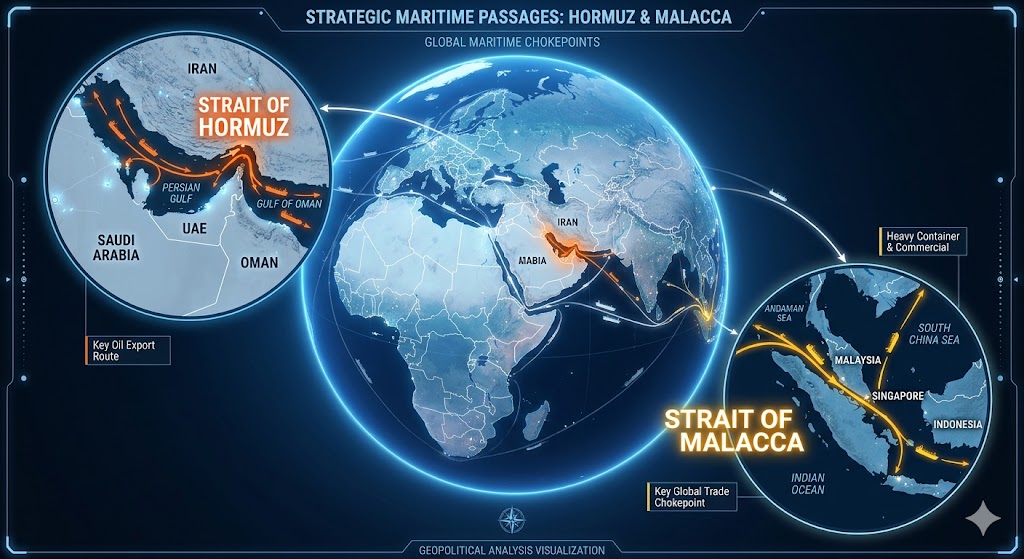
Recently, Iran’s Parliament announced a “professional mechanism” managed by a newly established Persian Gulf Strait Authority (PGSA) to oversee and collect tolls for vessel movement through the Strait of Hormuz.
Indonesia temporarily floated the idea of imposing a levy on ships passing through the Malacca Strait, though it later reaffirmed its commitment to international freedom of navigation laws.
Context: The “Closed” Nature of the Indian Ocean
Unlike the Atlantic and Pacific oceans, the Indian Ocean is geographically a “closed” ocean. Access to its waters is controlled by a few narrow straits.
- Global Hub: The Indian Ocean handles roughly 30% of global container traffic, 80% of the world’s sea-borne oil trade, and sees around 100,000 ships transit annually.
- The Achilles’ Heel: Because global mercantile routes converge at these narrow geographical bottlenecks, any geopolitical instability, toll imposition, or blockade at these chokepoints can paralyze global supply chains and trigger severe energy crises.
Key Maritime Chokepoints in the Indian Ocean
1. Strait of Hormuz (Gateway to the Persian Gulf)
- Location: Connects the Persian Gulf to the Gulf of Oman and the Arabian Sea.
- Strategic Value: It is the sole maritime gateway for approximately one-fifth of global oil and Liquefied Natural Gas (LNG) supplies.
- Current Threat: By establishing the PGSA and formalizing a toll system for commercial vessels, Iran is exercising sovereign control over an international strait, restricting access for operators aligned with U.S. interests. This threatens global energy security and inflates shipping costs.
2. Bab-el-Mandeb (“Gate of Tears”)
- Location: Located between the Arabian Peninsula (Yemen) and the Horn of Africa (Djibouti/Eritrea). It links the Red Sea and the Suez Canal to the Gulf of Aden and the Indian Ocean.
- Dimensions: Merely 26 km wide at its narrowest point.
- Strategic Value: Handled 9.3% of global crude oil and 8.7% of global sea-borne trade by volume in 2023. It is the crucial western gateway connecting Asia to Europe.
- Current Threat: The strait has been a recurring flashpoint. Iran-backed Houthi militants in Yemen severely disrupted traffic during the 2023–2024 Gaza conflict, and recently threatened to block the strait amid rising US-Iran hostilities.
- Alternatives & Costs: The only viable alternative is re-routing around the Cape of Good Hope (southern tip of Africa), which adds 10–14 days of transit time and approximately $2 million in extra costs per voyage.
3. Strait of Malacca (“Gooseberry Strait”)
- Location: Between the Malay Peninsula and the Indonesian island of Sumatra. It is the eastern gateway connecting the Indian Ocean to the South China Sea and the Pacific Ocean.
- Dimensions: Stretches roughly 900 km but is just 2.8 km wide at its narrowest (Phillips Channel).
- Strategic Value: Handles 24% of global maritime trade, 45% of global oil shipments, and serves as the lifeline for East and Southeast Asian manufacturing hubs. Singapore, located at its tip, hosts the world’s busiest container transshipment hub.
- “Malacca Dilemma”: A term coined by former Chinese President Hu Jintao (2003) highlighting China’s strategic vulnerability, as 75% of its imported oil passes through this single, easily blockaded chokepoint.
- Alternatives & Costs: Rerouting through the Lombok or Sunda Straits adds roughly 1,000–1,500 nautical miles (3–5 extra days) and bypasses the critical refueling infrastructure of Singapore.
Implications for India
- Energy Security: India imports more than 85% of its crude oil, with a massive share passing through the Strait of Hormuz. Any toll regime or blockade by Iran directly inflates India’s import bill and widens the Current Account Deficit (CAD).
- Trade Competitiveness: Disruptions in Bab-el-Mandeb force Indian exporters (especially those trading with Europe and the US East Coast) to use the Cape of Good Hope. The increased freight rates and insurance premiums erode the global competitiveness of Indian goods.
- Act East Policy: The security of the Malacca Strait is vital for India’s “Act East” policy and its bilateral trade with ASEAN nations, Japan, and South Korea.
Way Forward
- Naval Diplomacy & SAGAR: India must bolster its naval presence at these chokepoints (e.g., anti-piracy patrols in the Gulf of Aden) and deepen defense cooperation with littoral states under its Security and Growth for All in the Region (SAGAR) vision.
- Alternative Transit Corridors: Expediting the operationalization of the International North-South Transport Corridor (INSTC) and the India-Middle East-Europe Economic Corridor (IMEC) to reduce reliance on vulnerable maritime straits like Bab-el-Mandeb and the Suez Canal.
- Strategic Petroleum Reserves (SPR): India must aggressively expand its SPR capacity to buffer against sudden, short-term disruptions in the Strait of Hormuz.
PRACTICE QUESTIONS
1. Prelims (PT) Practice Question
Q. Consider the following pairs of maritime chokepoints and their connecting water bodies:
- Bab-el-Mandeb: Connects the Red Sea to the Gulf of Aden.
- Strait of Hormuz: Connects the Persian Gulf to the Gulf of Oman.
- Strait of Malacca: Connects the Andaman Sea to the South China Sea.
Which of the pairs given above is/are correctly matched?
(a) 1 and 2 only
(b) 2 and 3 only
(c) 1 and 3 only
(d) 1, 2, and 3
Answer: (d) 1, 2, and 3
- Explanation: All pairs are correctly matched. Bab-el-Mandeb links the Red Sea/Suez to the Gulf of Aden. The Strait of Hormuz is the only sea passage from the Persian Gulf to the open ocean (Gulf of Oman/Arabian Sea). The Strait of Malacca connects the Indian Ocean (via the Andaman Sea) to the Pacific Ocean (via the South China Sea).
2. Mains Practice Question
Q. “The Indian Ocean’s maritime chokepoints are the Achilles’ heel of global trade and energy security.” In light of recent geopolitical disruptions in the Strait of Hormuz and Bab-el-Mandeb, evaluate the strategic vulnerabilities they pose to the global economy. Suggest measures India should adopt to safeguard its maritime and economic interests. (250 words, 15 Marks)