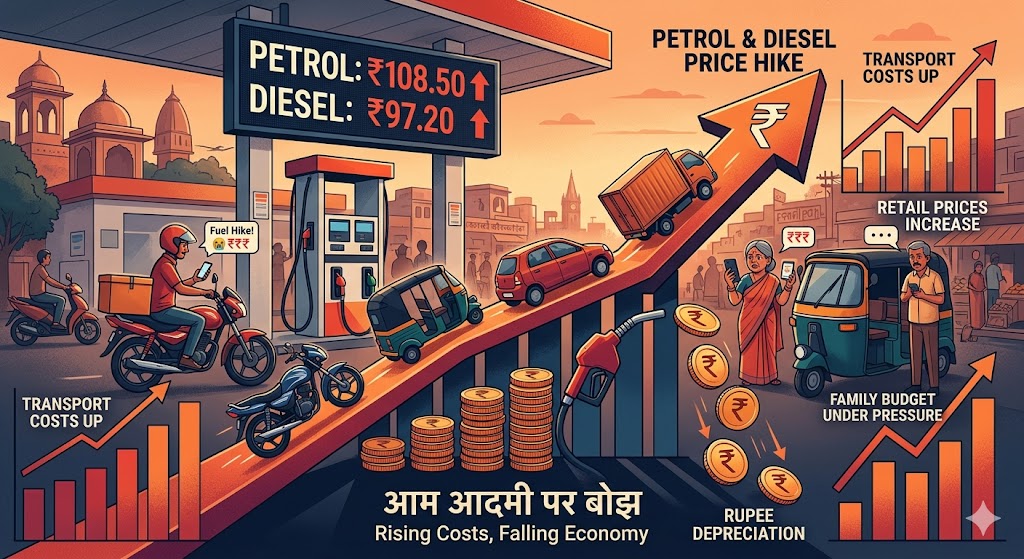
Recently, government-owned Oil Marketing Companies (OMCs) have hiked the retail prices of petrol and diesel in a staggered manner (a ₹3/litre hike followed by a 90-paise hike) after a four-year hiatus on major price increases.
Key Highlights of the Current Scenario
- Graded Price Revision: OMCs are opting for a “graded” or staggered increase in retail prices to avoid sudden macroeconomic shocks to consumers while trying to mitigate their own losses.
- Reduction in Daily Losses: Prior to the hikes, OMCs were facing massive under-recoveries (selling fuel below cost). The ₹3 hike reduced daily combined losses (from LPG, petrol, and diesel) by ₹250 crore (bringing it down to ₹750 crore). The subsequent hikes are expected to curtail daily losses to around ₹450 crore.
- No Government Bailout: The government has explicitly stated it is not considering a bailout package for OMCs, indicating that companies must rely on market-adjusted retail pricing to recover costs.
Primary Reasons for the Price Hike
- Surging Global Crude Prices: The benchmark Brent crude futures are trading high (oscillating between $105 and $110 per barrel). The Indian crude basket averaged over $106-$107 per barrel recently.
- Geopolitical Tensions: The sustained high crude prices are heavily driven by global supply chain anxieties, ongoing tensions in West Asia, and the cascading effects of the Russia-Ukraine conflict.
- Depreciation of the Indian Rupee: A weakening Rupee against the US Dollar severely increases the “landed cost” of crude oil imports. Currency depreciation often offsets the financial gains OMCs make from retail price revisions.
- Unsustainable OMC Financials: Operating under materially significant cost pressure, OMCs cannot sustain prolonged daily losses without risking their operational viability and capital expenditure plans.
Macroeconomic Implications
- Inflationary Pressures: Fuel is a universal intermediate good. A rise in petrol and diesel prices creates a cascading effect, increasing freight and transportation costs, which directly feeds into wholesale (WPI) and retail (CPI) inflation.
- Current Account Deficit (CAD): India imports roughly 85% of its crude oil requirements. High crude prices combined with a weak rupee widen the CAD.
- Fiscal Prudence vs. Welfare: By refusing a bailout to OMCs and allowing price hikes, the government is protecting its fiscal deficit targets but risking consumer inflation and reduced disposable income for citizens.
Background: Pricing Mechanism of Fuel in India
- Deregulation: The pricing of petrol and diesel has been deregulated in India. Petrol was deregulated in 2010 and diesel in 2014, linking their retail prices directly to international market rates.
- Dynamic Pricing: In 2017, India shifted to a dynamic daily pricing model, replacing the fortnightly revision mechanism, to ensure that the benefit of even the smallest change in international oil prices can be passed down to dealers and consumers. (However, in practice, OMCs have occasionally frozen prices during politically sensitive periods or extreme volatility).
Way Forward
- Energy Diversification: Expediting the transition to Renewable Energy, Electric Vehicles (FAME-II/III policies), and the National Green Hydrogen Mission to reduce crude import dependency.
- Ethanol Blending: Scaling up the E20 (20% ethanol blending) program to cut down the volume of crude oil imports.
- Strategic Petroleum Reserves (SPR): Expanding SPR capacity to insulate the domestic economy from sudden geopolitical crude price shocks.
PRACTICE QUESTIONS
1. Prelims (PT) Practice Question
Q. Consider the following statements regarding the pricing of petroleum products in India:
- Both Petrol and Diesel are fully deregulated products in India, and their prices are determined dynamically based on international crude prices.
- The ‘Indian Crude Basket’ represents a mix of sour grade (Oman & Dubai) and sweet grade (Brent) crude oil processed by Indian refineries.
- A depreciation in the value of the Indian Rupee directly decreases the landed cost of crude oil imports.
Which of the statements given above is/are correct?
(a) 1 and 2 only
(b) 2 and 3 only
(c) 1 only
(d) 1, 2, and 3
Answer: (a) 1 and 2 only
2. Mains Practice Question
Q. “The dual shock of surging global crude oil prices and a depreciating Rupee poses a severe test for India’s macroeconomic stability.” In light of this statement, analyze the impact of high crude prices on the Indian economy. Evaluate the role of Oil Marketing Companies (OMCs) in buffering these shocks. (250 Words, 15 Marks)