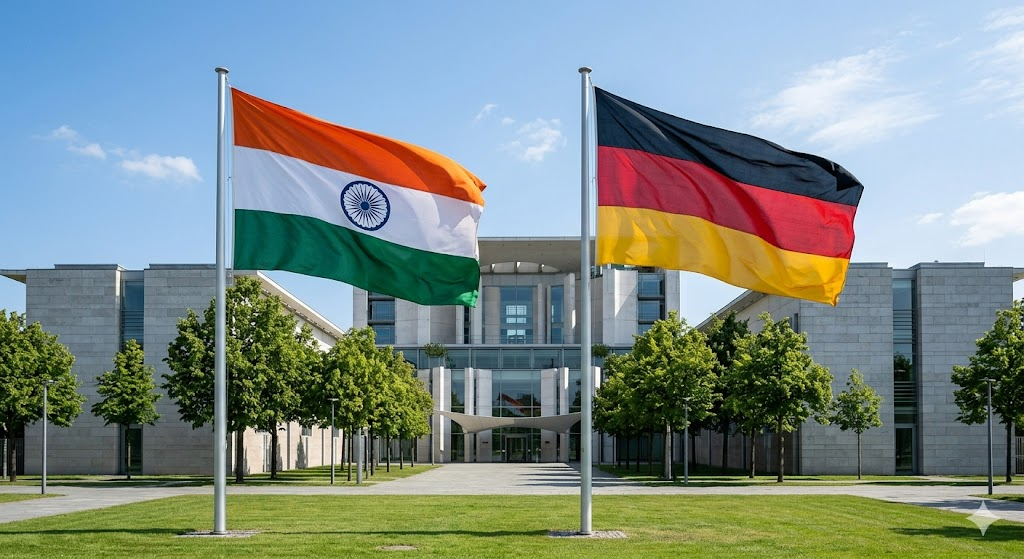
India and Germany formalized a Comprehensive Roadmap on Higher Education in January 2026 during the state visit of German Chancellor Friedrich Merz to India.
Key Highlights of the Roadmap
- Scope of Cooperation: The bilateral framework encompasses institutional collaboration, research partnerships, German language teaching, and structured student mobility.
- Academic Integration: It facilitates mobility at undergraduate, postgraduate, and doctoral levels, establishing joint learning pathways and preparatory routes for Indian students seeking to enter German public universities.
- NEP 2020 Alignment: Under the National Education Policy 2020, India has formally invited leading German universities to establish physical campuses on Indian soil, subject to specified regulatory conditions.
Academic Pathways & Institutional Frameworks
- German Pathway Programs: Institutions like Study Feeds (with Desh Bhagat University) and Jain University (Kochi) offer pathway programs. These allow students to complete their foundation year(s) in India (often without tuition fees) before transferring to German partner universities for accredited degrees in fields like CS and IT.
- Studienkolleg: These are specialized, usually one-year preparatory bridging courses for international students whose home-country school qualifications do not directly meet the entry requirements of German universities.
- DAAD (German Academic Exchange Service): Germany’s premier organization for international academic cooperation. It facilitates exchange through scholarships, mobility programs, and university partnerships.
- anabin & KMK Databases: Official German databases used to evaluate, verify, and assess the equivalence of foreign educational qualifications.
Why Germany is a Preferred Destination
According to a May 2026 TerraTern survey, Germany is the preferred destination for 75% of Indian students and early-career professionals from smaller cities. Key pull factors include:
- Financial Viability: Negligible or zero tuition fees in most public universities.
- Immigration Policies: Favorable student visa routes, dedicated job-seeker visas, and clear pathways to permanent residency.
- Academic Excellence: Global leadership in engineering, information technology, and advanced research programs.
Practice Questions
Prelims (PT) Question
Q. With reference to the India-Germany higher education cooperation, consider the following pairs:
| Term | Description |
| 1. DAAD | Germany’s main organization for academic exchange and scholarships. |
| 2. Studienkolleg | A database used to assess foreign educational qualifications. |
| 3. anabin | A one-year preparatory academic program for international students. |
How many of the pairs given above are correctly matched?
(a) None
(b) Only one
(c) Only two
(d) All three
Answer: (b)
- Pair 1 is correctly matched: DAAD is the German Academic Exchange Service.
- Pair 2 is incorrectly matched: Studienkolleg is a preparatory academic course, not a database.
- Pair 3 is incorrectly matched: anabin is the database used to assess foreign educational qualifications, not a preparatory program.
Mains Practice Question
Q. “The internationalization of higher education under the National Education Policy (NEP) 2020 presents a unique opportunity to transform India’s demographic dividend into a globally competitive workforce.” Discuss this statement in the context of the recently formalized India-Germany Comprehensive Roadmap on Higher Education. (150 words, 10 Marks)