Subject: Health and Science & Technology (General Studies Paper-II & III)
Table of Contents
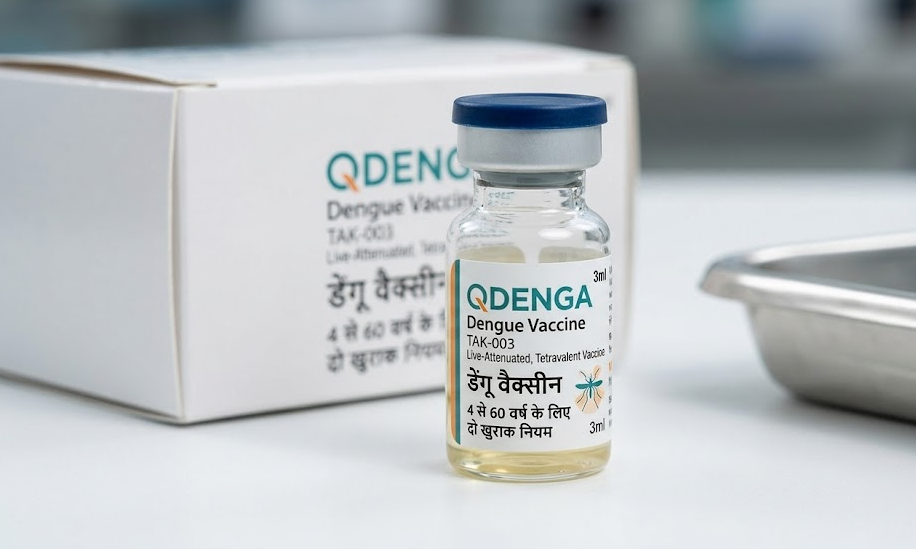
The Drug Controller General of India (DCGI) has granted market authorization to Takeda Biopharmaceuticals for its QDENGA (TAK-003) vaccine, marking a historic milestone as the first dengue vaccine to be approved in India.
Key Highlights
- About the QDENGA Vaccine
- Vaccine Type: It is a live-attenuated tetravalent vaccine. This means it uses a weakened form of the virus and is specifically designed to provide protection against all four serotypes (strains) of the dengue virus (DENV-1, 2, 3, and 4).
- Dosage and Target Age: It is approved for individuals aged 4 to 60 years and is administered as a two-dose subcutaneous regimen, with the doses given three months apart.
- No Pre-Vaccination Screening Required
- A major breakthrough with QDENGA is that it can be safely administered irrespective of an individual’s previous dengue infection history.
- Note: Earlier global vaccines (like Sanofi’s Dengvaxia) required pre-vaccination screening because administering them to individuals who had never had dengue (seronegative) increased the risk of severe disease upon subsequent infection. QDENGA eliminates this logistical hurdle.
- Clinical Efficacy
- Based on extensive Phase III trials across endemic countries, the vaccine demonstrated an efficacy of 80.2% against virologically confirmed dengue 12 months after the second dose.
- Crucially, it showed a 90.4% efficacy against dengue-related hospitalizations, which is vital for reducing the burden on healthcare infrastructure.
What is Dengue?
- Nature of Disease: Dengue is a viral infection transmitted to humans primarily through the bite of infected Aedes aegypti mosquitoes.
- Serotypes: The dengue virus (DENV) has four distinct but closely related serotypes (DENV-1, 2, 3, and 4). Recovery from one serotype provides lifelong immunity against that specific strain, but only temporary and partial immunity against the other three. Subsequent infections by different serotypes increase the risk of developing severe dengue.
- Symptoms and Severity: Symptoms range from a mild, flu-like illness (high fever, severe headache, joint and muscle pain, and retro-orbital pain behind the eyes) to severe dengue. Severe dengue (also known as Dengue Hemorrhagic Fever or Dengue Shock Syndrome) is a potentially fatal complication characterized by plasma leaking, severe bleeding, and respiratory distress.
Dengue Situation in India
- Escalating Disease Burden: Dengue remains a critical public health challenge in India. Over the past two decades, the number of reported cases in the country has increased by a staggering 11-fold.
- Global Share: India currently bears an immense proportion of the disease, accounting for nearly one-third (33%) of the total global dengue burden.
- Endemicity and Seasonality: The disease is highly endemic across most states in India. Outbreaks are cyclical and closely tied to the monsoon and post-monsoon seasons, which create ideal breeding grounds for mosquitoes in stagnant urban water.
- Underreporting Issues: While official statistics highlight a severe crisis, various epidemiological modelling studies suggest that the actual number of infections is substantially higher than reported, owing to asymptomatic cases, mild infections, and gaps in rural healthcare surveillance.
The Need for the Vaccine
- Absence of Specific Treatment: Currently, there are no specific antiviral drugs to treat a dengue infection. Medical intervention is purely supportive (such as fluid replacement therapy). Therefore, a preventive vaccine is the most effective defense mechanism.
- Limitations of Vector Control: Traditional methods to control mosquito populations—such as fogging, using repellents, and eliminating stagnant water—have proven insufficient to halt the rapid spread of the virus, particularly in densely populated and rapidly urbanizing Indian cities.
- Reducing Healthcare Burden: Annual dengue outbreaks place a massive strain on India’s healthcare infrastructure, leading to a shortage of hospital beds and blood platelets. A vaccine with high efficacy against hospitalization (like QDENGA’s 90.4% efficacy) is crucial to prevent the healthcare system from being overwhelmed.
- Simplifying Mass Immunization: Earlier vaccine attempts globally required mandatory pre-vaccination blood tests to ensure the person had a prior dengue infection (to avoid triggering severe dengue). The need for a vaccine that can be administered safely without pre-screening is critical for implementing practical, large-scale public immunization programs in a country of India’s size.
Prelims Practice Question
Question: With reference to ‘QDENGA’, recently approved by the Drug Controller General of India (DCGI), consider the following statements:
- It is a live-attenuated tetravalent vaccine that provides protection against all four serotypes of the dengue virus.
- It can only be administered to individuals who have a confirmed medical history of a previous dengue infection.
- It is the first dengue vaccine to receive market authorization in India.
Which of the statements given above is/are correct? (a) 1 and 2 only (b) 2 and 3 only (c) 1 and 3 only (d) 1, 2, and 3
Answer: (c) 1 and 3 only Explanation:
- Statement 1 is correct: QDENGA is a live-attenuated tetravalent vaccine protecting against all four serotypes.
- Statement 2 is incorrect: A key advantage of QDENGA is that it does not require pre-vaccination screening and can be given irrespective of whether the individual has had a prior dengue infection or not.
- Statement 3 is correct: It is India’s first approved dengue vaccine.