Subject: Polity and Governance (General Studies Paper-II)
Table of Contents
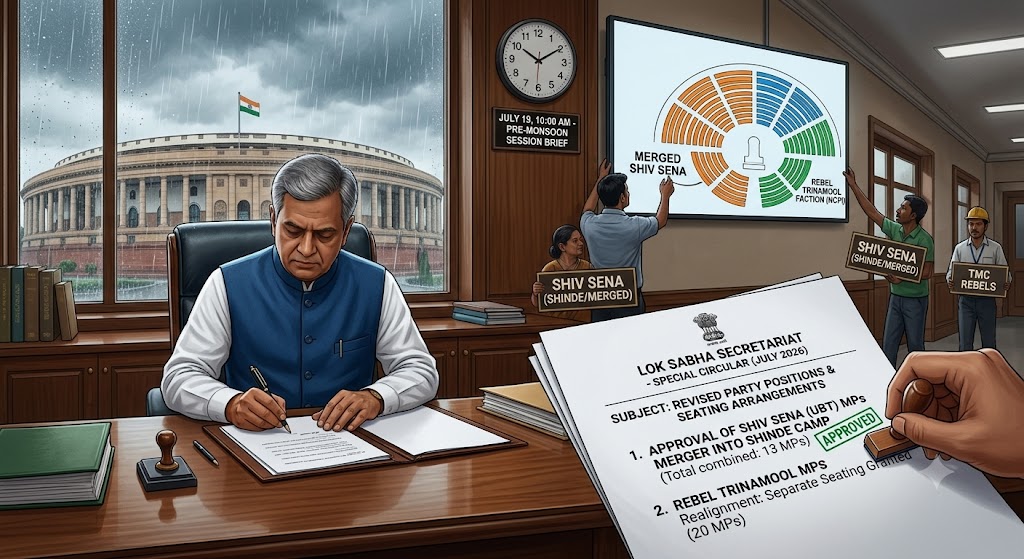
Just before the upcoming Monsoon Session, Lok Sabha Speaker Om Birla approved the merger of 6 Shiv Sena (Uddhav Balasaheb Thackeray – UBT) MPs into the Shiv Sena led by Maharashtra Chief Minister Eknath Shinde.
Additionally, a breakaway faction of 20 rebel MPs from the Trinamool Congress (TMC) has been granted permission for separate seating in the House. This faction has claimed a merger with a party named the ‘Nationalist Citizens Party of India’ (NCPI).
Key Highlights
Merger of Shiv Sena (UBT) MPs
- Following the Lok Sabha Speaker’s approval, the strength of the Shinde faction (Shiv Sena) in the Lower House has risen from 7 to 13, leaving the Uddhav Thackeray-led UBT faction with only 3 MPs.
- The Speaker took this decision after hearing both factions, consulting parliamentary experts, and reviewing past precedents.
Split in TMC and the New Faction
- Twenty MPs from the Trinamool Congress representing West Bengal rebelled and submitted a letter seeking a merger with the NCPI.
- This rebel faction has elected Sudip Bandyopadhyay as its leader and Kakoli Ghosh Dastidar as the Chief Whip.
- Although the Speaker has not yet formally recognized their merger as the NCPI, they have been allocated separate seating arrangements in the House.
Anti-Defection Law in India
- Constitutional Provisions: To curb the malpractice of political defection (historically referred to as ‘Aaya Ram, Gaya Ram’ politics), the Tenth Schedule was added to the Constitution of India via the 52nd Constitutional Amendment Act, 1985.
- Grounds for Disqualification: A member can be disqualified if they:
- Voluntarily give up the membership of their political party.
- Vote or abstain from voting in the House contrary to the directions (Whip) issued by their political party (unless condoned within 15 days).
- An independently elected member joins any political party.
- A nominated member joins any political party after the expiry of 6 months.
- Exception (Merger): As per the 91st Constitutional Amendment Act (2003), disqualification does not apply if at least two-thirds (2/3rds) of the members of a party agree to merge with another political party.
- Deciding Authority: The final decision on disqualification petitions rests with the Presiding Officer of the House (Speaker or Chairman). In the landmark ‘Kihoto Hollohan vs. Zachillhu’ (1992) case, the Supreme Court clarified that the Speaker’s decision is subject to ‘Judicial Review’.
Recent Incidents of Defection
- Maharashtra Political Crisis (2022-23): A major split occurred within the Shiv Sena and the Nationalist Congress Party (NCP), where the factions led by Eknath Shinde and Ajit Pawar claimed the support of more than two-thirds of their respective original legislative parties. Subsequently, the Election Commission recognized these rebel factions as the authentic original parties.
- Recent Developments in Lok Sabha: The merger of 6 Lok Sabha MPs of Shiv Sena (UBT) into the Shinde faction, and the attempt by 20 rebel TMC MPs to merge into the newly formed ‘Nationalist Citizens Party of India’ (NCPI).
- Allegations of ‘Operation Lotus’ in States: Previously, incidents of collective resignations by ruling party MLAs in Madhya Pradesh (2020) and Karnataka (2019)—who later contested by-elections on opposition party tickets to become ministers—led to the collapse of elected governments.
Relevance in the Current Context
- Stability of Governments: The law successfully prevents ‘retail defection’ (the switching of allegiance by one or two legislators), thereby saving governments from collapsing on a day-to-day basis.
- Respecting the Mandate: Indian elections are fought on party symbols and specific ideologies. This law endeavors to ensure that elected representatives remain loyal to the party under whose banner they sought votes.
- Party Discipline: It plays a relevant role in maintaining party discipline within the House through the mechanism of the Whip.
- Curbing Political Corruption and ‘Horse-Trading’: In the current political landscape, the influence of money power and the allure of ministerial portfolios have intensified. This law serves as a statutory shield to discourage the open buying and selling of public representatives. Without it, parliamentary democracy would completely fall prey to opportunism and corruption.
Impact on Overall Indian Politics
- Legitimizing ‘Wholesale’ Defection: While the law successfully curbed ‘retail defection’, the provision requiring a 2/3rd majority for a merger has effectively legalized ‘wholesale defection’. This remains the greatest loophole of the law.
- Decline of Internal Democracy: Due to the fear of the Whip, MPs and MLAs are unable to vote freely according to their conscience or the interests of their respective constituencies. They are reduced to mere rubber stamps of the party high command.
- Questions on the Impartiality of the Presiding Officer (Speaker): Speakers often remain loyal to their original political parties. They frequently delay decisions on disqualification petitions for months or even years to benefit the ruling dispensation, as no time frame is prescribed in the Constitution.
- Resignations and the By-election Loophole: Representatives bypass disqualification by directly resigning from their seats, only to contest by-elections on the opposition party’s ticket and secure ministerial berths. This directly defeats the core objective of the Anti-Defection Law.
Way Forward / Future Strategy
- Transfer of Deciding Power: In line with the recommendations of the Dinesh Goswami Committee and the Election Commission, the power to decide on disqualification should be transferred to the President or Governor, acting on the binding advice of the Election Commission.
- Setting a Time Frame: As suggested by the Supreme Court in the ‘Keisham Meghachandra Singh vs. Hon’ble Speaker (2020)’ case, a maximum time frame of 3 months should be mandated for the Speaker to decide on disqualification petitions.
- Limiting the Scope of the Whip: To foster internal party democracy, the use of the Whip should be restricted strictly to critical matters such as No-Confidence Motions, Confidence Motions, or Money Bills (Budget).
- Abolition of the Merger Clause: According to the 170th Report of the Law Commission, the exemption granted under the Tenth Schedule on the grounds of “split or merger” should be entirely abolished. If any member defects, they must mandatorily resign and seek a fresh mandate from the electorate.
Practice Question for Preliminary Examination
Q. With reference to the Tenth Schedule of the Indian Constitution, consider the following statements:
- To escape disqualification under the Anti-Defection Law, an elected member of a political party requires at least two-thirds (2/3rd) of the members of that party to merge with another party.
- The final decision regarding the disqualification of members in either House of Parliament is taken by the President of India on the advice of the Election Commission.
Which of the statements given above is/are correct? (a) 1 only (b) 2 only (c) Both 1 and 2 (d) Neither 1 nor 2
Answer: (a) 1 only
Explanation:
- Statement 1 is correct: Following the 91st Constitutional Amendment Act (2003), only a merger involving at least two-thirds of the members of a political party is exempted from the Anti-Defection Law.
- Statement 2 is incorrect: The final decision on disqualification under the Tenth Schedule is taken by the Presiding Officer of the House (the Speaker in Lok Sabha and the Chairman in Rajya Sabha), not by the President.
Practice Question for Mains Examination
Q. “In recent years, incidents of splits and mergers within political parties have raised serious questions about the effectiveness of the Tenth Schedule (Anti-Defection Law) of the Constitution.” In light of recent political developments in the Lok Sabha, analyze the flaws of this law and suggest necessary reforms. (250 words)
Approach for Mains Answer
- Introduction: Briefly introduce the primary objective of the Tenth Schedule (52nd Constitutional Amendment) and contextualize it with recent events (the recent mergers of Shiv Sena and TMC MPs).
- Body Part 1 (Flaws/Loopholes of the Law):
- Discuss the misuse of the ‘two-thirds’ (2/3rd) merger rule, which is often perceived as giving legitimacy to ‘wholesale defection’.
- Highlight concerns regarding the partiality of the Presiding Officer (Speaker) and the absence of a statutory time frame for adjudication.
- Analyze the ideological conflict between strict adherence to the party line and an individual MP’s freedom of expression/conscience.
- Body Part 2 (Required Reforms):
- Suggest shifting the adjudicating authority to the Election Commission or an independent tribunal (referencing the Dinesh Goswami Committee).
- Highlight the need for a fixed time limit (e.g., 3 months) for the Speaker’s ruling, citing relevant Supreme Court judgments.
- Conclusion: Conclude by emphasizing that for a healthy democracy, rigid legislation alone is insufficient; upholding political morality and safeguarding institutional autonomy are equally vital.