Subject: Disaster Management and Geography (General Studies Paper-I and III)
Table of Contents
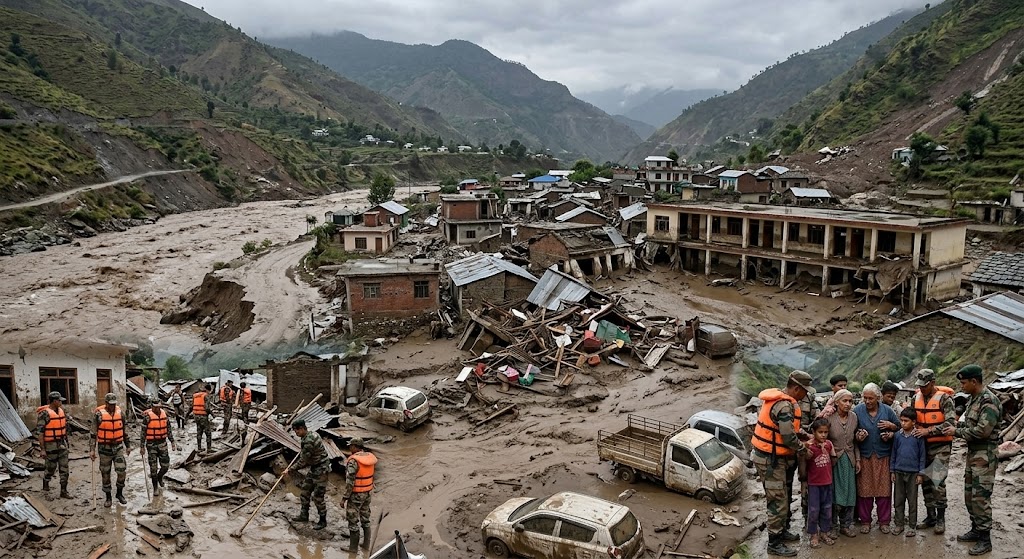
Torrential rains recently triggered severe flash floods and landslides in the Pir Panjal valley, specifically in the Poonch and Rajouri districts of Jammu and Kashmir. The extreme weather event resulted in the tragic loss of 11 lives, left 10 people missing, and caused extensive damage to public and private infrastructure.
Key Highlights
- Impact and Extent of Damage:
- Poonch district emerged as the worst-affected area. Out of the 11 reported deaths, 9 were from Poonch and 2 from Rajouri.
- Initial assessments indicate massive infrastructural loss, with more than 100 houses and around two dozen school structures damaged. Scores of vehicles were washed away, and landslides severely disrupted traffic and communication links across Kishtwar, Rajouri, and Poonch.
- Administrative and Rescue Operations:
- Chief Minister Omar Abdullah chaired a high-level review meeting, emphasizing that the administration’s foremost priority is to safeguard lives, trace missing persons, and ensure the expeditious restoration of roads, power, and drinking water.
- A coordinated on-ground rescue effort is being executed by the State Disaster Response Force (SDRF), the Army, local police, civil administration, and volunteers. Affected families are being relocated to safer zones.
- Suspension of Amarnath Yatra:
- Due to the escalating risk and adverse weather forecasts issued by the India Meteorological Department (IMD), authorities suspended the Amarnath Yatra from both traditional routes—Baltal and Pahalgam.
What is a ‘Flash Flood’?
- Definition: A flash flood is a rapid and extreme flow of high water into a normally dry area, or a sudden rise in a river or stream’s water level above a designated flood stage.
- Timeframe: Unlike regular riverine floods that take days to develop, flash floods occur rapidly—typically within 6 hours (often within 3 hours) of the triggering event.
- Origin/Mechanism: It originates when the rate of rainfall greatly exceeds the ground’s infiltration capacity (the soil’s ability to absorb water). The excess water rapidly accumulates and flows downhill with immense kinetic energy, transforming into a destructive torrent filled with debris, mud, and boulders.
Causes of ‘Flash Floods’
- Natural Causes:
- Cloudbursts & Torrential Rain: Highly localized, intense rainfall (exceeding 100 mm per hour) is the most common trigger.
- Glacial Lake Outburst Floods (GLOFs): Sudden release of large volumes of water from melting glaciers or breached glacial lakes.
- Natural Dams Bursting: Landslides or avalanches can temporarily block a river flow; when this natural ‘dam’ breaches under water pressure, it causes a sudden downstream flood.
- Anthropogenic (Human-induced) Causes:
- Encroachment on Floodplains: Building settlements and infrastructure over natural drainage systems and riverbeds.
- Deforestation: Cutting down trees reduces the soil’s water-holding capacity, leading to immediate surface runoff.
- Unscientific Infrastructure Projects: Indiscriminate blasting and cutting of steep slopes for roads and hydro-projects alter natural water channels and destabilize the terrain.
Vulnerability of the Himalayan Mountain Range
- Geological Fragility: The Himalayas are young, fold mountains. They are geologically active, still rising, and composed of loose, fragile sedimentary rocks, making them highly susceptible to landslides when saturated with water.
- Steep Topography: The steep gradients of the Himalayan valleys mean that runoff water moves downward with ferocious velocity. This fast-moving water easily uproots trees and carries massive boulders, which act like battering rams destroying everything in their path.
- Climate Change Sensitivity: The region is experiencing warming at a rate higher than the global average. This leads to erratic monsoon patterns, increased frequency of extreme weather events (like cloudbursts), and rapid melting of glaciers, compounding the flash flood risk.
Safety and Prevention Measures
The National Disaster Response Force (NDRF) outlines specific protocols to minimize loss of life during flash floods:
- Before the Flood:
- Identify high ground and evacuation routes in your area.
- Keep an emergency kit ready (first aid, flashlight, dry food, and essential documents).
- Monitor weather updates and warnings via IMD or NDMA apps.
- During the Flood:
- Move to Higher Ground Immediately: Do not wait for official instructions if you notice a sudden rise in water levels.
- Do Not Walk Through Flowing Water: Just 6 inches of fast-moving water can knock an adult off their feet.
- Do Not Drive Through Floodwaters: Nearly half of all flash flood fatalities occur in vehicles. 2 feet of rushing water can carry away most vehicles, including SUVs.
- Avoid Valleys and Canyons: Never seek shelter under trees or in dry riverbeds/natural drains, as water channels through these areas instantly.
- After the Flood:
- Avoid contact with floodwater (as it may be contaminated by sewage or chemicals) and stay away from downed power lines to prevent electrocution.
Way Forward
- Strengthening Early Warning Systems (EWS): Expanding the network of Doppler Weather Radars in the Himalayan belt for accurate, localized, and real-time forecasting of cloudbursts and intense rainfall.
- Climate-Resilient Infrastructure: Enforcing strict zoning laws to strictly prohibit construction in eco-sensitive zones, river catchments, and historical floodplains.
- Nature-Based Solutions: Promoting large-scale afforestation and watershed management programs to stabilize slopes and improve the water retention capacity of the soil.
- Community Capacity Building: Since flash floods provide very little reaction time, local communities must be trained as the ‘first responders’ through regular mock drills and disaster awareness campaigns in collaboration with the SDRF/NDRF.
Prelims Practice Question
Question: With reference to the geographical and cultural locations in Jammu and Kashmir highlighted during the recent flash floods, consider the following statements:
- The districts of Poonch and Rajouri are primarily located in the Pir Panjal mountain range.
- Baltal and Pahalgam serve as the two primary base camps for the annual Amarnath Yatra.
- The India Meteorological Department (IMD) operates under the Union Ministry of Home Affairs to issue disaster-related weather forecasts.
Which of the statements given above is/are correct?
(a) 1 and 2 only
(b) 2 and 3 only
(c) 1 and 3 only
(d) 1, 2, and 3
Answer: (a) 1 and 2 only
Explanation:
- Statement 1 is correct. Poonch and Rajouri are located in the Pir Panjal valley region of Jammu and Kashmir.
- Statement 2 is correct. Both Baltal (a shorter, steeper route) and Pahalgam (a longer, traditional route) are the base camps for the Amarnath Yatra.
- Statement 3 is incorrect. The India Meteorological Department (IMD) is an agency of the Ministry of Earth Sciences, not the Ministry of Home Affairs.
Mains Practice Question
Question: “The Himalayan region’s inherent ecological fragility, combined with changing climate patterns, has made it highly susceptible to extreme weather events.” In light of the recent flash floods in the Pir Panjal valley, analyze the vulnerabilities of the Himalayan states and suggest measures to build climate-resilient infrastructure. (250 words)
Approach for Mains Answer:
- Introduction: Begin by citing the recent flash floods in Poonch and Rajouri as a stark reminder of the region’s vulnerability to extreme weather events.
- Body Paragraph 1 (Vulnerabilities): Explain the geographical factors (steep slopes, young fold mountains) and anthropogenic factors (unplanned urbanization, deforestation, blocking of natural drainage systems) that exacerbate the impact of torrential rains in the Himalayas.
- Body Paragraph 2 (Mitigation and Resilience): Discuss the urgent need for robust Early Warning Systems (EWS) integrated with local administrations. Emphasize the importance of micro-zonation, enforcing strict building codes, and constructing climate-resilient infrastructure (like proper retaining walls and elevated roads).
- Conclusion: Conclude that while natural hazards cannot be entirely prevented, transitioning from a reactive relief-centric approach to a proactive disaster risk reduction (DRR) framework is essential for sustainable development in the Himalayan states.