Table of Contents
Recently, experts from the Indian Council for Agricultural Research (ICAR) highlighted the transformative impact of technological advancements in the field of Agri-Tech on India’s agricultural sector. The discussion underscored how farming has transitioned from a traditional practice to a multi-disciplinary, technology-driven industry.
Key Highlights of the Agri-Tech Revolution
Current Status of Farm Mechanization
- Mechanization Levels: Currently, 47% of farm work in India is mechanized. This scientific intervention has helped transition Indian agriculture from subsistence farming to surplus production, significantly boosting agricultural exports.
- Crop-Specific Disparities: While the harvesting of traditional field crops has been largely mechanized using precision equipment, the mechanization of horticulture crop harvesting remains a persistent challenge due to the delicate nature of fruits and vegetables.
Emerging Technological Interventions
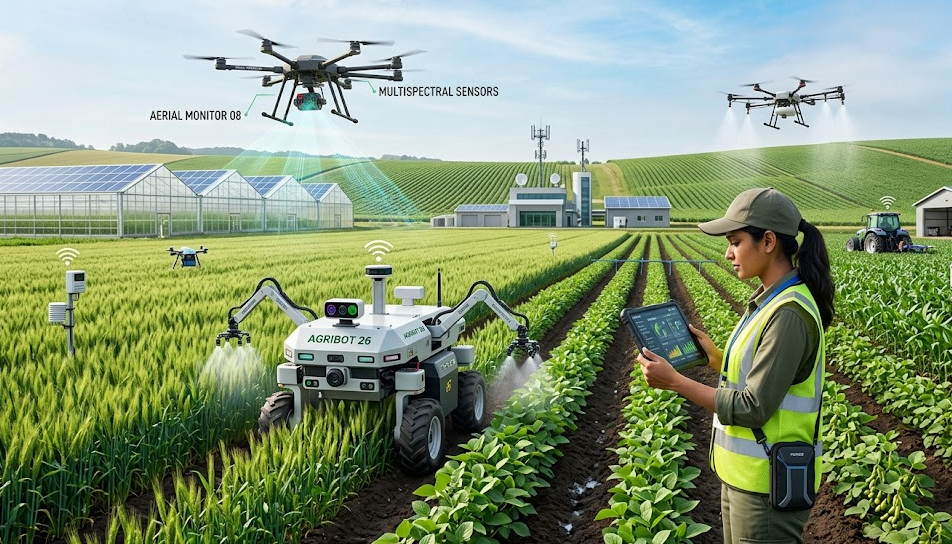
- Drone Technology: Unmanned Aerial Vehicles (UAVs/Drones) are no longer futuristic; they are being actively deployed on the ground for real-time crop management and the precise spraying of pesticides.
- Smart Agriculture: The integration of Artificial Intelligence (AI) and Machine Learning (ML) forms the foundational basis of modern smart farming, enabling predictive modeling for crop health.
- Internet of Things (IoT): IoT devices and sensors play a crucial role in seamlessly connecting various farm jobs, automating irrigation, and monitoring soil conditions.
A Multi-disciplinary Approach
- Agriculture is no longer a standalone biological discipline. It now heavily relies on mechanical engineers, automation experts, and computing professionals to drive the mechanization process.
- The sector is witnessing a surge in customized ad-tech solutions tailored to specific climatic and geographical conditions.
Post-Harvest and Structural Innovations
- Storage and Processing: Crop storage mechanisms and post-harvest technologies have undergone tremendous upgrades, many of which are being innovated by young professionals and agri-startups.
- Decentralized Energy: The agricultural sector is increasingly being bolstered by multiple decentralized energy systems (such as solar-powered micro-grids).
- Production Models: While collective and cooperative farming systems continue to benefit farm workers, the integration of technology now allows for the highly profitable production of high-value crops in low volumes.
What is Agri-Tech?
Agri-Tech (Agricultural Technology) refers to the integration of modern technology, data science, and engineering principles into the agricultural value chain. Its objective is to improve the efficiency, yield, profitability, and sustainability of agricultural operations.
Rather than relying entirely on traditional trial-and-error methods, Agri-Tech transitions the sector into Agriculture 4.0—an era dominated by data-driven decision-making. Core technologies driving this shift include:
- Precision Farming: Utilizing Internet of Things (IoT) sensors, soil health monitors, and GPS to apply inputs (water, fertilizers, pesticides) precisely where and when needed.
- Frontier Tech & Automation: Deploying drones for crop spraying and field mapping, automated micro-irrigation systems, and smart farm machinery.
- Predictive Analytics: Leveraging Artificial Intelligence (AI) and Machine Learning (ML) alongside high-resolution satellite imagery to forecast weather patterns, detect pest infestations early, and predict crop yields.
- Digital Marketplaces & Fintech: Building digital platforms that offer farmers direct market access, transparent price discovery, and seamless access to credit or crop insurance.
Relevance for India
With more than 50% of its workforce engaged in agriculture and allied activities, India’s economic resilience is inextricably linked to the farm sector. Agri-Tech holds immense strategic relevance for the country:
- Overcoming Structural Bottlenecks: Indian farming is highly fragmented, with over 80% of farmers being small and marginal holders (owning less than 2 hectares). Agri-Tech enables the aggregation of these smallholders through digital platforms and Farmer Producer Organizations (FPOs), giving them economies of scale.
- Climate Change Mitigation: Indian agriculture is deeply vulnerable to climate vagaries. AI-driven predictive modeling, weather alerts, and biotech-engineered climate-resilient seeds help farmers adapt to erratic monsoons, heatwaves, and droughts.
- Optimizing Resource Efficiency: India faces critical water stress and soil degradation. Precision irrigation and smart sensors prevent the over-application of water and chemical fertilizers, preserving soil health and reducing input costs.
- Eliminating Middlemen & Market Asymmetry: Digital platforms allow farmers to bypass complex traditional supply chains, connecting them directly with institutional buyers, processors, and retailers. This ensures a higher share of the final consumer price reaches the actual producer.
- A Budding Startup Hub: India has emerged as the third-largest startup ecosystem globally, with over 2,000 recognized Agri-Tech startups. This sub-sector is driving rural entrepreneurship and creating tech-enabled jobs.
Challenges in Adoption
Despite its massive potential, scaling Agri-Tech across rural India faces significant systemic hurdles:
| Challenge Category | Specific Issues |
| High Fragmentation | The small size of average landholdings makes individual capital investment in heavy tech (like advanced machinery or expensive sensors) economically unviable for most farmers. |
| The “Phygital” & Digital Divide | While mobile internet penetration is high, high-speed rural connectivity remains inconsistent. Additionally, there is a trust deficit and digital literacy gap among older, traditional farmers. |
| Data Silos & Lack of Standardization | Agricultural data in India (soil cards, land records, weather data) is highly fragmented across different state departments and private firms, limiting the accuracy of large-scale AI models. |
| Funding Asymmetry | A significant chunk of Agri-Tech venture capital flows into e-commerce and market-linkage platforms. Deep-tech, early-stage hardware startups (robotics, biotech) struggle to secure growth-stage funding. |
| Inadequate Last-Mile Delivery | Developing an app or tool is insufficient if there is no physical, on-the-ground support network to handhold farmers through installation, calibration, and troubleshooting. |
Way Forward
To unlock the full potential of Agri-Tech and align with India’s long-term agricultural growth goals, a multi-pronged approach is essential:
- Democratization through FPOs: Instead of targeting individual smallholders, tech delivery should be channeled through FPOs and custom hiring centers. This allows small farmers to access expensive drone services, high-end mechanization, and precision tools on a shared-cost or pay-per-use basis.
- Strengthening Foundational Digital Public Infrastructure: The government’s ongoing initiative to build the Agri-Stack (a federated architecture integrating farmers’ IDs, land records, and crop data) must be accelerated. Providing a unified open data standard will enable startups to build highly accurate, hyper-local advisory tools.
- Fostering “Phygital” Capacity Building: Tech solutions must be backed by localized training programs. Creating a network of village-level agri-entrepreneurs—such as tech-trained youth or input dealers—can bridge the trust gap and provide essential last-mile technical support.
- Targeted Fiscal Incentives: Government funding bodies, like the Agriculture Accelerator Fund, should prioritize deep-tech, sustainable inputs, and hardware innovations over mere delivery platforms. Public-private partnerships (PPPs) can also establish regional Centers of Excellence to co-create affordable, regional solutions.
- Shift toward Predictive Ecosystems: Moving beyond reactive problem-solving, Indian agriculture needs to transition toward predictive frameworks. By integrating agentic AI and predictive analytics into foundational agronomy research, the country can build a proactive supply chain that mitigates risks before they hit the field.
UPSC Practice Questions
Prelims (PT) Question
Q. With reference to the current status of agricultural mechanization and technology adoption in India, consider the following statements:
- Currently, nearly half of the overall farm work in India is mechanized, leading to surplus production.
- While the harvesting of field crops has seen significant mechanization, the mechanization of horticulture harvesting remains a challenge.
- Artificial Intelligence (AI) and the Internet of Things (IoT) are primarily restricted to post-harvest management and have no direct application in on-field crop management.
Which of the statements given above is/are correct?
(a) 1 and 2 only
(b) 2 and 3 only
(c) 1 and 3 only
(d) 1, 2, and 3
Answer: (a) 1 and 2 only
Explanation: Statement 3 is incorrect. AI, ML, and IoT form the core of “smart agriculture” and are actively used for on-field operations like crop management, connecting various farm jobs, and predictive analysis. Statements 1 and 2 are correct as per recent ICAR observations.
Mains Question
Q. “The transformation of Indian agriculture from a standalone discipline to a multi-disciplinary, technology-driven sector is crucial for ensuring food security and rural prosperity.”
In the context of this statement, evaluate the current state of the ‘Agri-Tech Revolution’ in India. What are the primary bottlenecks hindering the complete mechanization of the agricultural sector? (250 words)
Hints for Mains Answer:
- Introduction: Briefly introduce the “Agri-Tech Revolution.” Mention the paradigm shift from traditional farming to Smart Agriculture, highlighting that 47% of Indian farm work is now mechanized.
- Current State of Agri-Tech: Discuss the integration of frontier technologies. Mention the active use of drones (for pesticide spraying and crop monitoring), AI/ML for data-driven decisions, IoT for connecting farm equipment, and the deployment of decentralized energy systems.
- Multi-disciplinary Shift: Explain how engineering, automation, and computing are now vital to agriculture, allowing for customized geographical solutions and improved post-harvest storage.
- Primary Bottlenecks:
- Crop-specific challenges: Difficulty in mechanizing delicate horticulture crops compared to field crops.
- Structural issues: Fragmented and small landholdings make the ownership of heavy precision equipment economically unviable for marginal farmers.
- Socio-economic barriers: Lack of digital literacy, the “phygital” divide in rural areas, and the high initial capital cost of adopting AI/IoT solutions.
- Conclusion/Way Forward: Conclude by emphasizing the need for robust Custom Hiring Centres (CHCs), fostering collective/cooperative farming to achieve economies of scale, and supporting grassroots agri-tech startups to make technology affordable and accessible.