Table of Contents
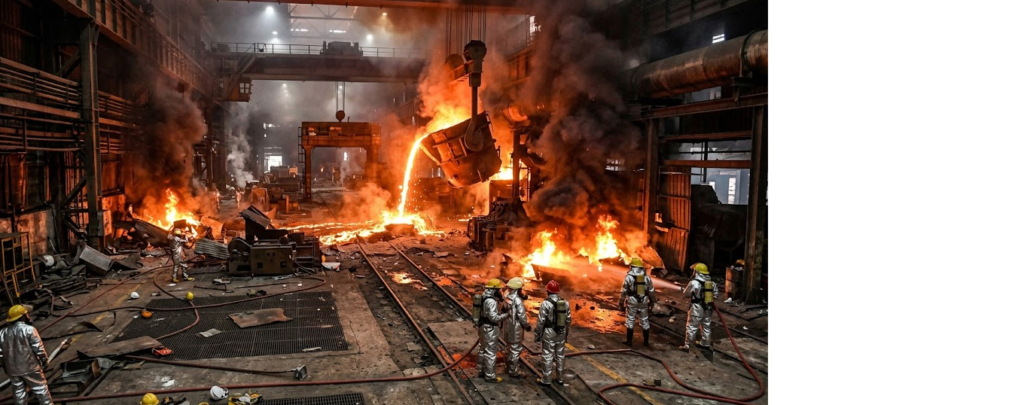
A severe industrial disaster occurred at the Rashtriya Ispat Nigam Limited (RINL) steel plant in Visakhapatnam, resulting in multiple casualties and critical injuries among workers.
Key Details of the Incident
- Location and Entity: The explosion took place at the Visakhapatnam Steel Plant (VSP), whose corporate entity is the Rashtriya Ispat Nigam Limited (RINL).
- Trigger: A ladle carrying hundreds of tonnes of hot liquid steel exploded in the melting shop unit.
- Extreme Hazard: The molten metal, kept at an ultra-high temperature of nearly 1,600 degrees Celsius, spilled and triggered a massive fire.
- Casualties: The mishap resulted in the death of 8 personnel (5 regular workers, 3 contract workers, including a manager-level officer) and left 6 critically injured with severe burns ranging from 40% to 90%.
Disaster Response and Mitigation Measures
- Emergency Deployment: Immediate deployment of 108 ambulance services (10 ambulances) and fire tenders. Rescue teams operated under hazardous conditions to douse flames and retrieve stranded workers.
- Administrative Coordination: A swift, multi-departmental relief operation was initiated involving the District Collector, City Police Commissioner, and the District Medical and Health Officer (DMHO).
- Monitoring: A 24×7 control room was established at the Collectorate to coordinate rescue efforts and assist relatives of the victims.
- Central and State Support:
- PMNRF: The Prime Minister announced an ex-gratia of ₹2 lakh to the next of kin of the deceased and ₹50,000 for the injured from the Prime Minister’s National Relief Fund.
- Union Ministry Action: The Union Ministry of Heavy Industries (Steel) ordered an air-ambulance for critical patients.
Key Governance and Safety Issues Highlighted
- Occupational Safety: The incident raises severe concerns regarding safety protocols and standard operating procedures (SOPs) in ultra-hazardous industrial environments like melting shops.
- Vulnerability of Contractual Labour: The casualty list underscores the vulnerability of contract workers who are frequently exposed to high-risk industrial zones, highlighting the need for equitable safety standards and insurance cover.
- Need for Accountability: The disaster has prompted demands from the opposition for a comprehensive and transparent inquiry to investigate systemic “safety lapses” and establish accountability to prevent future industrial mishaps.
Government Directives for Industrial Disasters
The regulatory framework for industrial safety in India is multi-tiered, involving environmental protection, labor rights, and disaster management laws:
- Legislative Framework: The foundation includes the Factories Act, 1948 (amended in 1987 to specifically address hazardous processes), the Environment Protection Act (EPA), 1986, and the Public Liability Insurance Act, 1991, which makes it mandatory for industries handling hazardous substances to hold insurance for providing immediate relief to accident victims.
- Specific Rules: The Manufacture, Storage, and Import of Hazardous Chemicals (MSIHC) Rules, 1989 and the Chemical Accidents (Emergency Planning, Preparedness, and Response) Rules, 1996 mandate the creation of on-site emergency plans and the establishment of crisis groups at national, state, and local levels.
- NDMA Guidelines (2007): The National Disaster Management Authority (NDMA) established comprehensive guidelines for Chemical Disasters. These stipulate a proactive, multi-sectoral approach, requiring Major Accident Hazard (MAH) units to maintain strict Standard Operating Procedures (SOPs) and conduct annual mock drills.
- OSH Code, 2020: The Occupational Safety, Health and Working Conditions Code consolidates 13 labor laws. It guarantees a worker’s explicit right to refuse dangerous work without penalty, mandates free annual health check-ups, and enforces standards for risk mitigation and Personal Protective Equipment (PPE).
Government Initiatives for Industrial Disasters
- Major Accident Hazards (MAH) Control System: Implemented by the Directorate General Factory Advice Service and Labour Institutes (DGFASLI), this technical initiative focuses on identifying, analyzing, and controlling risks in industrial activities involving highly hazardous chemicals.
- National Safety Council of India (NSCI): An apex body established by the Ministry of Labour and Employment to promote workplace safety consciousness, conduct awareness campaigns, and provide technical guidance to small and medium enterprises.
- Capacity Building and Training: The government regularly conducts specialized programs (e.g., through CIPET and the Department of Chemicals and Petrochemicals) focusing on Process Safety Management (PSM), Hazard and Operability (HAZOP) studies, and live emergency mock drills for plant personnel and first responders.
- APELL Framework: The adoption of the Awareness and Preparedness for Emergencies at Local Level (APELL) program aims to sensitize local communities residing near industrial zones about the nature of nearby risks and correct evacuation protocols.
Concerns Related to Implementation of the Initiatives
- Vulnerability of Unskilled Contract Labor: Between 50% and 70% of high-risk floor work (such as operating boilers or cleaning chemical tanks) is outsourced to daily-wage contractors. These workers rarely receive training on Material Safety Data Sheets (MSDS) and frequently act as “human sensors” whose injury is the first indicator of a system failure.
- Self-Certification Loopholes: Under the push for “Ease of Doing Business,” the new OSH Code relies heavily on third-party audits and self-certification. This often results in the under-reporting of near-misses and superficial safety compliance.
- Aging “Brownfield” Assets: A large proportion of chemical leaks and explosions occur in older, legacy plants. Management frequently views retrofitting these aging facilities with modern automated fail-safes or pressure sensors as a “dead investment,” running equipment until catastrophic fatigue.
- Evading Absolute Liability: Because contract workers are often not registered on formal company rolls, industries sometimes bypass the judicial scrutiny of the Public Liability Insurance Act by settling fatalities through informal, out-of-court “ex gratia” payments.
- Manpower and Infrastructure Deficits: Enforcement is severely weakened by a chronic shortage of trained factory inspectors, occupational health professionals, and poorly equipped Emergency Operation Centers (EOCs) at the district level.
Way Forward
- AI-Driven Predictive Maintenance: High-risk MAH units must be mandated to integrate IoT sensors that transmit real-time pressure, temperature, and structural data directly to central state servers. This removes local management’s ability to conceal near-misses and allows authorities to intervene proactively.
- Insurance-Linked Safety Scores: Corporate insurance premiums, environmental clearances, and commercial electricity tariffs should be tied directly to real-time, independent safety audit scores, turning occupational safety into a strict financial imperative.
- Coherent National Safety Architecture: Overlapping jurisdictions must be resolved by integrating the Factories Act, EPA, and NDMA guidelines into a unified framework. This should include a centralized database for hazardous industries and strict, non-negotiable penal provisions for compliance failures.
- Empowering the Contractual Workforce: Mandate rigorous, paid safety training and hazard identification programs for all contract workers before deployment in high-risk zones. Their specific rights and protections under the OSH Code must be aggressively enforced.
- Community-Integrated Drills: Establish functional coordination between an industry’s on-site emergency plans and the local Disaster Management Authority. Regular, unannounced joint mock drills must be conducted to ensure that both the plant personnel and the surrounding community are genuinely prepared.
Prelims Practice Question
Q. Consider the following statements regarding the recent industrial mishap in Visakhapatnam:
- Rashtriya Ispat Nigam Limited (RINL) is the corporate entity of the Visakhapatnam Steel Plant (VSP).
- Compensation to the victims of the disaster was exclusively funded through the State Disaster Response Fund (SDRF).
Which of the statements given above is/are correct?
(a) 1 only
(b) 2 only
(c) Both 1 and 2
(d) Neither 1 nor 2
Answer: (a) 1 only Explanation: Statement 1 is correct. Statement 2 is incorrect because the Prime Minister announced ex-gratia from the Prime Minister’s National Relief Fund (PMNRF), not exclusively the SDRF.
Mains Practice Question
Q. Frequent industrial accidents in heavy manufacturing sectors highlight significant gaps in occupational safety protocols. In light of the recent Visakhapatnam Steel Plant accident, discuss the systemic causes of such industrial disasters and suggest comprehensive measures to ensure a safe working environment. (15 Marks, 250 Words)