Table of Contents
External Affairs Minister S. Jaishankar and his Indonesian counterpart, Sugiono, co-chaired the 8th India-Indonesia Joint Commission meeting in New Delhi.
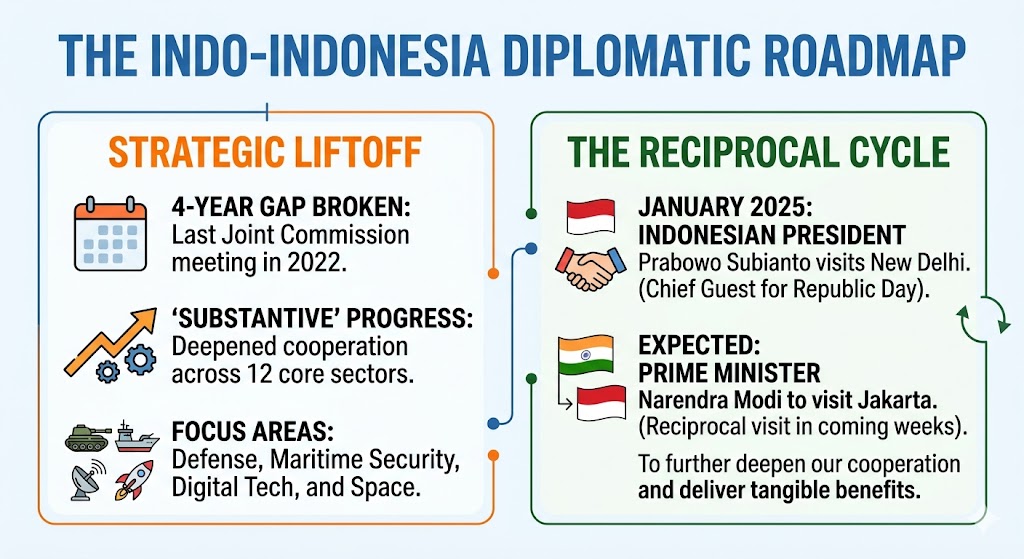
- The meeting acts as a preparatory step ahead of Prime Minister Narendra Modi’s highly anticipated visit to Indonesia in the coming weeks.
- Resumption of Dialogue: The Joint Commission convened after a four-year hiatus, though both sides acknowledged that “good progress” had been made in bilateral ties during this period.
Key Highlights of the Meeting
The dialogue was described as “substantive,” featuring a “full spectrum” review of the bilateral relationship.
Major Areas of Cooperation Discussed:
- Strategic & Security: Defence, security, and maritime cooperation.
- Economic & Technological: Trade and investment, digital infrastructure, energy, and connectivity.
- Health & Science: Pharmaceuticals, healthcare, and space exploration.
- Soft Power & Diplomacy: Education, cultural domains, consular services, and broader political ties.
Regional and Global Alignment
- Convergence of Maritime Visions: India’s ‘Act East’ policy and SAGAR (Security and Growth for All in the Region) doctrine naturally synergize with Indonesia’s ‘Global Maritime Fulcrum’ vision, creating a unified approach to Indo-Pacific security.
- ASEAN Centrality: India views Indonesia—the largest economy and a natural leader in Southeast Asia—as the vital cornerstone for upholding ASEAN centrality and ensuring a multipolar Asia.
- Voice of the Global South: As two major developing democracies, both nations collaborate extensively in forums like the G20, WTO, and UN climate summits to amplify the concerns of the Global South against Western hegemony.
- Balancing Geopolitics: In the face of US-China strategic polarization, New Delhi and Jakarta share a commitment to “strategic autonomy,” working together to prevent Southeast Asia from becoming a theater of great power rivalry.
Diplomatic Significance
- Breaking the Dialogue Hiatus: The 8th Joint Commission Meeting ends a crucial four-year gap (since 2022), signaling renewed political will to fast-track decisions stalled by bureaucratic delays.
- Reciprocal High-Level Engagement: The diplomatic calendar has come full circle—Indonesian President Prabowo Subianto was the Chief Guest for India’s 2025 Republic Day, and PM Modi’s mid-2026 visit to Jakarta serves as the high-stakes reciprocal answer.
- Full-Spectrum Blueprint: The recent meetings moved beyond traditional diplomacy, charting a modern 12-domain framework that includes new frontiers like Digital Public Infrastructure (DPI), space exploration, and critical minerals.
- Anchor for Regional Stability: The formal rejuvenation of the “New Delhi-Jakarta axis” sends a strong deterrent signal to regional adversaries, establishing the partnership as an irreplaceable anchor for stability in the Indo-Pacific.
India-Indonesia Relation: History to Present
- Ancient Maritime Links: Trade and cultural ties span over 2,000 years, driven by Kalinga and Chola merchants. The lasting impact is visible in Indonesian culture, heavily influenced by the Ramayana, Mahabharata, and Hindu-Buddhist architecture (e.g., Prambanan and Borobudur).
- Post-Independence Solidarity: Shared anti-colonial struggles united the two nations. Prime Minister Jawaharlal Nehru and President Sukarno were primary architects of the 1955 Bandung Conference, which birthed the Non-Aligned Movement (NAM).
- Evolution of the Partnership: The relationship was formally elevated to a ‘Strategic Partnership’ in 2005 and further upgraded to a ‘Comprehensive Strategic Partnership’ in 2018 to reflect modern geopolitical realities.
- Contemporary Defense Ties: The historical relationship has matured into robust hard-security cooperation, featuring regular coordinated naval patrols (CORPAT) in the Andaman Sea and the bilateral naval exercise ‘Samudra Shakti’.
Concerns Related to the Relation
- Skewed Trade Deficit: Despite high trade volumes, the balance is heavily tilted in Indonesia’s favor due to India’s massive, inelastic imports of raw coal and crude palm oil.
- Growing Chinese Influence: Beijing’s deep economic penetration in Indonesia via Belt and Road Initiative (BRI) infrastructure investments and high-speed rail projects poses a strategic challenge to Indian interests.
- Non-Tariff Barriers (NTBs): Indian exporters face severe regulatory hurdles and NTBs in the Indonesian market, particularly restricting the entry of Indian pharmaceuticals, agricultural goods, and IT services.
- Sluggish Project Implementation: Critical strategic initiatives, most notably the Andaman-Aceh connectivity project and the development of the Sabang Port, have suffered from slow execution and persistent bureaucratic friction.
Way Forward
- Trade Diversification: To correct the trade imbalance, India must aggressively pivot its exports toward high-value sectors, specifically fintech (exporting UPI), generic pharmaceuticals, and green energy technologies.
- Defense Export Push: India should transition from a defense partner to a defense supplier by offering indigenous platforms like BrahMos cruise missiles, coastal radar systems, and patrol vessels to the Indonesian armed forces.
- Fast-Tracking Connectivity: Both nations must prioritize and ensure the time-bound execution of the Andaman-Aceh maritime corridor to secure critical supply chains near the Strait of Malacca.
- Blue Economy & Space Synergy: Future cooperation should focus on joint investments in sustainable fisheries, ocean-based renewable energy, and leveraging ISRO’s capabilities for Indonesia’s satellite and telecommunication needs.
Preliminary Examination Question
Q. Consider the following statements regarding India-Indonesia relations:
- Both India and Indonesia are founding members of the Non-Aligned Movement (NAM), stemming from the 1955 Bandung Conference.
- Indonesia is India’s largest trading partner within the ASEAN grouping.
- The bilateral naval exercise between the two countries is known as SIMBEX.
- The Indonesian President was the Chief Guest at India’s Republic Day parade in 2025.
How many of the statements given above are correct?
(a) Only one
(b) Only two
(c) Only three
(d) All four
Correct Answer: (c) Only three
- Explanation: Statement 1 is correct (Bandung Conference led to NAM). Statement 2 is correct (Indonesia holds the largest trade volume with India in ASEAN). Statement 3 is incorrect (The bilateral naval exercise with Indonesia is Samudra Shakti; SIMBEX is with Singapore). Statement 4 is correct (President Prabowo Subianto was the 2025 Chief Guest).
Mains Examination Question
Q. “The convergence of India’s ‘Act East’ policy and Indonesia’s ‘Global Maritime Fulcrum’ vision is central to the stability of the Indo-Pacific.” Analyze this statement in the context of recent high-level diplomatic engagements between the two nations. Highlight the structural impediments that restrict the full potential of this bilateral relationship. (250 words, 15 Marks)
Hints for Structuring the Answer:
- Introduction: Mention the recent 8th Joint Commission meeting (2026), the end of the 4-year hiatus, and the reciprocal visits (Republic Day 2025 and PM Modi’s upcoming Jakarta visit). Define the ‘Comprehensive Strategic Partnership’.
- Convergence of Visions (The Core): Explain how Act East meets the Global Maritime Fulcrum. Focus on joint patrols near the Strait of Malacca, maintaining a “Free and Open Indo-Pacific,” and mutual balancing in ASEAN and G20.
- Structural Impediments (Challenges): Discuss the severe trade deficit (reliance on coal/palm oil), Chinese BRI influence in the region, non-tariff barriers hurting Indian pharma/IT, and delays in the Sabang port/Andaman-Aceh connectivity.
- Conclusion: Conclude with actionable solutions—diversifying trade via Digital Public Infrastructure (DPI), pushing defense exports (BrahMos), and shifting focus to the Blue Economy to ensure the New Delhi-Jakarta axis reaches its true potential.