Table of Contents
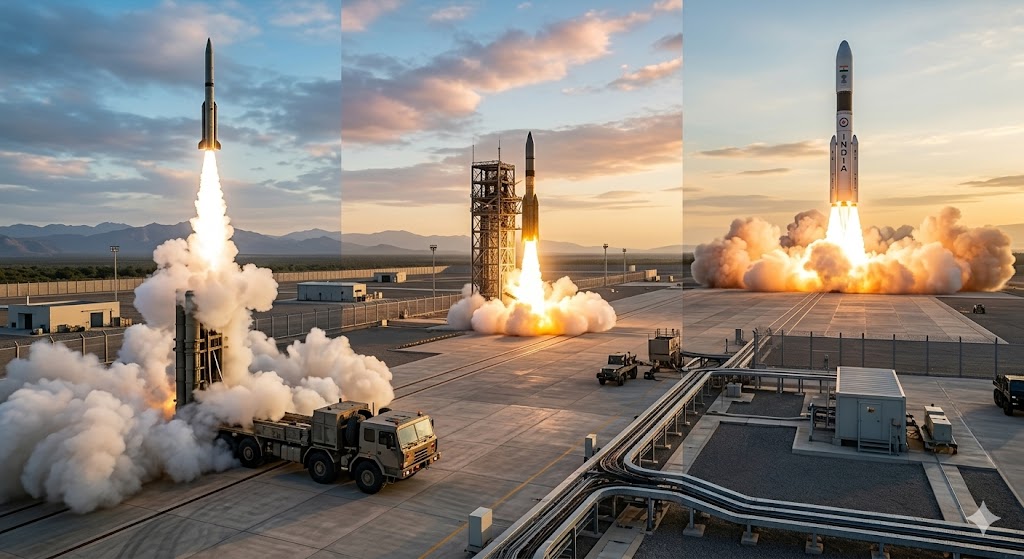
The Defence Research and Development Organisation (DRDO) recently conducted consecutive flight tests off the Odisha coast, successfully demonstrating India’s multi-layered Ballistic Missile Defence (BMD) system and the maiden flight of the Naval Anti-Ship Missile-Medium Range (NASM-MR).
Key Highlights of the Tests
- Multi-layered Ballistic Missile Defence (BMD)
- Elite Capability: The trials demonstrated India’s capability to intercept and destroy advanced, high-speed aerial threats, including those up to the Intercontinental Ballistic Missile (ICBM) class.
- Layered Architecture: The interceptors accurately engaged their designated targets, validating a complex architecture designed to neutralize hostile missiles at different altitudes (both inside and outside the atmosphere).
- Global Standing: With this successful demonstration, India joins an elite club of nations (such as the US, Russia, China, and Israel) possessing operational-level multi-layered BMD systems.
- Naval Anti-Ship Missile-Medium Range (NASM-MR)
- The maiden flight test of the NASM-MR successfully proved its flight parameters and guidance mechanisms.
- It is designed to enhance the Indian Navy’s precision strike capabilities against hostile maritime targets at medium ranges, providing a highly effective maritime strike option.
Strategic Significance
- Regional Deterrence: Enhances India’s strategic deterrence shield against the expanding missile arsenals and emerging capabilities (like MIRVs) of adversaries in the neighborhood.
- Aatmanirbharta in Defence: The tests validate indigenous design and development, showcasing the combined efforts of DRDO scientists, domestic industry partners, and the Armed Forces, thereby reducing reliance on imported anti-missile systems.
- Maritime Dominance: The NASM-MR provides a critical indigenous stand-off strike option, boosting the Navy’s ability to secure India’s strategic interests in the increasingly contested Indian Ocean Region (IOR).
- Countering Regional Missile Expansion (Extra Strategic Point): The prioritization of India’s multi-layered BMD system directly addresses the growing proliferation of advanced long-range ballistic vectors in the immediate neighborhood, specifically neutralizing threats like Pakistan’s developing Fateh-I, Fateh-II, and Chinese-origin P282 missile systems.
- Denying Nuclear Blackmail: A credible, operational missile shield protects critical military infrastructure, vital command nodes, and civilian population centers, shifting the regional balance away from adversarial asymmetric threats.
- Securing Sea Lines of Communication: The introduction of the NASM-MR gives the Indian Navy a highly potent tool to push back hostile surface combatants, reinforcing maritime deterrence in the critical waters of the Indian Ocean Region.
India’s Ballistic Missile Defence Programme
India’s Ballistic Missile Defence (BMD)architecture is envisioned as a highly integrated network comprising early-warning tracking radars, localized command-and-control nodes, and multi-tiered surface-to-air interceptors designed to eliminate threats sequentially. Under the overarching vision of indigenous umbrellas like Mission Sudarshan Chakra (India’s answer to the Iron Dome concept), the architecture divides interception into distinct altitudes:
- Exo-Atmospheric Interception: Targets hostile incoming missiles outside the Earth’s atmosphere at altitudes exceeding 100 km, destroying the threat while it is still in space.
- Endo-Atmospheric Interception: Operates as the inner shield, engaging and neutralizing targets that penetrate the lower regions of the atmosphere below the 100 km altitude threshold.
- Phase-II Capstone: The latest successful trials validated advanced interceptor variants engineered to detect, track, and destroy Intermediate-Range Ballistic Missiles (IRBMs) with ranges spanning 2,000 km to 5,000 km, paving the way to neutralize threats up to the Intercontinental Ballistic Missile (ICBM) class.
The Tactical Edge: NASM-MR’s Sea-Skimming Profile
While the BMD shield secures the skies, the maiden flight test of the Naval Anti-Ship Missile-Medium Range (NASM-MR) introduces a highly sophisticated offensive edge against hostile naval combatants. Central to its lethality is its low-level sea-skimming flight profile.
- Radar Evasion: By flying just meters above the water’s surface, the missile exploits the curvature of the Earth to remain hidden beneath the radar horizon of enemy warships during its cruise phase.
- Compressed Reaction Window: By blinding terminal air defence systems until the last possible moment, it maximizes terminal accuracy and leaves hostile close-in weapon systems (CIWS) with mere seconds to calculate an interception before impact.
- Sea-Skimming Profile: Modern anti-ship missiles (like the NASM-MR) often utilize a “sea-skimming” flight profile. This means the missile flies as close to the sea surface as possible (often just a few meters above the water) to stay below the radar horizon, making it extremely difficult for enemy warships to detect and intercept it until the final moments of the attack.
The Hard Realities: Operational & Technological Challenges
Despite these historic wins, moving from a successful test range to an active combat environment comes with stark friction points:
- The Hypersonic Threat Vector: While traditional ballistic missiles follow predictable trajectories, countering highly maneuverable hypersonic glide vehicles (HGVs) being developed by adversaries requires sensors with unprecedented processing speeds and agile interceptors.
- Tri-Service Integration: Merging land-based tracking networks, airborne early-warning systems, and naval fleet radars into a unified, real-time command-and-control matrix without latency remains an immense technological hurdle.
- Supply Chain & Cost Scaling: Mass-producing highly complex interceptor systems, specialized solid-fuel propulsion units, and advanced seeker heads demands massive, sustained capital and deep industrial supply-chain stability.
Way Forward: Moving from Testbed to Tactical Deployment
To convert these technological milestones into raw geopolitical leverage, India’s defence establishment must pivot rapidly toward active deployment:
- Transition to Immediate User Trials: With development trials yielding clean successes, the newly tested exo- and endo-atmospheric interceptor missile blocks must be handed over swiftly for rigorous user trials by the armed forces.
- Industrial Scaling & Atmanirbhar Bharat: Public-private partnerships must be scaled up to accelerate production capacity for indigenous sensors, seekers, and missile components, insulating the ecosystem from foreign supply-chain disruptions.
- Strategic Layering of Key Hubs: The immediate operational focus should shift to deploying the three-layered Sudarshan Chakra architecture to blanket critical metropolises, high-value economic zones, and strategic nuclear facilities.
UPSC Prelims Practice Question
Q. With reference to India’s Ballistic Missile Defence (BMD) programme and the recent DRDO tests, consider the following statements:
- The recent flight tests successfully demonstrated India’s capability to intercept threats up to the Intercontinental Ballistic Missile (ICBM) class.
- The Naval Anti-Ship Missile-Medium Range (NASM-MR) operates strictly at high altitudes during its terminal flight phase to avoid enemy anti-aircraft fire.
- India’s multi-layered BMD architecture is designed to intercept incoming hostile missiles exclusively outside the Earth’s atmosphere (exo-atmospheric).
Which of the statements given above is/are correct?
(a) 1 only
(b) 1 and 3 only
(c) 2 and 3 only
(d) 1, 2 and 3
Correct Answer: (a)
- Statement 1 is correct: The recent tests validate India’s multi-layered BMD capability to engage advanced threats, including those up to the ICBM class.
- Statement 2 is incorrect: NASM-MR is designed to employ a low-altitude “sea-skimming” flight profile to avoid radar detection, rather than flying at high altitudes.
- Statement 3 is incorrect: A “multi-layered” BMD system implies that it is designed to intercept threats across different layers—both outside (exo-atmospheric) and inside (endo-atmospheric) the Earth’s atmosphere.
UPSC Mains Practice Question
Q. “The successful demonstration of a multi-layered Ballistic Missile Defence (BMD) system marks a watershed moment in India’s strategic deterrence capabilities.” Evaluate this statement and discuss how such indigenous technological milestones bolster national security architecture. (150 words, 10 marks)
Brief Approach for Mains:
- Introduction: Mention DRDO’s recent successful testing of the multi-layered BMD system and NASM-MR, emphasizing India’s entry into the elite group of nations possessing ICBM-interception capabilities.
- Bolstering Strategic Deterrence:
- Neutralizing Threats: Provides a robust defensive shield against long-range ballistic missiles (IRBMs/ICBMs) from adversarial neighbors.
- Nuclear Doctrine Synergy: Protects vital national command centers and population nodes, which is critical for ensuring the survivability of retaliatory strike capabilities under India’s ‘No First Use’ (NFU) nuclear doctrine.
- Strengthening National Security Architecture:
- Maritime Security: Indigenously developed anti-ship missiles like NASM-MR strengthen the Navy’s stand-off strike options and sea denial capabilities in the Indian Ocean Region.
- Technological Sovereignty: Validates the ‘Aatmanirbhar Bharat’ vision in defense by proving domestic capacity in complex areas like active electronically scanned array (AESA) radars, high-speed interceptors, and real-time guidance algorithms.
- Conclusion: Conclude that the mastery over next-generation strategic technologies is imperative for India to maintain regional stability and effectively project power as a net security provider.