Table of Contents
The Health Department in Kerala is on high alert following a confirmed case of the Nipah virus outbreak in Kozhikode. Maximum vigilance and preventive protocols have been activated to contain the outbreak and prevent any human-to-human or nosocomial (hospital-acquired) transmission.
Key Highlights of the Recent Outbreak
- The Patient: A 43-year-old man from Ramanattukara is currently stable but on ventilator support after presenting with encephalitis symptoms at the Kozhikode Government Medical College Hospital.
- Contact Tracing & Surveillance: The Health Department swiftly prepared the patient’s route map and identified a primary contact list of 77 individuals.
- Composition: The list includes 58 healthcare workers, 14 family members, and 5 co-workers/friends.
- Risk Categorization: Based on the level of exposure, 2 individuals are categorized as “highest risk,” 13 as “high risk,” and 62 as “low risk.”
- Containment Measures:
- A Rapid Response Team (RRT) has been activated, ensuring adequate stocks of personal protective equipment (PPE) and medicines.
- A dedicated control room has been opened at the Kozhikode district medical administration’s office.
- As of now, no containment zone has been demarcated because no secondary contacts have exhibited symptoms.
What is Nipah Virus (NiV)?
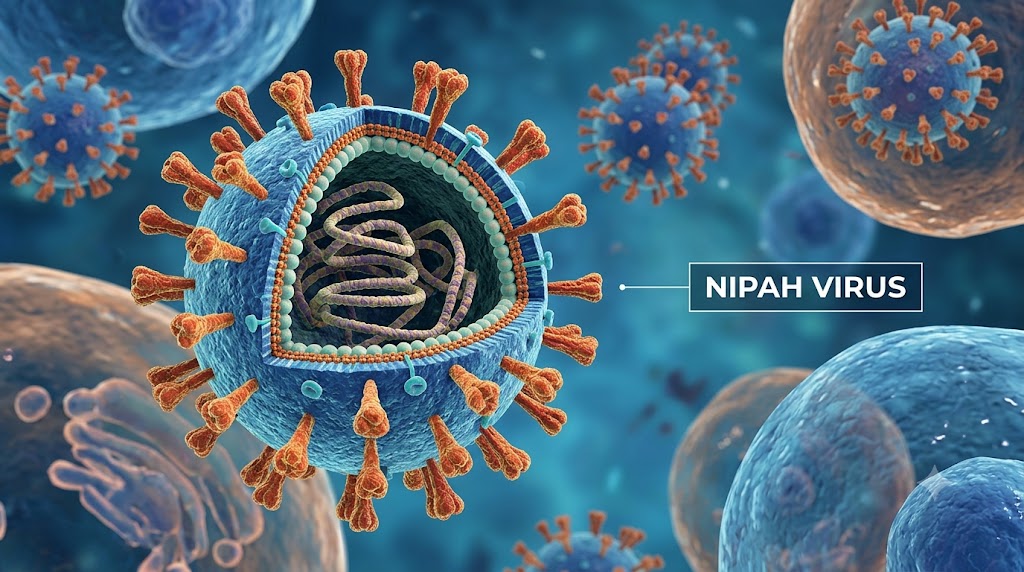
- Nature of the Pathogen: Nipah is a highly pathogenic, zoonotic RNA virus. It belongs to the Henipavirus genus within the Paramyxoviridae family.
- Natural Reservoir: The primary, natural hosts of the virus are fruit bats of the Pteropodidae family (commonly known as flying foxes). The bats carry the virus without exhibiting any signs of illness.
- Modes of Transmission:
- Animal-to-Human (Spillover): Infection occurs through direct contact with infected bats, intermediate hosts like pigs, or by consuming food contaminated by bat bodily fluids (saliva, urine, or excreta). A common source of transmission in South Asia is the consumption of raw date palm sap.
- Human-to-Human: The virus can spread directly between humans through close unprotected contact with an infected person’s respiratory droplets or bodily fluids. This poses a severe risk in household and healthcare settings (nosocomial transmission).
History of the Disease in India
While the virus was first discovered globally during an outbreak in Malaysia and Singapore in 1998–1999, India has been a recurring hotspot for the disease due to ecological and environmental factors.
- Eastern India (West Bengal): India’s earliest encounters with Nipah occurred in West Bengal. Outbreaks were recorded in Siliguri (2001)—which saw 66 cases—and Nadia district (2007). Recently, in early 2026, the state reported another outbreak involving healthcare workers in Barasat.
- Southern India (Kerala): Over the past decade, Kerala has become the epicenter of Nipah outbreaks in India, recording multiple localized clusters in 2018, 2019, 2021, 2023, and the recent cases in Kozhikode.
- Seasonal Pattern: Outbreaks in India and neighboring Bangladesh often exhibit a seasonal pattern (December to May), coinciding with bat activity and the harvesting of date palm sap.
Symptoms and Mortality
- Incubation Period: Symptoms typically manifest within 3 to 14 days of exposure, though rare incubation periods of up to 45 days have been documented.
- Initial Symptoms: The infection usually begins with flu-like symptoms, including fever, severe headache, myalgia (muscle pain), vomiting, and a sore throat.
- Severe Progression: As the disease advances, patients can experience dizziness, drowsiness, and altered consciousness. Many develop severe respiratory problems, including atypical pneumonia and acute respiratory distress.
- Neurological Impact: The hallmark of severe NiV infection is acute encephalitis (swelling of the brain), which can lead to seizures and rapidly progress to a coma within 24 to 48 hours. Long-term neurological conditions can persist in survivors.
- Mortality Rate: Nipah is classified as a high-consequence pathogen. The World Health Organization (WHO) estimates its case fatality rate (CFR) to be exceptionally high, ranging from 40% to 75%, depending on the outbreak context and healthcare capabilities.
Treatment and Prevention
- Treatment Limitations: Currently, there is no licensed vaccine or specific antiviral drug available to cure Nipah virus infections.
- Clinical Management: Treatment relies entirely on early intensive supportive care. This includes identifying complications early, managing symptoms, applying oxygen therapy, and providing specific organ support (such as mechanical ventilation or renal dialysis) as needed.
- Preventive Measures:
- Food Safety: Decreasing bat access to food sources by using protective coverings on date palm sap collection sites. Boiling freshly collected sap and thoroughly washing and peeling fruits before consumption are highly recommended. Fruits with bat bite marks must be discarded.
- Infection Prevention and Control (IPC): In healthcare settings, strict IPC protocols are vital. This includes the use of full Personal Protective Equipment (PPE), robust hand hygiene, and isolation of suspected cases.
- Public Health Response: Rapid outbreak containment relies on swift contact tracing, route mapping of the infected individual, and the deployment of Rapid Response Teams (RRT) to break the chain of human-to-human transmission.
UPSC Prelims Practice Question
Q. Consider the following statements regarding the Nipah Virus (NiV):
- It is a zoonotic virus with fruit bats of the Pteropodidae family acting as its natural reservoir.
- The virus can only be transmitted from animals to humans and does not exhibit human-to-human transmission.
- Due to its high mortality rate, a specific antiviral vaccine is widely administered under the Universal Immunization Programme in endemic areas.
Which of the statements given above is/are correct?
(a) 1 only
(b) 1 and 2 only
(c) 2 and 3 only
(d) 1, 2 and 3
Correct Answer: (a)
- Statement 1 is correct: Nipah is a zoonotic virus whose natural hosts are fruit bats.
- Statement 2 is incorrect: Human-to-human transmission is a significant risk, especially among family caregivers and in hospital settings (nosocomial transmission).
- Statement 3 is incorrect: There is currently no approved vaccine or specific drug treatment available for Nipah virus infection. Treatment is limited strictly to supportive care.
UPSC Mains Practice Question
Q. “The recurring outbreaks of the Nipah virus highlight the growing threat of emerging zoonotic diseases in India.” Discuss the epidemiology of the Nipah virus and evaluate India’s public health preparedness in managing such high-mortality viral outbreaks. (150 words, 10 marks)
Brief Approach for Mains:
- Introduction: Briefly define zoonotic diseases and introduce the context of the Nipah virus, mentioning its recurrent nature in states like Kerala.
- Epidemiology: Explain the pathogen’s natural host (fruit bats), intermediate hosts (pigs), modes of transmission (contaminated food, human-to-human via respiratory droplets), and its high case fatality rate (40-75%).
- India’s Preparedness & Response:
- Positives (The Kerala Model): Rapid mobilization of Rapid Response Teams (RRTs), extensive contact tracing, route mapping, detailed risk categorization, and strict quarantine protocols.
- Challenges: The absence of approved vaccines, the necessity for highly specialized Biosafety Level-4 (BSL-4) laboratories for testing, and the persistent risk of nosocomial transmission crippling healthcare infrastructure.
- Conclusion: Conclude with the necessity of adopting the ‘One Health’ approach—integrating human, animal, and environmental health monitoring—to predict and prevent future spillover events before they escalate into localized epidemics.