Table of Contents
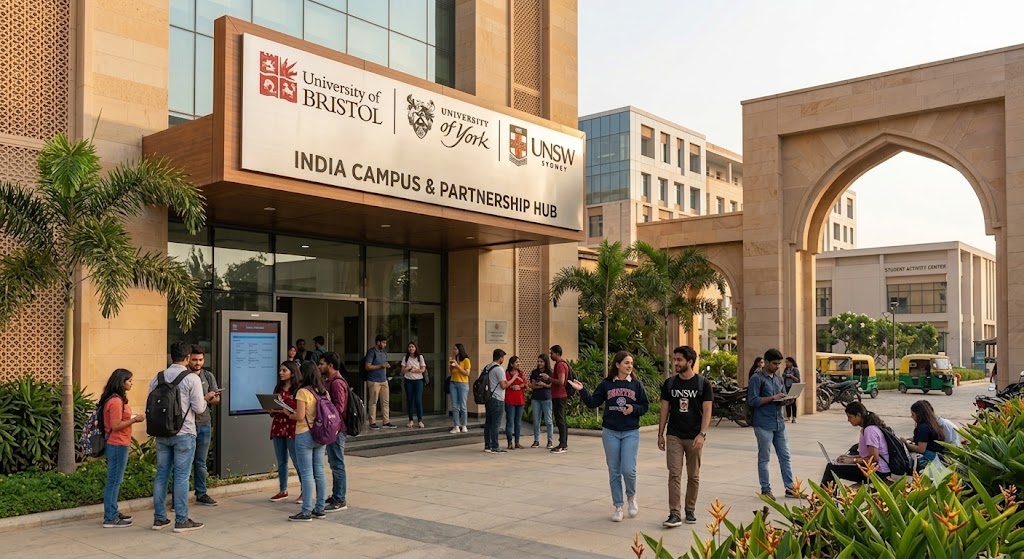
The Ministry of Education, through the University Grants Commission (UGC), recently issued Letters of Approval (LoAs) to three globally ranked Foreign Higher Education Institutions (FHEIs) — the University of Bristol, the University of York, and the University of New South Wales (UNSW) — to establish campuses in India.
Key Highlights of the Development
- Campus Locations: The University of Bristol and the University of York will set up their campuses in Mumbai, while the University of New South Wales (UNSW) will establish its campus in Bengaluru (Manyata Business Park).
- Total UGC Approvals: This brings the total number of foreign universities with formal UGC campus approvals in India to five. The earlier two approved under this specific route were the University of Southampton and the University of Liverpool.
- Academic Focus: These campuses will offer cutting-edge undergraduate and postgraduate programmes in fields like Artificial Intelligence, Cyber Security, Data Science, Business Management, Finance, and Immersive Arts.
- Regulatory Framework: The approvals have been granted under the UGC (Setting up and Operation of Campuses of Foreign Higher Educational Institutions in India) Regulations, 2023, providing a streamlined framework while ensuring institutional autonomy and global standards.
Importance of the Step
- Internationalisation at Home: It directly fulfills the vision of the National Education Policy (NEP) 2020 to promote India as a global study destination and attain the highest international standards in higher education.
- Curbing Capital and Brain Drain: By offering world-class UK and Australian university education within India at significantly lower fees, it reduces the compulsion for Indian students to relocate abroad, helping retain domestic talent and foreign exchange.
- Research & Innovation Ecosystem: The entry of these institutions is expected to foster global learning partnerships, joint research initiatives (especially in renewable energy, health, and transport), and cross-border academic mobility.
New Education Policy (NEP) 2020 & Internationalisation
The entry of FHEIs is a direct outcome of the vision laid out in the National Education Policy (NEP) 2020, which emphasizes “Internationalisation at Home.”
- Policy Mandate: NEP 2020 explicitly states that top globally ranked universities (specifically those in the top 100 or top 500 overall/subject-wise) will be facilitated to operate in India.
- Regulatory Framework: To actualize this, the government notified the UGC (Setting up and Operation of Campuses of Foreign Higher Educational Institutions in India) Regulations, 2023.
- Institutional Autonomy: Under these regulations, FHEIs are granted significant autonomy to evolve their curricula, devise admission processes, and repatriate funds to their home jurisdictions, ensuring ease of operation.
- Mobility & Integration: NEP advocates for the mutual recognition of degrees, credit transfers, and the promotion of joint/dual degree programs to integrate the Indian education system with global standards.
Significance of the Move
The establishment of foreign university campuses within India carries profound economic, academic, and demographic implications.
- Reversing Capital Outflow: Indian students spend billions of dollars annually on foreign education. Domestic campuses of FHEIs will offer global degrees at a fraction of the cost, retaining substantial foreign exchange within the country.
- Mitigating Brain Drain: By providing world-class education and subsequent placement opportunities locally, the move helps convert ‘brain drain’ into ‘brain gain’ and ‘brain circulation’.
- Elevating Domestic Standards: The presence of prestigious foreign institutions will foster healthy competition. Domestic public and private universities will be incentivized to upgrade their pedagogy, curricula, and infrastructure to remain competitive.
- Enhancing Research & Innovation: FHEIs bring deep expertise in niche domains (like Artificial Intelligence, Quantum Computing, and Immersive Arts), which can plug existing gaps in India’s R&D ecosystem through cross-border research collaborations.
- Meeting Rising Demand: With a target to achieve a 50% Gross Enrolment Ratio (GER) in higher education by 2035, India needs massive capacity expansion. FHEIs help absorb this demand without straining public exchequer resources.
Challenges
While the policy is progressive, its implementation faces several structural and socio-economic hurdles.
- Equity and Inclusivity Constraints: FHEIs are exempt from domestic reservation policies (SC/ST/OBC quotas) and have full autonomy over their fee structures. This raises concerns that these institutions will become exclusive enclaves for the urban, affluent elite.
- Internal Brain Drain: Offering highly competitive, market-driven salaries, FHEIs might poach top-tier faculty and researchers from premier domestic institutions (like IITs, IIMs, and Central Universities), weakening the domestic public education system.
- Quality Assurance: There is a historical risk of foreign universities offering diluted versions of their courses in overseas campuses compared to their home campuses. Ensuring parity in academic rigor and infrastructure is a major regulatory challenge.
- Regulatory & Bureaucratic Friction: Despite the liberalized UGC guidelines, challenges related to taxation, land acquisition, and the repatriation of surplus funds could create operational bottlenecks for foreign entities.
Way Forward
To maximize the benefits of internationalisation while safeguarding domestic interests, a balanced and nuanced approach is required.
- Mandating Financial Aid: While fee autonomy is necessary, the UGC should encourage or mandate FHEIs to establish robust scholarship funds and need-blind admission avenues to ensure talented students from marginalized backgrounds are not excluded.
- Promoting Twinning & Faculty Exchange: FHEIs should be incentivized to partner with state and central universities for faculty development programs. This ensures the transfer of pedagogical best practices to the broader Indian academic ecosystem rather than isolating them in elite campuses.
- Strict Quality Oversight: The UGC must implement stringent, periodic peer-review mechanisms to ensure that the infrastructure, faculty-to-student ratio, and research output at the Indian campuses are strictly on par with the institution’s home campus.
- Focus on STEM and Core Research: Approvals should prioritize institutions bringing cutting-edge STEM, deep-tech, and medical research capabilities over those merely offering generic management or humanities degrees, aligning foreign expertise with India’s core developmental needs.
Value Addition for UPSC
- UGC Regulations vs. GIFT City: It is important to distinguish between regulatory frameworks. While the 2023 UGC regulations govern the setting up of foreign campuses anywhere in India (like Mumbai and Bengaluru), foreign universities like Deakin University and University of Wollongong have established campuses specifically in Gujarat’s GIFT City. Those are governed by a separate framework under the International Financial Services Centres Authority (IFSCA).
- Eligibility for UGC FHEI: To be eligible to set up a campus under the UGC rules, a foreign institution must either be ranked within the top 500 in global university rankings (overall or subject-wise) or possess outstanding expertise in a particular area.
UPSC Prelims Practice Question
Q. With reference to the establishment of campuses by Foreign Higher Educational Institutions (FHEIs) in India, consider the following statements:
- Under the UGC Regulations of 2023, foreign universities are restricted to setting up campuses exclusively within designated Special Economic Zones (SEZs) or GIFT City.
- The University of Bristol and the University of York have recently received approvals to establish their campuses in Mumbai.
- The establishment of foreign university campuses in India is a stated objective under the National Education Policy (NEP) 2020.
Which of the statements given above is/are correct?
(a) 1 and 2 only
(b) 2 and 3 only
(c) 3 only
(d) 1, 2 and 3
Correct Answer: (b)
- Statement 1 is incorrect: The UGC (Setting up and Operation of Campuses of Foreign Higher Educational Institutions in India) Regulations, 2023, allow FHEIs to set up campuses anywhere in India. The regulations restricting campuses to GIFT City are separate and governed by IFSCA.
- Statement 2 is correct: The recent Letters of Approval grant the University of Bristol and the University of York permission to open enterprise and overseas campuses in Mumbai.
- Statement 3 is correct: NEP 2020 explicitly advocates for the internationalisation of higher education, encouraging top-performing global universities to operate in India to elevate domestic educational standards.
UPSC Mains Practice Question
Q. “The entry of Foreign Higher Educational Institutions (FHEIs) into India is a double-edged sword for the domestic academic ecosystem.” Analyze this statement in the context of the internationalisation goals of the National Education Policy (NEP) 2020. (150 words, 10 marks)
Brief Approach for Mains:
- Introduction: Mention the recent UGC approvals to globally ranked universities (like Bristol, York, and UNSW) as a milestone in implementing NEP 2020’s internationalisation vision.
- Positive Edge (Benefits):
- Curbs “brain drain” and the massive outflow of foreign exchange by providing global-standard education domestically.
- Fosters healthy competition, pressuring domestic public and private universities to upgrade their curricula, pedagogy, and research infrastructure.
- Integrates Indian academia with global research networks in niche areas like AI and clean energy.
- Negative Edge (Challenges/Concerns):
- Internal Brain Drain: FHEIs might poach top-tier faculty from domestic public universities by offering lucrative, market-driven compensation.
- Equity and Inclusivity: FHEIs have autonomy in their admission processes and are exempt from domestic reservation policies, raising concerns about affordability and access for marginalized sections.
- Elitism: Risk of creating a two-tier education system where premium foreign campuses cater only to the affluent urban elite.
- Conclusion: Conclude that a balanced regulatory approach by the UGC—ensuring academic and administrative autonomy for FHEIs while subtly encouraging scholarships, equity, and domestic joint ventures—is essential to realize the true intent of NEP 2020.