Table of Contents
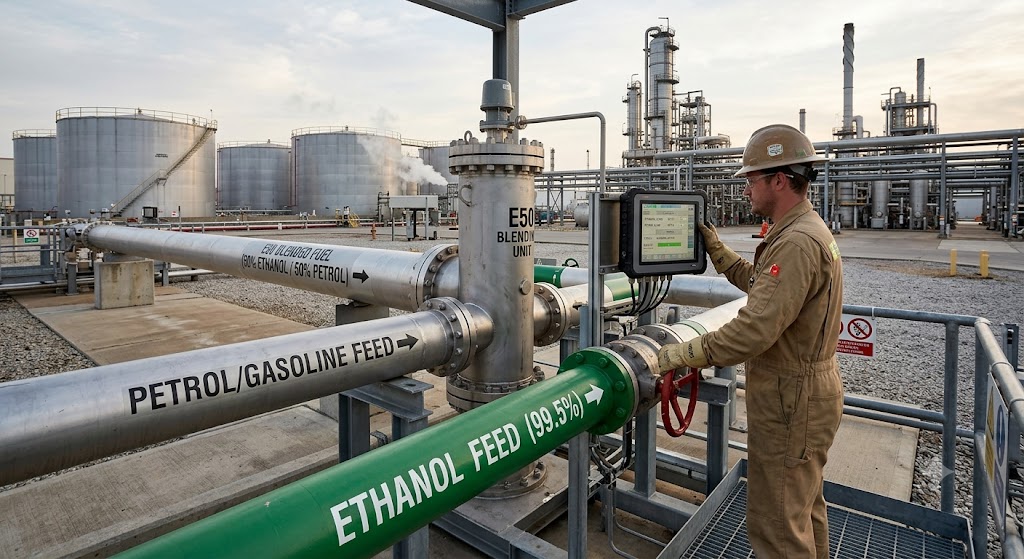
Aiming to boost the uptake of biofuels, the Union government has removed the central excise duty on petrol blended with higher proportions of ethanol, specifically the 22%, 25%, 27%, and 30% blends.
Key Highlights of the Notification
- Rationale – Preventing Dual Levy: Blending ethanol with petrol is legally considered a “manufacturing activity.” Currently, petrol attracts central excise duty, while ethanol attracts GST. If not exempted, the final blended product could attract excise duty again on the full quantity. This exemption prevents tax cascading (charging duties a second time).
- Status of Lower Blends: The Ministry of Finance had already exempted blended petrol up to 20% (E20) from this excise duty on the blended product.
- Not an Immediate Rollout: The government clarified that this tax exemption is a “preliminary prerequisite.” It does not signal the immediate commercial rollout of E22-E30 blends, which will only happen after extensive testing and stakeholder consultations.
- Recent Milestones: This notification follows India’s formal launch of the E85 variant (85% ethanol blended with 15% gasoline) on June 5.
Industry Response
- Policy Stability: Industry bodies like the Grain Ethanol Manufacturers Association (GEMA) view this as a strong signal of long-term policy commitment.
- Investment Catalyst: Removing tax ambiguity is essential to attract fresh investments across the entire ethanol value chain, including production, storage, fuel retailing, and flex-fuel mobility solutions.
- Cooperative Federalism Needed: Distiller associations have urged state governments to align their local tax structures to ensure the end consumer actually benefits at the retail pump.
What is the Ethanol Blended Petrol (EBP) Programme?
- Origin and Objective: Launched by the Ministry of Petroleum and Natural Gas in 2003, it aims to reduce import dependence, save foreign exchange, and provide an eco-friendly substitute for fossil fuels.
- The Process: It involves blending ethanol (a bio-alcohol produced from the fermentation of agricultural sugars and starches) directly with traditional motor spirit (petrol).
- Implementation: Oil Marketing Companies (OMCs) are mandated to procure ethanol from domestic distilleries at remunerative prices fixed strategically by the government.
- Target Evolution: Starting from a modest 5% blending target, the programme has progressively scaled up, with the current primary mission focused on achieving a nationwide 20% blend (E20).
National Policy on Biofuels (2018)
- Categorization of Fuels: The policy classifies biofuels into First Generation (1G – from food crops), Second Generation (2G – from lignocellulosic biomass/agricultural waste), and Third Generation (3G – algal biofuels).
- Expanded Feedstock: It broadened the permissible raw materials for ethanol production to include surplus food grains (like corn and FCI rice) and damaged grains unfit for human consumption.
- Advanced Targets: A recent critical amendment to the policy advanced the target for achieving 20% ethanol blending in petrol (E20) from the year 2030 to 2025-26.
- Financial Incentives: It provides strong financial backing, including Viability Gap Funding (VGF), specifically to encourage the establishment of advanced 2G bio-refineries.
Flex-Fuel Vehicles (FFVs)
- Definition: These are vehicles equipped with an internal combustion engine (ICE) specifically designed to run on more than one type of fuel, generally a varying mixture of petrol and ethanol.
- Hardware Modifications: FFVs contain specialized, corrosion-resistant engine components (like upgraded fuel lines, pumps, and injectors) to withstand the unique chemical properties of high-ethanol blends.
- Smart Engine Management: They feature integrated electronic control modules (ECMs) that automatically detect the exact ethanol-petrol ratio in the tank and adjust fuel injection and ignition timing accordingly.
- Transition Enabler: The adoption of FFVs is a non-negotiable prerequisite for India to move beyond the E20 limit and introduce higher blends like E85 (85% ethanol) or E100.
Significance of the Move
- Energy Security: Substituting imported crude oil with domestically produced ethanol significantly insulates India from global oil price shocks and saves billions in foreign exchange.
- Environmental Sustainability: Ethanol burns much cleaner than pure petrol, leading to a substantial reduction in tailpipe emissions, greenhouse gases (GHGs), and carbon monoxide.
- Agrarian Economy Boost: It creates a stable, secondary revenue stream for farmers by converting surplus sugarcane, maize, and damaged grains into lucrative biofuel.
- Waste Utilization: Promoting 2G ethanol effectively transforms agricultural residue (like rice stubble) into wealth, simultaneously addressing the severe air pollution caused by crop burning.
Challenges
- Automotive Compatibility: Modifying existing vehicle fleets and manufacturing new engines to handle higher ethanol blends without severe corrosion involves substantial capital expenditure for automakers.
- Storage and Logistics: Ethanol is highly hygroscopic (it readily absorbs moisture), meaning it cannot be transported via traditional petroleum pipelines and requires dedicated, specialized storage infrastructure.
- Food vs. Fuel Dilemma: Diverting arable land, intensive water resources, and vital food crops (like rice) toward fuel production raises long-term concerns regarding food security and groundwater depletion.
- Taxation Disparities: Unaligned tax structures and varying Value Added Tax (VAT) rates across different states can negate central excise exemptions, complicating seamless procurement and pricing.
Way Forward
- Prioritize 2G Biofuels: Policy focus and subsidies must aggressively pivot toward Second Generation (2G) ethanol plants that utilize agricultural waste, resolving the impending food-vs-fuel conflict.
- Infrastructure Overhaul: Massive investments are required to build dedicated ethanol rail transport networks, decentralized storage depots, and specialized dispensing pumps at retail outlets.
- Incentivize FFV Adoption: The government should offer tax rebates, lower GST brackets, and Production Linked Incentive (PLI) benefits to accelerate the manufacturing and consumer adoption of Flex-Fuel Vehicles.
- Ensure Cooperative Federalism: A unified, predictable pan-India tax regime for biofuels must be established through the GST Council to guarantee policy stability and attract long-term private investment.
UPSC Prelims Practice Question
Q. With reference to the taxation and blending of ethanol in India, consider the following statements:
- Under the current tax regime, petrol is subject to central excise duty, whereas ethanol used for blending is subject to the Goods and Services Tax (GST).
- The blending of ethanol with petrol is classified as a manufacturing activity, which inherently makes the final blend liable for excise duty unless specifically exempted.
- The Government of India has mandated the immediate nationwide commercial rollout of E30 (30% ethanol) petrol to achieve its 2025-26 biofuel targets.
Which of the statements given above is/are correct?
(a) 1 and 2 only
(b) 2 and 3 only
(c) 1 and 3 only
(d) 1, 2 and 3
Correct Answer: (a)
- Statement 1 is correct: In India’s dual tax structure for fuels, traditional transport fuels like petrol/diesel are outside the GST net (attracting excise/VAT), while ethanol is taxed under the GST regime.
- Statement 2 is correct: Blending is legally considered a manufacturing process. To avoid “dual levy” (taxing the already-taxed petrol and ethanol again upon blending), the Centre issues specific excise exemptions for the final blended product.
- Statement 3 is incorrect: The government has clarified that the recent tax exemptions for E22, E25, E27, and E30 are purely preparatory. The rollout of these higher blends will only occur after extensive testing; it is not an immediate nationwide mandate.
UPSC Mains Practice Question
Q. “Tax harmonization and policy stability are critical prerequisites for the success of India’s Ethanol Blended Petrol (EBP) Programme.” In light of the recent excise duty exemptions on higher ethanol blends, discuss the economic and environmental significance of the EBP programme. What are the key challenges in moving towards higher blends like E85? (150 words, 10 marks)
Brief Approach for Mains:
- Introduction: Briefly mention the recent removal of central excise duty on higher ethanol blends (E22-E30) to prevent dual levy, showcasing the government’s push for policy stability.
- Economic & Environmental Significance:
- Economic: Massive forex savings by reducing crude oil imports; boosts the agricultural economy and farmers’ income (through procurement of surplus grain/sugarcane); spurs investments in distilleries and logistics.
- Environmental: Significant reduction in greenhouse gas (GHG) emissions, carbon monoxide, and unburnt hydrocarbons compared to unblended petrol.
- Challenges towards Higher Blends (E20 to E85):
- Automotive Transition: Requires massive investments in Flex-Fuel Vehicles (FFVs) and modifying existing engine components to prevent corrosion from high-ethanol content.
- Supply Chain: Need for dedicated ethanol storage, distinct dispensing pumps at retail outlets, and robust logistics.
- Taxation Friction: Lack of uniform tax alignment between the Centre (Excise/GST) and States (VAT) can negate consumer benefits.
- Conclusion: Conclude that advancing beyond E20 requires a “Whole of Government” approach involving OEM manufacturers, sugar/grain mills, and cooperative federalism in taxation.