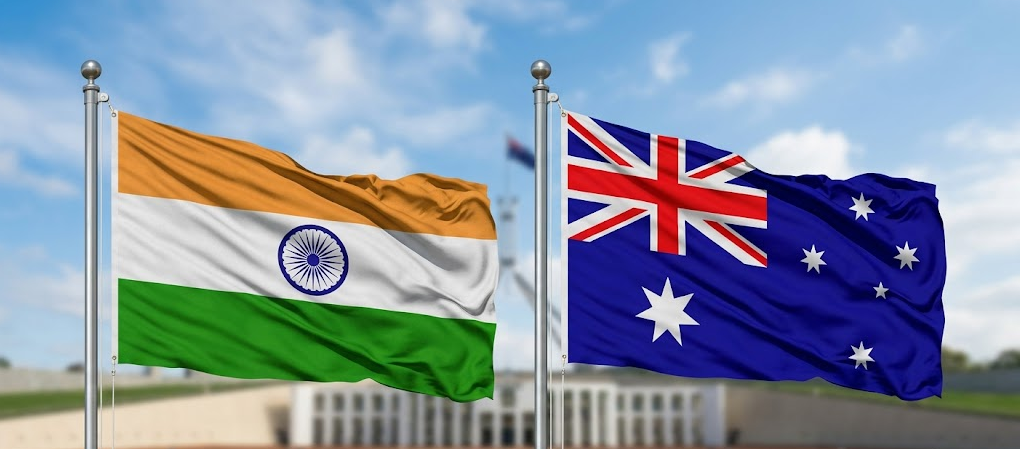
Recently, India and Australia adopted a historic ‘Joint Declaration on Defence and Security Cooperation’ to deepen military engagement, defence industrial cooperation, and maritime security amid rising geopolitical uncertainty in the Indo-Pacific region. Alongside this, both nations have also signed significant agreements in the sectors of civil nuclear energy and critical minerals.
Key Highlights
Expansion of Defence and Security Cooperation
- Strategic Roadmap: Adopted by Prime Minister Narendra Modi and his Australian counterpart Anthony Albanese, this declaration sets out a blueprint to enhance strategic consultations, interoperability between the armed forces, and information sharing.
- Military Engagement: Both countries have agreed to increase the complexity of bilateral and multilateral military exercises and expand the deployment of military aircraft from each other’s territories.
- Personnel Exchange: Opportunities for cooperation in the defence workforce will be explored through education, training, and liaison appointments.
- Maritime Security Roadmap: The ‘India-Australia Maritime Security Cooperation Roadmap’ will be implemented to strengthen coordination in the Indian Ocean and the wider Indo-Pacific region.
Civil Nuclear Energy and Clean Energy
- Under the new agreement between the two countries, the path will be paved for the commercial supply of uranium from Australia to India for nuclear energy projects.
- This breakthrough comes after the historic civil nuclear cooperation agreement signed between the two nations about 12 years ago, which will accelerate India’s clean energy goals.
Technology, Critical Minerals, and Energy Security
- New Partnership: The ‘Australia-India Partnership on Cyber, Critical Technologies, and Supply Chains’ has been launched.
- Minerals Corridor: Both countries will work together on a Critical Minerals Corridor.
- Energy Security Framework: A resolve has been made to strengthen energy security by maintaining a stable and reliable supply of coal, diesel, other liquid fuels, and natural gas.
Institutional Mechanism and Regional Architecture
- This new declaration builds upon the ‘Joint Declaration on Security Cooperation’ signed in the year 2009.
- It will complement existing mechanisms such as the 2+2 Foreign and Defence Ministerial Dialogue, the Foreign Ministers’ Framework Dialogue, and the Defence Ministers’ Dialogue.
- Both countries reiterated their commitment to regional forums such as the Indian Ocean Rim Association (IORA), the ASEAN-centric regional architecture, and the Pacific Islands Forum (PIF).
UPSC Prelims Practice Question
Q. With reference to the recently adopted ‘India-Australia Joint Declaration on Defence and Security Cooperation’, consider the following statements:
- Under this declaration, both countries have agreed to expand the deployment of military aircraft from each other’s territories.
- The recent civil nuclear agreement aims to facilitate the commercial supply of uranium from Australia to India for nuclear energy projects.
- This new declaration will replace existing institutional mechanisms such as the ‘2+2 Foreign and Defence Ministerial Dialogue’.
Which of the statements given above are correct?
- (a) 1 and 2 only
- (b) 2 and 3 only
- (c) 1 and 3 only
- (d) 1, 2 and 3
Correct Answer: (a) 1 and 2 only
Explanation: Statements 1 and 2 are absolutely correct. Statement 3 is incorrect because this new declaration will not replace the existing ‘2+2 Foreign and Defence Ministerial Dialogue’, but rather complement it.
UPSC Mains Practice Question
Q. “The recent Joint Declaration between India and Australia is not limited merely to maritime security, but also demonstrates a strategic shift toward clean energy and critical mineral security.” Critically analyze this statement in light of the emerging geopolitical realities in the Indo-Pacific region. (250 words, 15 marks)
Approach for Mains Answer:
- Introduction: Provide a brief introduction to the recently adopted Joint Declaration by India and Australia and the growing bilateral relations between the two democracies.
- Body Part 1 (Defence and Maritime Security Dimension): Explain its role in ensuring stability in the Indo-Pacific region through interoperability, complex military exercises, mutual aircraft deployment, and the Maritime Security Cooperation Roadmap.
- Body Part 2 (Energy and Critical Mineral Security Dimension): Discuss the importance of accelerating clean energy objectives through uranium supply and building a resilient supply chain via the Australia-India Partnership on Cyber, Critical Technologies, and Supply Chains, along with the Critical Minerals Corridor.
- Body Part 3 (Geopolitical Uncertainty and Regional Institutions): Highlight the shared vision of both countries in strengthening multilateral forums such as IORA, ASEAN, and PIF amid rising uncertainties in the Indo-Pacific.
- Conclusion: Present a balanced and forward-looking conclusion, highlighting the multi-dimensional nature of the India-Australia partnership.