Subject: Polity and Governance (General Studies Paper-II)
Table of Contents
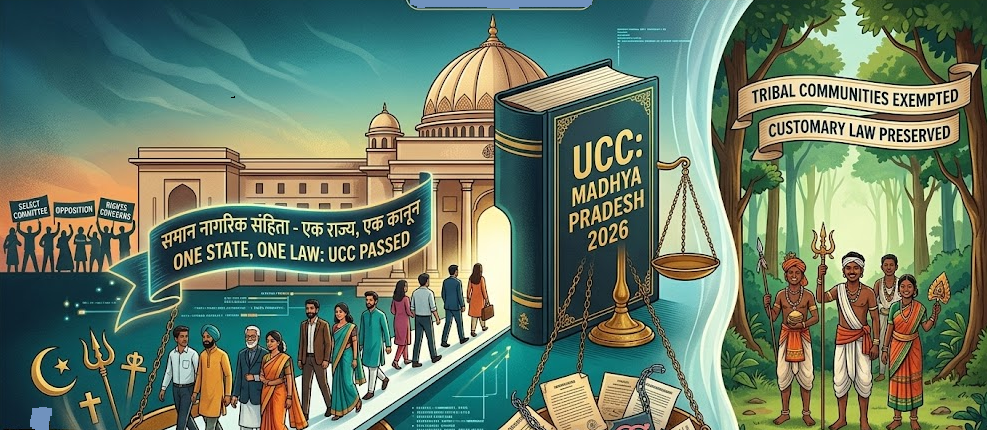
The Madhya Pradesh Legislative Assembly recently passed the Madhya Pradesh Uniform Civil Code 2026 Bill via a voice vote during the Monsoon Session. The Bill was passed amid strong protests from the Opposition, who demanded that the draft legislation be referred to a select committee for further scrutiny.
Key Highlights
- Major Provisions of the Bill:
- Ban on Certain Practices: The Bill seeks to criminalize practices such as polygamy and nikah halala.
- Live-in Relationships: It makes the registration of live-in relationships mandatory within the State.
- Tribal Exemption: Significantly, the draft legislation entirely exempts the State’s large tribal population from the purview of the UCC to protect their customary laws and practices.
- Government’s Stance:
- The ruling government defended the Bill as a step towards ensuring legal equality for all citizens, irrespective of their religion, referencing the vision of Dr. B.R. Ambedkar.
- The Chief Minister emphasized that the UCC aims to deliver gender justice, drawing parallels with the abolition of triple talaq at the national level, thereby ensuring uniform legal rights for women across all communities.
- Opposition’s Concerns:
- Violation of Fundamental Rights: Opposition legislators argued that the Bill violates fundamental rights guaranteed under the Constitution, particularly those related to the protection of distinct culture and minority rights.
- Allegations of Targeting: The Opposition criticized the unilateral passage of the Bill, alleging that it was drafted to target and trouble the Muslim community and bypass detailed legislative scrutiny (by not referring it to a select committee).
- Constitutional Background (Value Addition):
- Article 44: Part IV of the Constitution (Directive Principles of State Policy) states that the State shall endeavour to secure for the citizens a Uniform Civil Code throughout the territory of India.
- State Competence: Personal laws (marriage, divorce, inheritance) fall under the Concurrent List (Entry 5) of the Seventh Schedule. Therefore, State legislatures have the power to enact a UCC for their respective states, provided it receives the President’s assent (if it contradicts existing central laws).
What is Uniform Civil Code?
- Definition: The Uniform Civil Code (UCC) refers to a common set of laws governing personal matters such as marriage, divorce, inheritance, adoption, and succession for all citizens of India, irrespective of their religion, gender, or sexual orientation.
- Constitutional Provision: Article 44 under Part IV (Directive Principles of State Policy) of the Constitution mandates that “the State shall endeavor to secure for the citizens a uniform civil code throughout the territory of India.”
- Current Status: Presently, different religious communities are governed by their respective personal laws (e.g., Hindu Marriage Act, 1955; Muslim Personal Law (Shariat) Application Act, 1937). Goa is currently the only state with a functional UCC (the Portuguese Civil Code of 1867), while states like Uttarakhand and Madhya Pradesh are introducing state-level UCC legislation.
Relevance of UCC for India
- Ensuring Gender Justice: Many existing personal laws are highly patriarchal and discriminate against women in matters of inheritance, marriage, and divorce (e.g., polygamy, unequal share in property). A UCC would establish equal rights for women across all religions, upholding Articles 14 and 15 of the Constitution.
- Fostering National Integration: A common civil code will help consolidate the nation by replacing disparate, religion-based loyalties with a unified national legal identity, promoting the true spirit of secularism.
- Simplification of the Legal System: The presence of multiple personal laws creates a highly complex and overlapping legal framework. A UCC would simplify the laws, making them more accessible to ordinary citizens and significantly reducing the burden on the judiciary.
- Separation of Religion from Law: In a secular, modern republic, law should be based on human rights and constitutional values rather than ancient religious scriptures. A UCC ensures that the state does not differentiate between citizens based on their faith.
Concerns Related to UCC
- Fears of Majoritarianism: Minority communities often view the UCC as an attempt to impose the cultural and religious practices of the majority community upon them, seeing it as an infringement on their Right to Freedom of Religion (Article 25) and minority rights (Article 29).
- Impact on Tribal Autonomy: India has a vast tribal population with distinct customary laws and practices protected by the Constitution (such as under the Sixth Schedule and Article 371). Imposing a rigid UCC could disrupt their unique socio-cultural fabric.
- Legal Fragmentation via State UCCs: Personal laws fall under the Concurrent List (Entry 5). If individual states enact their own versions of the UCC (as seen recently), it will lead to a fragmented legal landscape rather than a truly “national” uniform code, causing confusion in inter-state marriages and property disputes.
- Lack of Consensus: As noted by the 21st Law Commission, a UCC is “neither necessary nor desirable at this stage” because India is a highly diverse country, and implementing a single code without a broad consensus could lead to social unrest.
Way Forward
- Piecemeal Reform Over Blanket Imposition: Instead of abruptly enforcing a single code, the government should adopt a gradual approach. Discriminatory practices within individual personal laws should be amended step-by-step (e.g., the ban on Triple Talaq).
- Focus on ‘Just Code’ rather than ‘Uniform Code’: The primary objective must be gender equality and justice. The government should focus on drafting a “Just Code” that removes inequalities across all religions rather than blindly pushing for uniformity.
- Codification of Existing Laws: All personal laws and tribal customary laws should first be codified to identify existing prejudices, stereotypes, and unconstitutional elements, making it easier to reform them.
- Broad-Based Consensus Building: The government and the Law Commission must hold extensive, transparent consultations with religious leaders, tribal councils, women’s rights organizations, and civil society to build trust and address apprehensions before drafting a national UCC.
Prelims Practice Question
Question: With reference to the implementation of the Uniform Civil Code (UCC) in India, consider the following statements:
- Article 44 of the Indian Constitution mandates the State to immediately enforce a Uniform Civil Code across the country.
- Laws relating to marriage, divorce, and inheritance fall under the State List of the Seventh Schedule, allowing states exclusive power to draft their own UCC.
- The recently passed Madhya Pradesh Uniform Civil Code 2026 Bill completely exempts the tribal population of the state from its provisions.
Which of the statements given above is/are correct?
(a) 1 and 2 only
(b) 3 only
(c) 2 and 3 only
(d) 1, 2, and 3
Answer: (b) 3 only
Explanation:
- Statement 1 is incorrect: Article 44 is a Directive Principle of State Policy (DPSP), which means it is a guiding principle for the state and is non-justiciable (not legally enforceable immediately).
- Statement 2 is incorrect: Personal laws (marriage, divorce, inheritance, etc.) fall under the Concurrent List (List III), not the State List. Both Parliament and State Legislatures can make laws on these subjects.
- Statement 3 is correct: The Madhya Pradesh UCC Bill explicitly exempts the state’s tribal population from its ambit.
Mains Practice Question
Question: “The enactment of state-level Uniform Civil Codes (UCC) reignites the debate between the Directive Principle of securing a uniform law (Article 44) and the Fundamental Right to freedom of religion (Article 25).” Analyze the constitutional validity and socio-political implications of states implementing their own versions of the UCC in India. (250 words)
Approach for Mains Answer:
- Introduction: Mention the recent passage of the UCC Bill by Madhya Pradesh (following the precedent set by Uttarakhand) and define what a UCC entails (uniform laws for marriage, divorce, inheritance, etc.).
- Body Paragraph 1 (Constitutional Validity): Discuss the legislative competence of states. Mention Entry 5 of the Concurrent List which allows states to legislate on personal laws. Note that such state bills require the President’s assent under Article 254(2) if they override existing Central laws.
- Body Paragraph 2 (The Article 44 vs. Article 25 Debate): Explain the friction between the state’s endeavor to provide gender justice and equality (Articles 14, 15, and 44) versus the protection of religious freedom and minority rights (Articles 25, 26, and 29).
- Body Paragraph 3 (Socio-Political Implications): Discuss the positives (curbing regressive practices like polygamy/halala, promoting gender equality) and the challenges (piecemeal approach leading to legal fragmentation across states, fears of majoritarianism, and the complexities of exempting certain communities like tribals).
- Conclusion: Conclude with the view that while a UCC is a constitutional ideal, a consensus-building approach—perhaps guided by the Law Commission’s recommendations on reforming personal laws—is essential to preserve India’s multicultural fabric.