Subject: International Relations and Economy (General Studies Paper-II and III)
Table of Contents
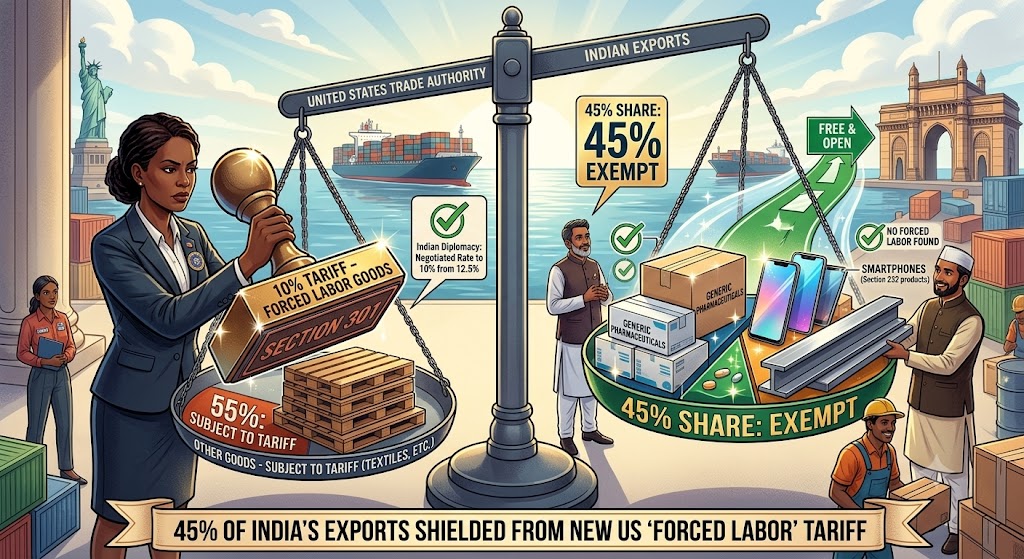
The United States recently announced permanent tariffs on imports from 60 trading partners, following an investigation by the U.S. Trade Representative (USTR) into goods produced using forced labour. The Ministry of Commerce and Industry (Government of India) has stated that approximately 45% of India’s exports to the U.S. will remain outside the purview of these new 10% additional tariffs.
Key Highlights
- Reduction in Proposed Tariffs & India’s Placement:
- Following persistent diplomatic engagement and detailed written submissions during the USTR investigation, the U.S. scaled down the proposed forced-labour tariff on Indian exports from 12.5% to 10%.
- Out of the 60 economies investigated, India has been placed in the lower tier of additional tariffs, providing a relative advantage over the 38 countries that face a higher tariff burden.
- The Exempted 45% Export Bracket:
- Zero-Duty Products: Key export categories such as generic pharmaceuticals, smartphones, and other specified products will continue to attract zero additional duties and are completely exempt from the new 10% levy.
- Section 232 Overlap: Products that are already penalized under Section 232 of the U.S. Trade Expansion Act (such as steel, aluminium, and auto parts) face existing tariffs of 25-50%. These goods are exempt from the additional 10% forced labour duty. Since Section 232 tariffs apply uniformly to nearly all countries, India is not at a comparative disadvantage here.
- Impact on the Remaining 55%:
- The remaining 55% of India’s exports to the U.S. (including engineering goods, chemicals, plastics, leather, and jewellery) will attract the new 10% Section 301 duty.
- However, the Commerce Ministry noted that India’s overall “tariff incidence is comparatively lower” than most other economies targeted by the USTR.
- Textile Exports and Quota Mechanisms:
- The USTR has established a “textile mechanism” offering Tariff-Rate Quotas (TRQs) to nations like Bangladesh, Cambodia, Indonesia, and Malaysia. This allows them exemptions if they import U.S.-origin cotton and fibres.
- India was excluded from this specific exemption. However, the Indian government continues to negotiate with the U.S. for a favorable quota-based system for Indian textile exports as part of broader bilateral trade talks.
Reasons for the U.S. Imposing Tariffs
- Curbing Unfair Competition: According to the U.S. Trade Representative (USTR) investigation, if a country fails to restrict imports of goods made with forced labor, its domestic producers gain an unfair cost advantage due to cheaper raw materials. The U.S. argues this disadvantages American companies that comply with ethical standards across their supply chains.
- Displacement of Trade: The U.S. maintains that when other nations permit cheap, forced-labor-derived products in their domestic markets, they crowd out ethically produced, higher-cost goods (including U.S. exports).
- Section 301 (Trade Act of 1974): Empowers the U.S. President to take punitive action (like tariffs) against foreign nations whose trade practices are deemed “unjustifiable, unreasonable, or discriminatory” and restrict U.S. commerce. The current 10% tariffs on forced labour goods fall under this section.
- Section 232 (Trade Expansion Act of 1962): Allows the U.S. to adjust imports (via quotas or tariffs) if the Department of Commerce finds that certain products threaten to impair “national security.” This has been famously used to place heavy global tariffs on steel and aluminium imports.
International Legal Framework
- International Labour Organization (ILO): Forced labor is explicitly defined and prohibited under the ILO’s Forced Labour Convention, 1930 (No. 29) as any work or service exacted from any person under the threat of penalty and for which the person has not offered themselves voluntarily.
- Universal Declaration of Human Rights (UDHR): Article 4 of the UN Universal Declaration of Human Rights explicitly bans slavery and involuntary servitude in all forms.
- Legal Paradox: While eradicating forced labor is a universal human rights imperative, a single nation (the U.S.) evaluating other countries’ import policies to enforce secondary sanctions or tariffs remains a highly contentious and complex issue under international law.
Unilateral Tariffs vs. WTO Obligations
- Direct Violation of Multilateralism: The World Trade Organization (WTO) framework and its Dispute Settlement Understanding (DSU) require member states to adjudicate trade disputes through multilateral channels. Unilateral tariff enforcement under Section 301 circumvents this core principle.
- Breach of Core GATT Principles: Levying punitive duties on 60 trading partners violates Article I (Most Favored Nation – MFN) and Article II (Tariff Bindings) of GATT, as it raises import duties beyond bound rates without prior WTO authorization.
- Reliance on GATT Article XX (General Exceptions): The U.S. frequently attempts to justify unilateral measures under GATT Article XX(a) (Public Morals) or Article XX(e) (products of prison labor). However, previous WTO panels have ruled unilateral Section 301 tariffs (such as those levied against China) to be inconsistent with WTO rules.
The Way Forward
- Joint Challenge at the WTO: India and other affected like-minded nations should form a coordinated coalition to challenge these protectionist and unilateral measures before the WTO Dispute Settlement Body (DSB).
- Transparency in Domestic Supply Chains: India should strictly enforce its consolidated Labour Codes and enhance supply chain traceability. Ensuring that Indian exports are entirely free from forced labor is vital to preempt non-tariff barriers (NTBs) from developed markets.
- Diplomatic Outreach & TRQ Access: The U.S. has established a Tariff-Rate Quota (TRQ) mechanism for select sectors like textiles (currently extended to nations such as Bangladesh and Cambodia). India must pursue targeted diplomatic negotiations to secure similar quota-based exemptions for its labor-intensive textile sector.
- Export Market Diversification: To insulate itself from U.S. trade shocks, India should accelerate negotiations for Free Trade Agreements (FTAs) with Europe, Africa, ASEAN, and Latin America to diversify its export destinations.
Prelims Practice Question
Question: With reference to the trade relations between India and the United States, consider the following statements:
- The recent 10% tariff imposed by the U.S. under Section 301 on multiple countries is primarily aimed at curbing the importation of goods produced using forced labour.
- The Government of India has announced that 100% of its exports to the U.S. will now be subject to this new 10% additional duty.
- Indian goods like steel and aluminium, which are already covered under Section 232 of the U.S. Trade Expansion Act, are exempt from the newly added Section 301 tariffs.
Which of the statements given above is/are correct?
(a) 1 and 2 only
(b) 2 and 3 only
(c) 1 and 3 only
(d) 1, 2, and 3
Answer: (c) 1 and 3 only
Explanation:
- Statement 1 is correct: The recent Section 301 tariffs are explicitly aimed at economies failing to adequately enforce bans on forced labour imports.
- Statement 2 is incorrect: Approximately 45% of India’s exports (including pharmaceuticals, smartphones, and Section 232 goods) remain outside the purview of this new tariff.
- Statement 3 is correct: Products already covered under Section 232 are exempted from the additional 10% Section 301 duty.
Mains Practice Question
Question: “The increasing use of domestic trade laws by developed nations, such as Section 301 and Section 232 by the United States, reflects a shift toward protectionism masked as ethical and security concerns.” Analyze this statement in the context of the recent U.S. tariffs on forced labour goods and discuss its implications for India’s export competitiveness. (250 words)
Approach for Mains Answer:
- Introduction: Briefly outline the recent USTR action imposing permanent tariffs on 60 trading partners over forced labour, noting India’s negotiated 10% tariff slab.
- Body Paragraph 1 (The Trend of Protectionism): Explain how ethical rationales (forced labour) and national security arguments (Section 232 on steel) are increasingly being used to bypass the WTO’s multilateral dispute settlement mechanisms.
- Body Paragraph 2 (Implications for India): Discuss both the negatives (55% of exports facing the 10% tariff, exclusion from the textile TRQ mechanism) and the strategic positives (successful diplomacy lowering the proposed rate from 12.5% to 10%, shielding 45% of critical exports like pharmaceuticals and electronics).
- Conclusion: Conclude that while India has managed to mitigate the immediate fallout through active engagement, it must prioritize diversifying its export markets and strengthening domestic supply chains (via PLI schemes) to insulate itself from such unilateral trade shocks in the future.