Subject: Polity and Governance (General Studies Paper-II)
Table of Contents
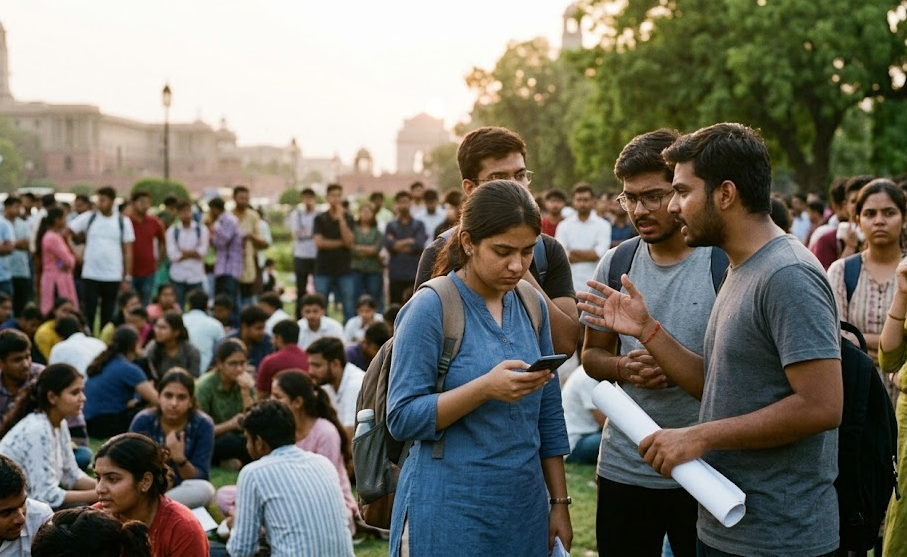
The recent widespread protests surrounding the National Eligibility cum Entrance Test (NEET-UG) catastrophe, leading to the resignation of Union Education Minister Dharmendra Pradhan, have sparked a broader debate on political accountability, youth mobilization, and the nature of democracy in India.
The Decline of Political Accountability
- Historical Precedent vs. Current Reality: Historically, ministers (like Railway Ministers) would resign accepting moral responsibility for major failures, even without direct personal negligence.
- Loss of ‘Honour’ in Politics: There is a perceived loss of honour, self-respect, and decency in modern politics. Where clinging to power, privileges (red beacon cars, Lutyens’ bungalows), and self-aggrandisement have become priorities over public accountability.
- The Reluctant Resignation: The resignation of the Education Minister, which arguably should have been immediate following the NEET paper leaks, was delayed and only extracted after massive public protests.
- Furthermore, the resignation letter was criticized for lacking an acceptance of moral responsibility, instead framing the exit as a tactical move to thwart “anti-national” elements.
The Rise of the Youth and Protest
- A Unified, Faceless Protest: The protests successfully united youth across deep-seated caste and religious lines identities that usually define political mobilization in India.
- Role of Alternative Media: Bypassing mainstream television, which was perceived as aligned with the ruling establishment, the protesters effectively used social media to build massive, rapid support.
- Resilience Against State Action: The agitation withstood severe state measures, including internet shutdowns, mobility restrictions, and alleged police brutality (use of shock batons and pellet guns), proving that a determined, non-aligned movement cannot be easily crushed or hijacked by the political elite.
Broader Implications for Indian Democracy
- Pushback Against Authoritarianism: The success of the protests as a significant pushback against perceived authoritarianism, fear, and the threat of reprisal. It serves as a reminder that “people remain the masters.”
- Unravelling of the ‘Dominant Party System’: The event is a seminal moment that challenges the current dominant-party system. It exposes the limits of converting narrow electoral victories into expansive mandates to push unitary or majoritarian agendas.
- The Power of Satyagraha: The movement, supported by figures like Sonam Wangchuk, reaffirmed the power of non-violent struggle (Satyagraha) in forcing an inflexible government to negotiate and act, offering a lesson to democratic institutions and a passive media.
Implications on the Indian Political System
- Challenge to the Dominant Party Framework
- Demonstrates that even in a dominant-party system where a strong executive holds a decisive parliamentary majority and faces a fragmented Opposition there are clear limits to unilateral governance.
- Shows that converting electoral majorities into expansive mandates without broad institutional or civil consensus creates systemic friction that can erupt outside Parliament.
- Re-assertion of Popular Sovereignty & Non-Violent Resistance:
- Reaffirms the foundational democratic principle that ultimate authority rests with the citizenry (“people remain the masters”).
- Re-establishes the efficacy of non-violent, Indian-style Satyagraha as an extra-parliamentary check on executive power when formal constitutional checks and balances (media, passive judiciary, parliamentary debate) are perceived as weakened.
- Depolarization and Transcending Identity Politics:
- Highlighted how core economic and developmental issues—such as meritocracy, entrance exams, and access to formal employment—can bridge deep-seated societal divides (caste, religion, region).
- Signals a shift where youth-led, issue-based coalitions can bypass conventional identity-based political alignment to demand direct institutional governance.
- Institutional Credibility Crisis:
- Underscores an urgent need for structural reform within public administrative and testing bodies (like the National Testing Agency).
- Exposes how excessive centralization and heavy-handed law enforcement response to peaceful dissent can erode public trust in regulatory and state machinery.
Implications on Political Parties
A. For the Ruling Party / Establishment
- Limits of Hyper-Centralized Control: Reveals that narrative management, social media bans, or branding protesters as “anti-national” fail when applied to broad-based, non-sectarian youth grievances regarding basic livelihood and merit.
- Necessity of Tactical Retreats: Forces a realization that maintaining absolute rigidity risks broader political destabilization; ministerial resignations and negotiations become essential to manage political risk.
- Governance Realignment: Signals that policy focus must pivot from symbolic or majoritarian agendas to functional governance, administrative integrity, and youth aspirations.
B. For Mainstream Opposition Parties
- Exposition of Political Disconnect: Highlights the vulnerability of conventional Opposition parties, which were largely bypassed by the self-organized, decentralized student movement.
- Imperative for Issue-Based Engagement: Demonstrates that to effectively challenge a dominant party, Opposition forces must align with organic, grassroots issues (employment, exam integrity, public health/education) rather than relying solely on traditional electoral alliances.
C. For Non-Party / Alternative Political Movements
- Rise of Faceless, Decentralized Mobilization: Proves that satire, social media, and non-aligned civic platforms can build rapid national consensus without needing a formal party apparatus or recognized leadership.
- Protection Against Co-optation: Shows that non-alignment with established political entities protects youth movements from being easily discredited, split, or hijacked by electoral politics, granting them significant moral authority.
Mains Practice Question
Question: “The recent youth-led protests against the NEET-UG examination irregularities highlight a growing crisis of institutional credibility and a shift in the dynamics of political accountability in India.” Analyze this statement, discussing the implications of such non-parliamentary mobilizations for Indian democracy. (250 words)
Approach for Mains Answer:
- Introduction: Briefly outline the NEET-UG controversy and the subsequent nationwide protests that led to the resignation of the Union Education Minister.
- Body Paragraph 1 (Crisis of Credibility): Discuss how the repeated failure of centralized examination systems (like NTA) undermines merit and destroys the trust of the youth in state institutions. Mention the historical contrast in taking ‘moral responsibility’ by ministers.
- Body Paragraph 2 (Shift in Political Accountability): Explain how accountability is no longer voluntary but has to be forced through massive public pressure. Highlight the government’s initial reluctance and the attempt to label dissent as “anti-national.”
- Body Paragraph 3 (Role of Non-Parliamentary Mobilization): Analyze the success of the youth protests (e.g., CJP). Discuss how they transcended caste/religious divides, utilized social media to bypass mainstream narratives, and utilized non-violent resistance (Satyagraha) to demand justice.
- Conclusion: Conclude by emphasizing that while strong electoral mandates provide stability, a healthy democracy requires robust, independent institutions and an active, vigilant citizenry to ensure checks and balances against authoritarian tendencies.