Table of Contents
The U.S. Secretary of State recently concluded a four-day visit to India, holding high-level bilateral dialogues with India’s External Affairs Minister (EAM). The visit took place against the backdrop of the U.S.–Israel conflict with Iran and major supply chain disruptions in the Middle East.
Key Highlights of the Discussions
- Reaffirmation of the Strategic Alliance:
- The U.S. clarified that its “tactical” engagements with other countries (referencing Pakistan’s recent role in mediating a pause in the Gulf conflict) will not come at the expense of its core strategic alliance with India.
- The U.S. President reiterated strong bilateral ties, stating that India can count on the U.S. “100%”.
- Geopolitics of the Strait of Hormuz:
- U.S. Accusations: The U.S. accused Iran of strangulating maritime commerce by laying mines in international waters, holding civilian vessels hostage, and attempting to impose transit tolls on ships passing through the Strait of Hormuz.
- Extension of the Indo-Pacific Concept: The U.S. emphasized that the vision of a “Free and Open Indo-Pacific” inherently extends to other critical international waters, including the Persian Gulf and the Strait of Hormuz, advocating for toll-free, unimpeded maritime commerce.
- Energy and Supply Chain Disruptions:
- Both nations acknowledged the severe disruptions to global supply chains caused by the ongoing military campaign in Iran.
- The U.S. asserted that its military campaign had achieved clear goals, claiming the destruction of Iran’s naval and long-range missile capabilities to prevent nuclear proliferation.
- Trade and Bilateral Issues:
- Key focus areas included energy cooperation, bilateral trade, and visa issues for skilled Indian professionals.
- The U.S. administration clarified that its tough stance on trade is not India-specific, but rather a broader policy shift designed to reverse previous “outsourcing-based” economic models.
India’s Stance and Imperatives
- Diplomatic Balancing (Strategic Autonomy): India remains one of the few global players maintaining strong concurrent relationships with the U.S., Israel, Iran, and the Gulf nations. This allows India to navigate complex diplomatic fault lines without choosing blocks.
- Energy Diversification: Acknowledging the extreme risks currently concentrated in the Strait of Hormuz, the EAM stressed that diversifying India’s energy supply is an immediate economic and strategic imperative.
India’s Strategic Interest in the Strait of Hormuz
- Energy Security and Import Dependency: The Strait of Hormuz is a vital maritime chokepoint connecting the Persian Gulf to the open ocean. A significant portion of India’s crude oil and liquefied natural gas (LNG) imports transit through this narrow waterway.
- Protection of Maritime Commerce: The recent geopolitical tensions (including the U.S.–Israel conflict with Iran) have led to the disruption of supply chains. Iran’s blockades and attempts to impose transit tolls pose a direct threat to “safe and unimpeded maritime commerce,” directly impacting India’s economy through inflation and widened current account deficits.
- Need for Diversification: The vulnerability of this route has accelerated India’s need to “de-risk” and diversify its energy supply chains, prompting a significant uptick in energy imports from other reliable sources, including the United States.
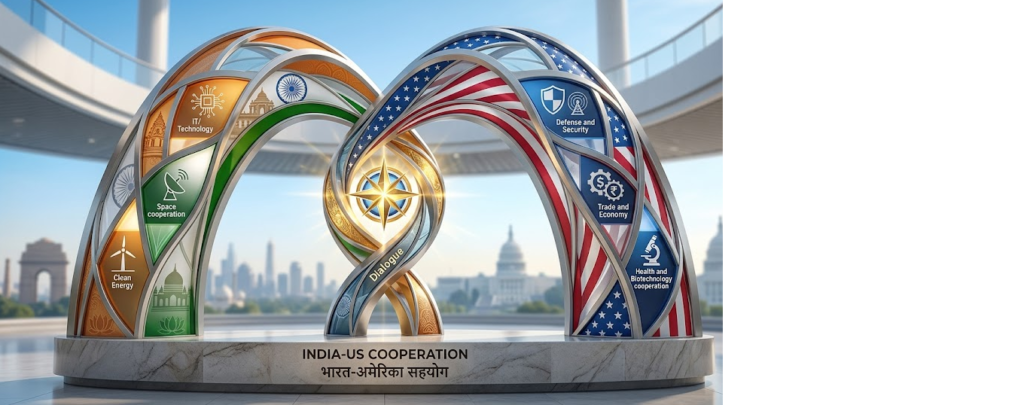
India–U.S. Cooperation Across Sectors
- Trade & Commerce: The signing of the Interim Trade Agreement in February 2026 served as a major reset, with the U.S. slashing tariffs on Indian goods down to 18% from an earlier peak of 50%. India, in turn, has committed to purchasing $500 billion in U.S. goods over the next five years, focusing on agricultural products, coking coal, and energy.
- Technology & AI: The nations are significantly expanding technology cooperation through the iCET (Initiative on Critical and Emerging Technology). This includes increasing trade in Graphics Processing Units (GPUs) for data centers, building AI policies, and developing semiconductor resilience.
- Defence & Security: The 10-year Master Defence Partnership framework strengthens interoperability. Joint exercises like Yudh Abhyas and Malabar, coupled with co-production of military hardware (e.g., GE-F414 engines, Apache helicopters) solidify their security alliance against regional threats.
- Energy: The U.S. has emerged as a top supplier of crude oil and natural gas for India. Furthermore, cooperation is expanding into civil nuclear energy and critical minerals.
India–U.S. Relations in Recent Times
- Strategic Reset and Reassurance: Despite recent trade frictions under the Trump administration (such as the 2025 punitive tariffs due to India’s Russian oil purchases), the current relationship is gaining momentum. U.S. Secretary of State Marco Rubio’s May 2026 visit reinforced that the U.S. views India as one of its most important strategic partners.
- Bilateral Alignment over Global Conflicts: U.S. leadership recently assured India of “100% support.” Furthermore, Washington clarified that its “tactical” engagements with countries like Pakistan regarding the Gulf crisis will not occur at the expense of its core strategic alliance with New Delhi.
- Multilateral Frameworks: Both nations continue to deepen their collaboration via groupings like the QUAD and I2U2, working toward a shared vision of a “free and open Indo-Pacific” that extends to international waters beyond just the Pacific.
Key Challenges
- Geopolitical Balancing: India’s principle of strategic autonomy—maintaining strong ties with Russia (despite U.S. pressure to limit Russian oil purchases) and engaging with Iran—creates occasional friction with Washington’s broader Middle East and European objectives.
- Visa and Immigration: U.S. immigration policies, particularly H-1B visa limits, continue to pose challenges for the Indian IT industry and skilled workers.
- Protectionist Trade Policies: While the interim deal stabilized tariffs, the broader “Buy American” push and protectionist sentiments in both countries require delicate long-term negotiation.
Way Forward
- Finalize the Bilateral Trade Agreement (BTA): Building on the 2026 interim deal, both sides must finalize a comprehensive BTA that addresses non-tariff barriers, digital trade rules, and medical device regulations.
- Institutionalize Tech and Defence Ties: Both nations must continue prioritizing co-development in space, cyber security, and AI, ensuring that political transitions do not stall initiatives like iCET.
- Diplomatic Synergy: India should continue leveraging dialogue and diplomacy to ensure uninterrupted maritime trade while communicating clearly to the U.S. that its multipolar engagements (like SCO or BRICS) are complementary, not contrary, to the India–U.S. global partnership.
PRELIMS PRACTICE QUESTION (PT)
Q. Consider the following statements regarding the Strait of Hormuz:
- It is a critical maritime chokepoint connecting the Persian Gulf to the Gulf of Oman and the Arabian Sea.
- Iran and the United Arab Emirates (UAE) are the only countries that share a coastline with this strait.
- According to the United Nations Convention on the Law of the Sea (UNCLOS), ships of all nations enjoy the right of transit passage through international straits used for navigation.
Which of the statements given above is/are correct? (a) 1 and 2 only (b) 1 and 3 only (c) 2 and 3 only (d) 1, 2 and 3
Answer: (b) 1 and 3 only Explanation: Statement 1 is correct; it connects the Persian Gulf to the Gulf of Oman. Statement 2 is incorrect; the Strait is bordered by Iran to the north and the UAE and Oman (the Musandam Peninsula) to the south. Statement 3 is correct; UNCLOS guarantees transit passage through international straits, a right currently being contested by blockades and proposed tolls in the region.
MAINS PRACTICE QUESTION
Q. “India’s policy of strategic autonomy is continuously tested by the geopolitical volatilities in the Middle East.” In the context of the recent disruptions in the Strait of Hormuz and the deepening U.S.–India partnership, evaluate the implications for India’s energy security and its diplomatic balancing act in West Asia. (15 Marks, 250 words)
Brief Framework for Answer:
- Introduction: Briefly outline the current context (U.S.-Israel-Iran conflict, disruptions in the Strait of Hormuz) and define India’s strategic stakes in the region.
- Body Paragraph 1 (Energy Security Implications): Discuss how the blockade/tolls in Hormuz threaten India’s energy imports (inflation, current account deficit) and highlight the urgent need for diversifying energy baskets (renewables, sourcing from alternate regions).
- Body Paragraph 2 (Diplomatic Balancing): Analyze how India manages its multi-alignment strategy—balancing its growing defense and strategic alignment with the U.S. while safeguarding historical and energy ties with Iran and Arab nations.
- Conclusion: Conclude with the importance of maintaining an independent foreign policy focused on national interest while advocating for freedom of navigation and peaceful dispute resolution.