Table of Contents
The Supreme Court (SC) has directed on Aravalli Hills Conservation that the proposed expert committee tasked with defining the Aravalli hills and ranges must ensure larger public participation by consulting domain experts and various stakeholders.
Key Details of the SC Directive
- Compact Committee Composition: The SC emphasized that the panel should remain compact and functional, ideally consisting of 5-7 members, rather than becoming an unwieldy group of 30-40 people. It will include experts from diverse fields such as environment, science, forestry, and regulated mining.
- Mandate of the Committee:
- Redefining the Aravallis: Scientifically map and define the boundaries of the Aravalli hills and ranges.
- Roadmap for Activities: Formulate a clear roadmap for permissible activities, including the scope of regulated mining in the ecologically sensitive region.
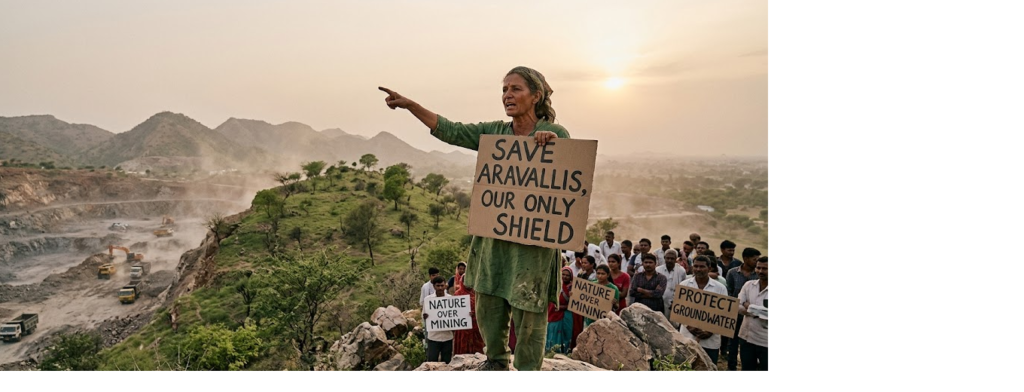
- Public and Stakeholder Consultation: Acknowledging that previous exercises lacked public input, the SC noted that valuable suggestions often come from citizens and affected communities. The committee is directed to devise a mechanism to hear diverse stakeholders.
- Direct Court Supervision: The experts will work “under the umbrella” of the Supreme Court, ensuring independent and transparent functioning.
Background: The “100-Metre” Definition Controversy
- November 2025 Judgment: The SC previously accepted a uniform definition proposed by a government committee. It defined an “Aravalli Hill” as any landform rising 100 metres or more above local relief, and an “Aravalli Range” as a cluster of such hills within 500 metres of each other.
- Ecological Concerns: Environmentalists warned that this strict threshold would exclude vast portions of the ecosystem. In Rajasthan alone, only 1,048 out of 12,081 hills met the 100-metre criteria. This would strip lower ridges, valleys, and foothills of environmental protection, exposing them to aggressive unregulated mining and urbanization.
- Judicial Freeze (December 2025): Taking suo motu cognizance of the public furore and recognizing the “significant regulatory lacuna,” the SC stayed its own November judgment. It halted all fresh mining leases across the region and ordered the formation of a new expert committee to resolve these critical ambiguities.
Significance of the Aravalli Range
- Geological Antiquity: It is the oldest fold mountain system in India, stretching approximately 800 km across Gujarat, Rajasthan, Haryana, and Delhi.
- Ecological Barrier: It acts as a crucial physical barrier, checking the eastward expansion of the Thar Desert into the fertile plains of the Ganga-Yamuna basin.
- Climate & Air Quality: The range plays a vital role in regulating the climate of northwest India, controlling sand and dust storms, and functioning as the “green lungs” for the heavily polluted Delhi-NCR region.
- Biodiversity & Water Security: It serves as a critical groundwater recharge zone and a habitat for rich biodiversity, acting as a wildlife corridor linking various protected areas.
Concerns Related To Conservation Of Aravalli Range
- Rampant Illegal Mining:
- Despite repeated judicial interventions and bans, the illegal extraction of stones, sand, and commercially valuable minerals (such as marble, zinc, and copper) continues.
- This unchecked quarrying has led to the complete flattening of several hillocks, irreversibly altering the region’s topography and natural drainage.
- Accelerated Desertification:
- The Aravalli Range acts as a critical natural barrier, checking the eastward expansion of the Thar Desert into the fertile Indo-Gangetic plains.
- Deforestation and mining create physical “gaps” in the mountain wall, allowing desert sand to drift, which intensifies dust storms and aridity across Delhi-NCR and Haryana.
- Depletion of Groundwater Reserves:
- The lower slopes, valleys, and foothills serve as indispensable percolation zones for groundwater recharge.
- Destruction of these zones, combined with deep mining, severely compromises the water security of water-stressed states and threatens the catchment areas of rivers like the Luni, Banas, and Sabarmati.
- Loss of Ecological Continuity and Biodiversity:
- Treating the Aravallis as fragmented peaks rather than a “single living ecosystem” ignores the reality of continuous wildlife corridors.
- Rampant real estate development and mining fragment these habitats, threatening biodiversity in protected areas like the Sariska Tiger Reserve and Asola Bhatti Wildlife Sanctuary.
- Enforcement Challenges and State Apathy:
- Fragmented policies and a lack of coordination across the four states (Gujarat, Rajasthan, Haryana, and Delhi) create regulatory arbitrage.
- Without comprehensive mapping and strict oversight, authorities struggle to prosecute the politically backed mining mafia.
Way Forward
- Holistic Ecological Definition:
- Adopt a landscape-level approach that recognizes the Aravallis as a continuous, unified ecological system.
- The legal definition must explicitly protect the entire structural integrity of the range, including supporting slopes, valleys, and connecting ridges, rather than relying on arbitrary elevation thresholds.
- Comprehensive Scientific Mapping:
- Undertake standardized, geo-referenced mapping of the entire region using drone surveys, GIS, and Survey of India toposheets.
- Clearly demarcate ecologically fragile regions into absolute “No-Go” inviolate zones.
- Management Plan for Sustainable Mining (MPSM):
- As directed by the Supreme Court, formulate a robust MPSM to regulate legal mining.
- Clearances must be based on scientific carrying-capacity studies and cumulative environmental impact assessments, strictly enforcing the “Polluter Pays” principle for ecological damage.
- Strict Enforcement and Technological Surveillance:
- Strengthen institutional coordination and deploy modern surveillance tools—such as satellite imagery, drones, night-vision cameras, and e-challans—to crack down on illegal sand and stone mafias.
- Ecosystem Restoration and Afforestation:
- Mandate the ecological restoration of abandoned, mined-out areas and degraded forests.
- Fast-track initiatives like the Aravalli Green Wall Project—which aims to create a 5 km green buffer around the hill range—to stabilize soil, control wind erosion, and combat desertification.
- Inclusive Stakeholder Consultation:
- Following the Supreme Court’s May 2026 directives, democratize the conservation process. Ensure that the expert committees actively consult environmentalists, indigenous tribal communities (like the Bhils and Meenas), and the general public to build a transparent and sustainable roadmap.
PRELIMS PRACTICE QUESTION
Q. Consider the following statements regarding the Aravalli Range:
- It is one of the oldest block mountain systems in the world, spanning across Gujarat, Rajasthan, Haryana, and Punjab.
- The Guru Shikhar peak is the highest point of the Aravalli range.
- Defining the Aravalli hills strictly by a 100-metre elevation threshold has been criticized for excluding a significant portion of the lower ranges from environmental protection.
Which of the statements given above is/are correct?
(a) 1 and 2 only
(b) 2 and 3 only
(c) 3 only
(d) 1, 2, and 3
Answer: (b)
Explanation:
- Statement 1 is incorrect: The Aravalli is one of the oldest fold mountain systems, not block mountains. Additionally, it spans Gujarat, Rajasthan, Haryana, and Delhi, but not Punjab.
- Statement 2 is correct: Guru Shikhar (1,722 m) in Mount Abu, Rajasthan, is the highest peak of the Aravallis.
- Statement 3 is correct: Environmentalists and the Supreme Court noted that applying a strict 100-metre elevation threshold would strip protection from over 90% of the hills, exposing them to unregulated mining.
MAINS PRACTICE QUESTION
Q. The Aravalli range is often described as the ecological shield of North-Western India. Discuss the ecological significance of the Aravallis and critically examine the challenges in regulating mining activities in this region in light of recent Supreme Court interventions. (15 Marks, 250 Words)
Approach to the Answer:
- Introduction: Introduce the Aravalli range as India’s oldest fold mountain system and highlight its geographical spread.
- Body Part 1 (Ecological Significance): Discuss its role as a barrier against desertification, a vital groundwater recharge zone, a regulator of regional climate (the “green lungs” for Delhi-NCR), and a rich biodiversity corridor.
- Body Part 2 (Challenges in Regulating Mining): Explain the tension between economic demands for construction materials and ecological conservation. Detail the definitional ambiguities (the 100-metre threshold controversy), the menace of illegal mining, and how excluding lower hillocks threatens the entire contiguous ecosystem.
- Body Part 3 (Supreme Court Interventions): Mention the SC’s proactive role—the stay on the restrictive November 2025 definition, the judicial freeze on new mining leases, and the formation of a multidisciplinary expert committee emphasizing public and stakeholder consultation.
- Conclusion: Conclude with the need for a comprehensive Management Plan for Sustainable Mining (MPSM) that integrates scientific mapping, ecological carrying capacity, and inclusive policy-making to safeguard this critical mountain system.