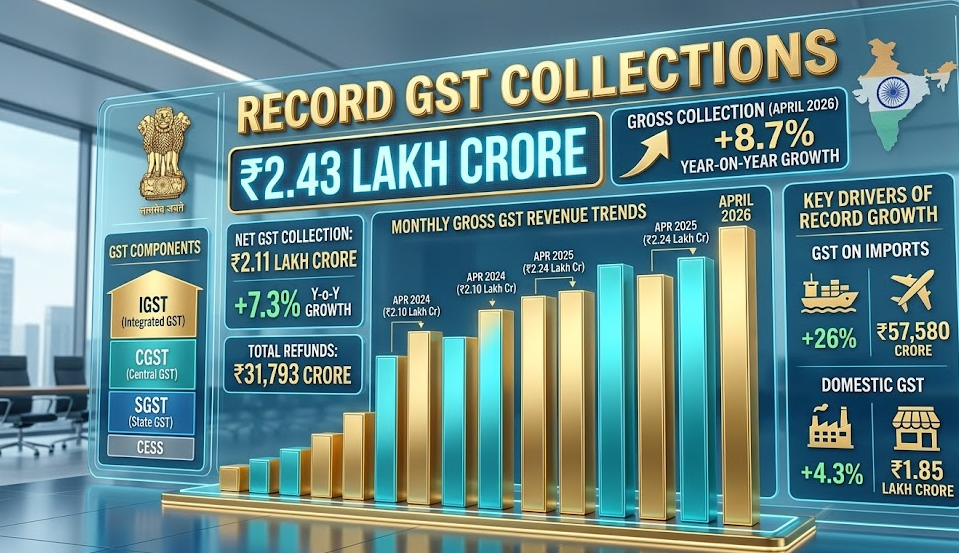
India’s Goods and Services Tax (GST) revenue hit an all-time high of ₹2.43 lakh crore in April 2026, marking an 8.7% year-on-year growth despite global geopolitical headwinds and the West Asia crisis.
Key Points
- Record-Breaking Milestone: The record GST collection of ₹2.43 lakh crore is the highest ever since the inception of the GST regime in 2017, surpassing all previous monthly records.
- Import-Led Growth: The growth was heavily skewed toward imports, which surged by 26% (₹57,580 crore), while domestic transactions grew at a more modest pace of 4.3% (₹1.85 lakh crore).
- Net vs. Gross Revenue: While the gross collection was ₹2.43 lakh crore, the net collection (after accounting for refunds) stood at ₹2.11 lakh crore, showing a 7.3% growth over the previous year.
- Consumption Softness: Analysts suggest that the slower growth in domestic GST (4.3%) indicates a “softness” in domestic consumption and a moderation in discretionary spending due to global uncertainties.
- Resilience of GST 2.0: Despite the domestic slowdown, the steady performance of domestic revenues suggests that “GST 2.0” measures—such as rate rationalization and simplification—are supporting the tax base without erosion.
The “K-Shaped” Consumption Recovery
The divergence between record GST (driven by imports) and “soft” domestic consumption (only 4.3% growth) points to a K-shaped recovery.
- A K-shaped recovery occurs when different sections of the economy recover at different rates, times, or magnitudes following a recession or crisis.
- In the context of 2026, we see a stark divergence between “India” (urban, affluent) and “Bharat” (rural, low-income).
- High-end, premium imports (luxury cars, electronics) are booming, while rural and lower-middle-class discretionary spending is moderated by inflation. This reflects increasing income inequality.
- The Divergence: The upper arm of the ‘K’ represents those whose incomes remained stable or grew (IT professionals, formal sector, stock market investors). Their demand for luxury imports and high-end services is driving the 26% growth in Import GST.
- The Lower Arm: The lower arm represents daily wage earners, MSMEs, and rural households hit by high food and fuel inflation. Their “softness” in consumption is why domestic GST growth is lagging at 4.3%.
“GST 2.0” and Cooperative Federalism
“GST 2.0” refers to the second phase of the GST regime, moving beyond initial implementation hurdles toward deep structural efficiency and trust-based compliance.
- The GST Council as a Model: It remains the only constitutional body (Article 279A) where the Centre and States deliberate on equal footing. It is the “Parliament of Indian Fiscal Federalism.”
- Key Shifts in GST 2.0:
- Rate Rationalization: Moving toward a simplified 3-tier structure (instead of 4-5 tiers) to reduce classification disputes.
- Tech-Led Enforcement: Using AI/ML for “Deep Data Analytics” to catch tax evaders without “Tax Terrorism” (harassment of honest taxpayers).
- End of Compensation: With the GST compensation period over, states must now rely on their own efficiency and the growth of the tax base, leading to the “Revenue Deficit” warnings issued by the Finance Ministry.
Causes of the Price/Revenue Increase
- Year-End Financial Push: The typical seasonal spike as businesses close their books for the financial year (FY26) and ensure all pending tax liabilities are cleared.
- High Import Value: The significant jump in revenue from imports (Integrated GST) reflects either an increase in the volume of high-value goods entering India or a rise in the value of imports due to currency depreciation and global price hikes.
- Efficiency in Tax Administration: Measures under the GST 2.0 framework, including better data analytics and anti-evasion drives, have helped stabilize and improve the collection norm to a 7-8% monthly growth rate.
- The “March Effect”: Tax experts attribute the high April numbers to activity in March, where both the industry and tax administration make a final push to meet year-end financial targets.
Effect on the Indian Economy and People
- Economic Stability: Record revenues provide the government with a fiscal cushion to manage the budget deficit and fund welfare schemes despite the increased cost of energy imports.
- Indicator of Cautious Spending: For the common man, the data suggests a trend of reduced discretionary spending (non-essential items like luxury goods, electronics, etc.), as people prioritize essentials amidst high inflation and West Asia-related uncertainty.
- Business Environment: While simplification measures are helping, the slower domestic growth may prompt industries to seek further rate rationalization to stimulate demand.
Explanation of Relevant Terms
1. GST (Gross vs. Net)
- Gross GST: The total tax collected by the government before any refunds are issued to exporters or businesses that overpaid.
- Net GST: The actual amount remaining in the government’s exchequer after all valid tax refunds are deducted.
2. Import GST (IGST on Imports)
- Under the GST regime, an Integrated GST (IGST) is levied on the import of goods and services.
- It is equivalent to the domestic GST rate and is collected by the Customs Department.
- The high tax revenue from imports points toward supply chain normalization and resilient external demand linkages within the Indian economy.
UPSC Practice Questions
Prelims (PT) Question
Q. With reference to the GST collections in India, consider the following statements:
- The GST revenue from domestic sales has consistently outpaced the revenue from imports in the last two fiscal years.
- Net GST collection is always higher than Gross GST collection due to interest and penalties.
- April typically records higher GST collections than other months due to financial year-end targets.
Which of the statements given above is/are correct?
A) 3 only
B) 1 and 3 only
C) 2 and 3 only
D) 1, 2, and 3
Answer: A) 3 only
Explanation: Statement 1 is incorrect as current data shows imports are outpacing domestic growth. Statement 2 is incorrect because Net is always lower than Gross after refunds.
Mains Question
Q. “While record GST collections indicate a resilient tax administration, the divergence between import-led growth and domestic consumption presents a complex challenge for India’s internal economy.” Critically analyze. (250 words)