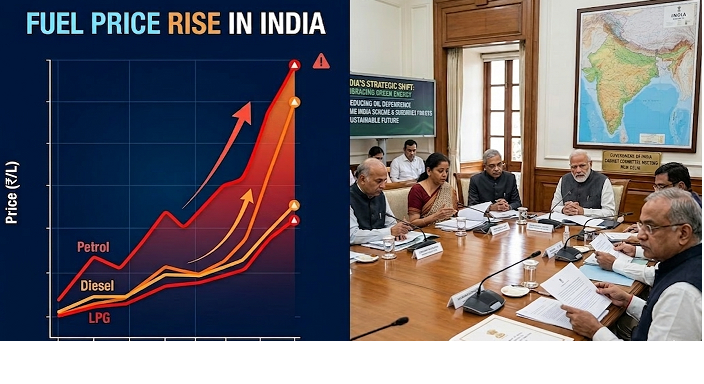
In May 2026, Indian Oil Marketing Companies (OMCs) implemented a record hike in commercial LPG and bulk diesel prices, while the Finance Ministry simultaneously reduced export duties on fuel to balance domestic supply with export earnings.
Key Points
- Commercial LPG Shock: Oil Marketing Companies (OMCs) have raised the price of 19-kg commercial LPG cylinders by ₹993. This is considered as fuel price shock for customers as in Delhi, prices have breached the ₹3,000 mark for the first time.
- Impact on Migrants: The price of 5-kg Free Trade LPG (FTL was hiked by ₹261. This specifically affects migrant populations and gig-economy workers who lack permanent address proof for regular connections.
- Bulk Diesel Surge: Prices for bulk diesel users (like industries and bus fleets) were raised from ₹137 to ₹149 per litre, a significant increase that will likely have a cascading effect on logistics costs.
- Export Duty Recalibration: In a major policy shift, the Finance Ministry reduced the Special Additional Excise Duty (SAED) on diesel exports to ₹23/litre (from ₹55.5) and ATF to ₹33/litre (from ₹42).
- Aviation Struggles: While domestic ATF prices were held steady after a 9% hike in April, international ATF prices were hiked by $76.55 per kilolitre, increasing the operational costs for international carriers.
Causes of the Price Increase
- Geopolitical Conflict: The ongoing war involving the U.S., Israel, and Iran has destabilized the primary oil-producing region in the world and created fuel price shock.
- Supply Chain Chokepoint: The closure of the Strait of Hormuz by Iran has halted the transit of nearly 20% of global oil and 90% of India’s LPG imports, creating a severe supply-side shock.
- Crude Price Surge: International benchmark Brent crude has soared to $126 per barrel, significantly higher than the levels budgeted for by the Indian government.
- Currency Weakness: The Rupee has depreciated to record lows (around ₹92.50/$). Since India imports 85% of its oil, a weaker currency makes every imported barrel more expensive in domestic terms.
Effect on the Indian Economy
- Current Account Deficit (CAD): The massive oil import bill is widening the CAD, putting the Indian economy’s external stability at risk.
- Foreign Capital Flight: The “Risk-Off” sentiment caused by high oil prices has led to FPIs selling over ₹60,000 crore in Indian equities as of April 2026.
- Fiscal Deficit Stress: While the government has kept retail prices steady, the potential for increased subsidies or further duty cuts (like the SAED reduction) creates pressure on the fiscal deficit targets.
- Industrial Input Costs: The ₹12/litre hike in bulk diesel raises operational costs for railways, state transport buses, and the manufacturing sector, potentially slowing down industrial growth.
Effect on the People
- “Menu Inflation”: The ₹993 hike in commercial LPG is being directly passed on by restaurants and hotels to customers, making eating out and food delivery significantly more expensive.
- Impact on Migrants: The ₹261 hike in 5-kg FTL (Free Trade LPG) cylinders hits the urban poor and migrant workers hardest, as they rely on these smaller, address-proof-free connections for daily cooking.
- Logistics & Essentials: Higher bulk diesel costs eventually filter down into the transport costs for fruits, vegetables, and milk, leading to “indirect inflation” in essential commodities for the common man.
Explanation of Relevant Terms
| Term | Definition & Context |
| OMC | Oil Marketing Companies (e.g., IOCL, BPCL, HPCL). They are state-owned entities that buy crude and sell refined products to the public. |
| SAED | Special Additional Excise Duty. Often referred to as a Windfall Tax, this is an additional tax imposed by the government on companies that are gaining excessive profits due to favorable external conditions (like high global oil prices). Reducing it encourages exports, while increasing it ensures fuel stays within the domestic market. |
| ATF | Aviation Turbine Fuel. Specialized fuel used to power aircraft. Price relief on domestic ATF is crucial for the survival of Indian airlines. |
| FPI | Foreign Portfolio Investment. “Hot money” invested by foreign entities in Indian stocks/bonds. Large outflows (as seen in 2026) crash markets and weaken the Rupee. |
| FII | Foreign Institutional Investor. Large institutions like hedge funds or pension funds that drive the bulk of foreign capital movement in India. |
| Excise Duty | An indirect tax levied on the production or sale of specific goods (like fuel). It is a major source of revenue for the Central Government. |
UPSC Practice Questions
1. Prelims (PT) Question
Q. With reference to the “Special Additional Excise Duty (SAED)” often seen in the news, consider the following statements:
- It is a tax levied on the “windfall profits” earned by domestic oil producers and exporters.
- The primary objective of adjusting SAED is to ensure the availability of fuel in the domestic market during global supply disruptions.
- The power to increase or decrease SAED lies with the Securities and Exchange Board of India (SEBI).
Which of the statements given above are correct?
A) 1 and 2 only
B) 2 and 3 only
C) 1 and 3 only
D) 1, 2, and 3
Answer: A) 1 and 2 only
Explanation: Statement 3 is incorrect because the Ministry of Finance (specifically the Department of Revenue), not SEBI, manages excise duties.
2. Mains Question
Q. “India’s energy security is increasingly hostage to the geopolitical volatility of the Persian Gulf.” Critically analyze the impact of the 2026 West Asia crisis on India’s macroeconomic stability, with specific reference to the ‘Twin Deficit’ challenge. (250 words)