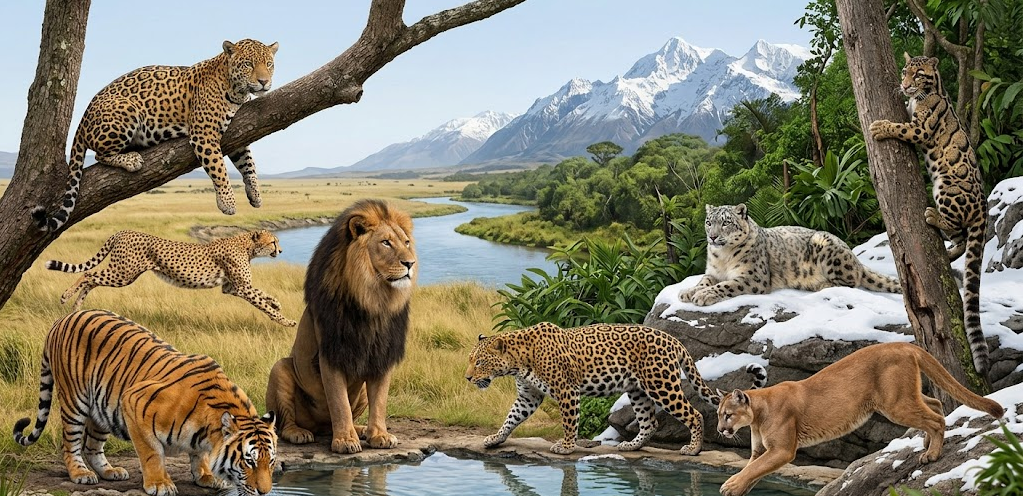
The inaugural International Big Cat Alliance (IBCA) Summit is scheduled to be held in New Delhi from June 1 to 3, 2026. The summit is expected to adopt the ‘Delhi Declaration’, the first-ever global charter specifically dedicated to the conservation of the world’s seven major big cat species.
What is the International Big Cat Alliance (IBCA)?
- Genesis: Conceived and piloted by India. It was officially launched by Prime Minister Narendra Modi in April 2023 to mark the 50th anniversary of Project Tiger.
- Objective: To create a global platform for the protection and conservation of seven big cat species and their habitats through collective action, research, and financial cooperation.
- Membership: Open to 97 “range” countries (countries that host these cats) as well as non-range countries, intergovernmental organizations, and scientific bodies.
- Theme: “Save big cats, save humanity, save ecosystem.”
The Seven Big Cats under IBCA
The alliance focuses on the following seven species. It is important to note that India is the only country in the world to have five of these seven in the wild (excluding Jaguars and Pumas).
| Big Cat | Primary Habitat/Range | IUCN Status (General) |
| Tiger | Asia (India holds ~75% of global population) | Endangered |
| Lion | Africa; Gir Forest in India (Asiatic Lion) | Vulnerable |
| Leopard | Africa and Asia | Vulnerable |
| Snow Leopard | Central and South Asian mountains | Vulnerable |
| Cheetah | Africa; Reintroduced in India (Kuno National Park) | Vulnerable |
| Jaguar | Americas (North & South) | Near Threatened |
| Puma (Cougar) | Americas (North & South) | Least Concern |
Key Focus of the ‘Delhi Declaration’
The summit’s primary output, the Delhi Declaration, will emphasize:
- Landscape-based Approach: Shifting from isolated “protected areas” to conserving large, contiguous landscapes and migratory corridors.
- Transboundary Cooperation: Coordinating conservation efforts between countries where big cat habitats cross national borders (e.g., Sundarbans between India and Bangladesh).
- Knowledge Sharing: Pooling scientific research, technical expertise, and anti-poaching strategies.
- Financial Mechanisms: Mobilizing resources from multilateral agencies, financial institutions, and corporate leaders to support range countries with limited budgets.
Significance for India’s Conservation Diplomacy
- Global Leadership: By spearheading IBCA, India is positioning itself as a global leader in wildlife conservation, moving from “Project Tiger” success to a “Global Big Cat” guardian.
- South-South Cooperation: Providing a template for other developing nations in Africa and SE Asia to replicate India’s community-based conservation models.
- Ecosystem Services: The alliance highlights that big cats are “Umbrella Species”—by saving them, we protect vast forests and water sources that are critical for human survival and climate mitigation.
UPSC Practice Questions
Preliminary Examination (PT)
Q1. Consider the following statements regarding the International Big Cat Alliance (IBCA):
- It was launched by India to commemorate the golden jubilee of Project Tiger.
- The alliance aims to conserve all seven major big cat species, including those not found in India.
- The IBCA Secretariat is permanently headquartered in Nairobi, Kenya.
Which of the statements given above is/are correct?
(a) 1 and 2 only
(b) 2 and 3 only
(c) 1 only
(d) 1, 2, and 3
Answer: (a) 1 and 2 only
Explanation: IBCA was launched in 2023 (50 years of Project Tiger). It covers all 7 cats. However, India has proposed to host the Secretariat in India, not Kenya.
Mains Examination
Q2. “The conservation of big cats is not merely a biological necessity but a foundational step towards ensuring global ecosystem stability.” Discuss the role of the International Big Cat Alliance (IBCA) in fostering conservation diplomacy. (15 Marks, 250 Words)
Model Structure:
- Introduction: Mention the launch of IBCA by India and the upcoming Delhi Declaration. Define big cats as “Apex Predators” and “Umbrella Species.”
- Body:
- Ecological Significance: Explain how big cat conservation protects biodiversity, carbon sinks, and water catchments (linking to the theme: Save Big Cats, Save Humanity).
- The Diplomacy Aspect: Discuss how India is using its “Tiger Success” to lead 95+ nations, promoting transboundary cooperation and knowledge exchange.
- Financial & Technical Synergy: Role of the alliance in bridging the gap between resource-rich institutions and range-rich developing nations.
- Conclusion: Summarize that IBCA represents a shift from “national pride” to “global responsibility,” making wildlife conservation a core component of international relations.