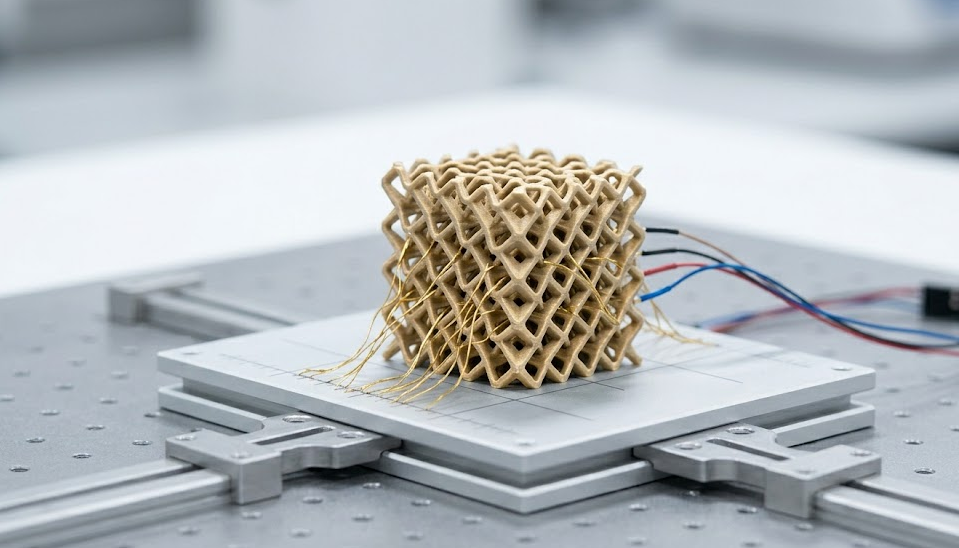
Recently, a study published in the journal Nature Physics revealed that researchers have developed a synthetic metamaterial capable of “physical learning.” Unlike traditional materials, this synthetic system can reorganise its internal mechanical properties in response to external conditions, mimicking biological adaptation.
What are Metamaterials?
- Definition: These are artificial materials engineered to have properties that are not found in naturally occurring materials.
- Key Characteristic: Their unique properties derive not from their chemical composition, but from their geometrically designed structure (the way they are physically arranged).
- Existing Applications: Bending light (cloaking devices), soundproofing, earthquake protection for buildings, and stealth technology (hiding objects from radar).
The Innovation: A Learning Robotic Chain
The research team built a metamaterial consisting of a chain of connected units, where each unit functions like a “mechanical neuron.”
| Component | Function |
| Microcontroller | Acts as the “brain” for local decision-making. |
| Angle Sensor | Detects external stress or displacement (environmental sensing). |
| Small Motor | Adjusts the stiffness (internal reorganization) of the unit. |
The Mechanism: Hardware-Based Contrastive Learning
The system uses a technique called Contrastive Learning, typically used in machine-learning algorithms, but implemented here entirely through hardware.
- Free State: The material is nudged, and it adopts a natural, unforced shape.
- Clamped State: The material is manually forced into a desired “target” shape (e.g., a ‘U’ or ‘L’ shape).
- The Contrast: The microcontroller compares the two states and calculates the difference in angles.
- Adaptation: The motor adjusts the stiffness so that the next time the material is nudged, it naturally moves closer to the target shape.
Key Scientific Breakthroughs
- Non-Reciprocity: Traditional physics suggests that if you push a spring, it pushes back (reciprocity). This material can “learn” to respond differently depending on which side it is nudged from, allowing it to navigate complex tasks like locomotion.
- Local Decision-Making: Unlike a central brain, each unit “talks” only to its immediate and next-nearest neighbors. This removes the need for complex, centralized data processing networks.
- Energy vs. Work: While a simple spring seeks the lowest energy state, this metamaterial seeks to minimize the work done by its internal motors to reach a stable state.
- Memory and Forgetting: The chain demonstrated the ability to learn a shape (like a letter), “forget” it, and learn a new one in sequence.
Potential Applications
- Soft Robotics: Robots that can agilely adapt to uneven terrain without complex central programming.
- Advanced Prosthetics: Artificial limbs that “learn” and adapt to the specific movements and environment of the user.
- Dynamic Infrastructure: Structures that can alter their rigidity to survive varying environmental stresses like wind or tremors.
How Physical Learning Works
The emerging framework for physical learning in metamaterials often involves several key principles:
- Embodied Sense-Compute-Actuate Cycle: Sensing, computing the required response, and actuating the change all occur locally and simultaneously within the material’s architecture.
- Decentralized Intelligence: The material is composed of numerous identical “unit cells” or nodes (e.g., motorised hinges, robotic links). Each node can only communicate and share information with its immediate neighbors, not a central controller.
- Learning Degrees of Freedom: The material possesses tunable internal parameters, such as the local stiffness of individual links or the preferred angle of hinges. These are analogous to the “weights” in a neural network.
- Local Learning Rules: Each unit cell follows a simple, predetermined mathematical rule to update its own learning degrees of freedom based only on its internal state and information from its direct neighbors.
PRACTICE QUESTIONS
Q1. With reference to “Metamaterials,” recently seen in the news, consider the following statements:
- Their properties are primarily determined by their chemical composition rather than their physical structure.
- They can be engineered to exhibit properties like negative refractive indices, which are not found in nature.
- They are being researched for applications in seismic protection and stealth technology.
Which of the statements given above is/are correct?
A) 1 and 2 only
B) 2 and 3 only
C) 1 and 3 only
D) 1, 2, and 3
Q2. The term “Contrastive Learning,” in the context of the recent Nature Physics study, refers to:
A) A method where a central AI brain controls all parts of a robot.
B) A process where a material adapts by comparing its current state with a desired target state.
C) A chemical process that changes the molecular weight of a polymer.
D) A technique used to increase the heat resistance of steel during forging.
ANSWERS AND EXPLANATIONS
Ans 1: B (2 and 3 only)
- Statement 1 is incorrect: The defining feature of metamaterials is that their properties come from their physical structure/arrangement, not just their chemistry.
- Statement 2 is correct: Metamaterials are famous for bending light or sound in “counterintuitive” ways.
- Statement 3 is correct: They are used in shielding buildings and radar-hiding technology.
Ans 2: B
- Explanation: As described in the study, “physical” contrastive learning involves the microcontroller comparing the “free state” and “clamped state” to adjust the physical stiffness of the material units.
MAINS PRACTICE QUESTION
“The development of materials capable of ‘physical learning’ blurs the traditional line between biological organisms and synthetic machines.” Discuss the significance of adaptive metamaterials in the future of soft robotics and disaster-resilient infrastructure. (250 words)