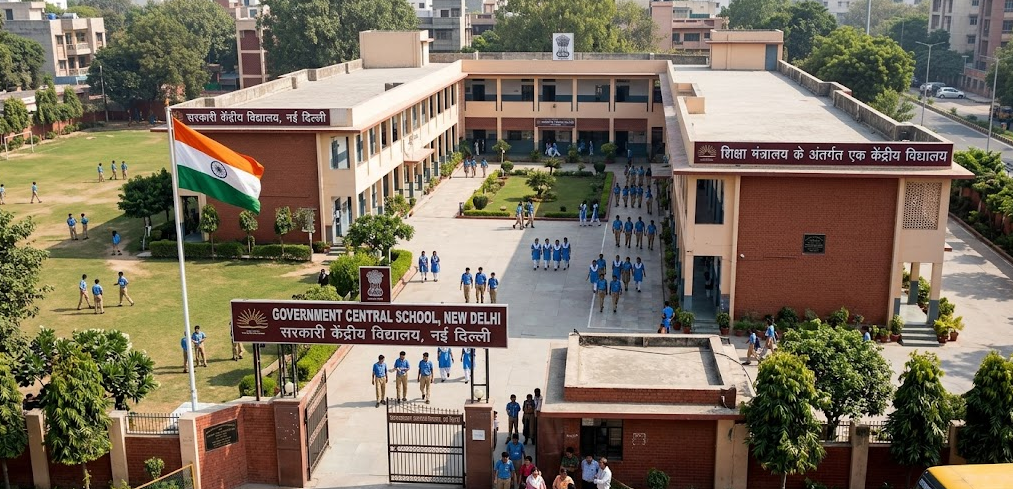
The Ministry of Education has issued comprehensive new guidelines mandating the formation of School Management Committees (SMCs) to decentralize school governance. These guidelines align with the National Education Policy (NEP) 2020 and supersede all previous instructions under the Right to Education (RTE) Act and the Samagra Shiksha Abhiyan.
Key Provisions of the New Guidelines
A. Unified Framework and Scope
- Extension to Higher Classes: The mandate for SMCs now covers all schools up to Class 12 (secondary and senior secondary institutions). Previously under the RTE Act, SMCs were primarily focused on elementary education (up to Class 8).
- Replacement of SMDCs: The new SMCs will replace the existing School Management Development Committees (SMDCs) to create a single, unified, and streamlined approach to school leadership.
- Timeframe: Every school must constitute its SMC within one month of the start of the academic year.
B. Democratic and Inclusive Composition
To ensure grassroots involvement and treat education as a “shared responsibility,” the SMC composition is strictly defined:
- Parents/Guardians: Must constitute 75% of the committee members.
- Women Representation: Must constitute at least 50% of the committee.
- Other Stakeholders (25%): Includes elected local officials, teachers, alumni, and local experts (e.g., Anganwadi workers, ASHA workers, and academicians).
- Social Inclusion: Proportionate representation is mandatory for Socio-Economically Disadvantaged Groups (SEDGs), including SC, ST, OBC, and Children with Special Needs (CwSN).
C. Enhanced Financial Autonomy and Operational Powers
The SMC is no longer just an advisory body; it holds significant executive power:
- Civil Works: Committees are authorized to independently execute school civil works costing up to ₹30 lakh.
- Public Tendering: For projects exceeding ₹30 lakh, SMCs will participate in the public tendering process (per CPWD/PWD manuals) to ensure transparency.
- Financial Oversight: Responsible for reviewing the school budget, preventing financial irregularities, and maintaining accurate records of receipts and expenditures.
D. Core Responsibilities
- Mainstreaming: Leading community drives to identify and bring out-of-school children back into the formal education system.
- Resource Distribution: Ensuring the timely and fair distribution of student entitlements, such as uniforms, textbooks, and scholarships.
Significance of the Move
- True Decentralization: Shifts power from state/district bureaucracies directly to the community, making governance bottom-up and context-specific.
- Transparency and Social Audit: With 75% parent representation and direct control over budgets, the SMCs act as an inbuilt mechanism for social audits, reducing fund leakage.
- Convergence of Services: Including Anganwadi and ASHA workers integrates early childhood care, health, and education at the school level.
Potential Challenges
- Capacity Deficit: Many parents, especially in rural or marginalized areas, may lack the financial literacy required to manage budgets up to ₹30 lakh or handle civil works.
- Elite Capture: There is a risk that influential individuals or local politicians within the 25% quota could dominate the decision-making process, overriding the voices of marginalized parents.
UPSC Practice Questions
PART 1: Preliminary Examination (Objective Type)
Q1. With reference to the new guidelines issued for School Management Committees (SMCs) by the Ministry of Education, consider the following statements:
- The mandate for forming SMCs is restricted only to elementary schools (up to Class 8) as per the Right to Education Act.
- At least 75% of the members of an SMC must be parents or guardians of the students.
- SMCs are authorized to execute all school civil works costing up to ₹30 lakh without undergoing the standard public tendering process.
Which of the statements given above are correct? (a) 1 and 2 only
(b) 2 and 3 only
(c) 1 and 3 only
(d) 1, 2, and 3
- Answer: (b) 2 and 3 only
- Explanation:
- Statement 1 is incorrect: The new guidelines explicitly state that the mandate extends to all schools, including secondary institutions up to Class 12, replacing the older SMDCs.
- Statement 2 is correct: The composition mandates 75% parents/guardians and 50% women.
- Statement 3 is correct: The committees hold financial power to execute civil works up to ₹30 lakh; beyond this amount, they must participate in the public tendering process.
PART 2: Mains Examination (Descriptive Type)
Q1. “Community participation is the bedrock of successful educational reforms.” Analyze how the new guidelines for School Management Committees (SMCs) under NEP 2020 aim to decentralize school governance and the potential challenges in their effective implementation. (15 Marks, 250 Words)
Model Structure for Answer:
- Introduction:
- Mention the Ministry of Education’s recent guidelines to revamp SMCs in alignment with NEP 2020.
- Define the core philosophy: treating education as a “shared responsibility” between the state and the community.
- Body Paragraph 1: Mechanisms of Decentralization:
- Structural: Unifying school leadership up to Class 12 (replacing SMDCs).
- Democratic: Mandating 75% parent representation, 50% women, and quotas for Socio-Economically Disadvantaged Groups (SEDGs).
- Financial: Empowering SMCs with executive financial control (handling civil works up to ₹30 lakh, budget reviews), moving away from mere advisory roles.
- Body Paragraph 2: Significance/Impact:
- Promotes transparency and facilitates localized social audits.
- Improves learning outcomes by keeping track of out-of-school children and ensuring the delivery of entitlements (scholarships, uniforms).
- Involves local experts (ASHA/Anganwadi), creating a holistic ecosystem of health and education.
- Body Paragraph 3: Challenges in Implementation:
- Lack of technical and financial capacity among parents to oversee civil works and maintain rigorous financial records.
- Risk of proxy representation or “elite capture” by local politicians/influential families.
- Apathy or lack of time among daily-wage-earning parents to participate actively.
- Conclusion:
- Conclude that structural empowerment must be followed by robust capacity-building and training programs for SMC members. Only an informed and trained committee can transform these guidelines from paper mandates to grassroots democratic governance.