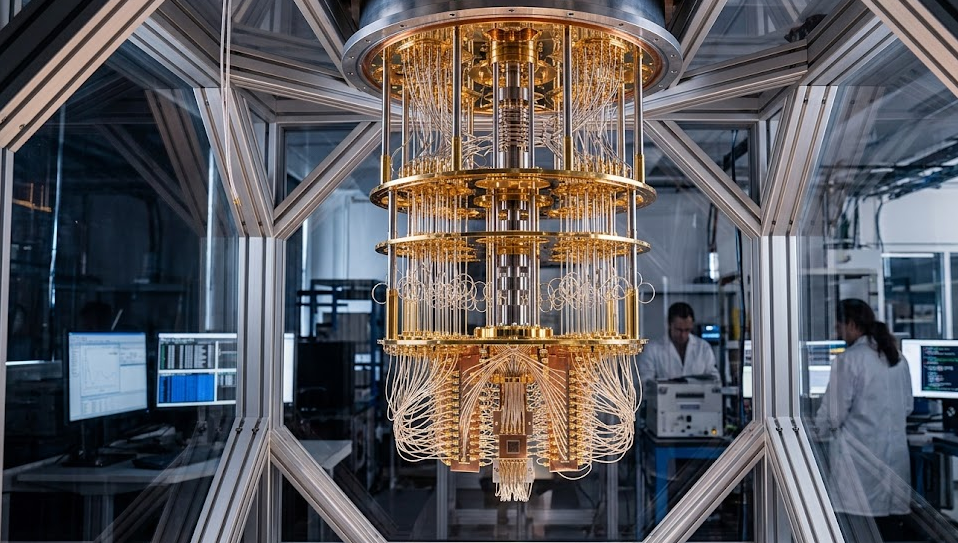
Recently, researchers from Google Quantum AI published a study in Physical Review X identifying a significant obstacle to the reliability of quantum computers: “Correlated Phase Error Bursts.” This discovery highlights a new type of systemic error triggered by background ionizing radiation.
Background: The Frontier of Quantum Computing
- Quantum computers represent the next frontier in technology, promising to solve complex calculations exponentially faster than “traditional” (classical) computers.
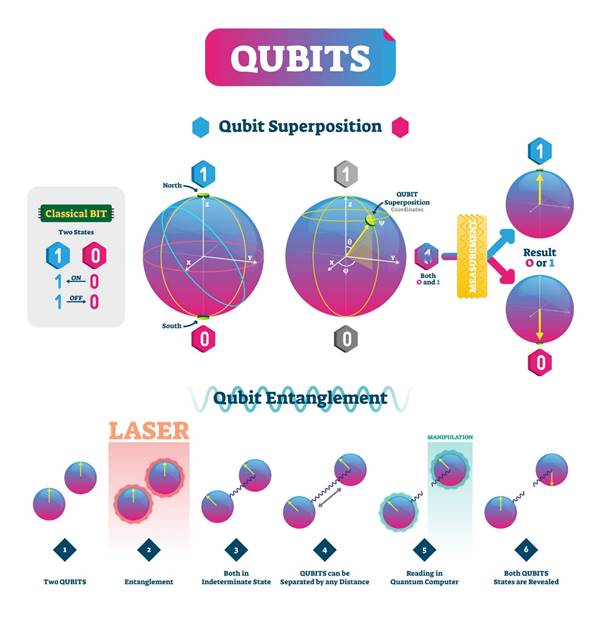
- Unlike classical bits (0 or 1), quantum computers use Qubits, which can exist in a superposition of states.
The “Ghost in the Machine”: Correlated Phase Error Bursts
The study identified a major vulnerability in superconducting quantum chips caused by ionizing radiation (from outer space or trace elements in the Earth’s crust).
- The Radiation Impact: When ionizing radiation strikes the silicon substrate of a quantum chip, it generates a “splash” of vibrations across the chip.
- The Generation of Quasiparticles: These vibrations break the pairs of electrons (Cooper pairs) that allow superconductors to function. This creates a swarm of quasiparticles—essentially electronic debris.
- The Failure of “Fences”: While scientists previously developed hardware “fences” to prevent these quasiparticles from physically entering sensitive qubit areas, the new study found that their mere presence is enough to cause damage.
- Frequency Shifting: The presence of quasiparticles near a qubit causes its frequency to shift (by as much as 3 MHz for a duration of 1 ms).
- Correlation Effect: Crucially, these shifts happen to many qubits simultaneously. In quantum computing, 1 ms is considered an “eternity,” during which massive data loss can occur.
Impact on Quantum Error Correction (QEC)
This discovery poses a fundamental threat to Quantum Error Correction, which is the “safety net” designed to keep quantum computers running even when individual qubits fail.
- The Assumption: QEC typically operates on the assumption that errors in different qubits are independent and random.
- The Reality: Correlated phase error bursts hit multiple qubits at once. Because the errors are “correlated” (linked together), the standard safety nets fail to catch them. This could set an upper limit on the reliability of current quantum architectures.
Potential Solutions
Researchers are exploring two primary methods to mitigate this:
- Quasiparticle Traps: Designing components that “absorb” the electronic static before it can influence the qubits.
- Damping Technologies: Using specialized materials or designs to dampen the “vibrational splash” caused by radiation hits.
What is a Quantum Computer?
A quantum computer is a device that performs calculations by exploiting the unique laws of quantum mechanics, such as superposition and entanglement. Unlike classical computers that process information in bits ($0$ or $1$), quantum computers use Quantum Bits (Qubits).
Key Concepts:
- Superposition: A qubit can exist in a state of 0, 1, or both simultaneously.
- Entanglement: A phenomenon where two qubits become linked, such that the state of one instantly influences the state of the other, regardless of the distance between them.
- Quantum Supremacy/Advantage: The point where a quantum computer can solve a problem that is practically impossible for the world’s most powerful supercomputer to solve in a reasonable timeframe.
Comparison: Classical vs. Quantum Computing
| Feature | Classical Computing | Quantum Computing |
| Basic Unit | Bit ($0$ or $1$) | Qubit ($0$, $1$, and Superposition) |
| Logic | Boolean Algebra | Quantum Mechanics |
| Power | Increases linearly with bits | Increases exponentially with qubits ($2^n$) |
| Environment | Operates at room temperature | Requires extreme cold (near Absolute Zero) |
Usage and Relevance
- Cryptography & Cyber Security:
- Threat: Quantum computers could potentially break current encryption standards (like RSA).
- Opportunity: Development of Post-Quantum Cryptography and Quantum Key Distribution (QKD) for unbreakable communication.
- Drug Discovery & Healthcare:
- Simulating molecular structures to discover new drugs and vaccines, a task too complex for classical computers.
- Material Science:
- Designing new materials with specific properties, such as high-temperature superconductors or more efficient battery chemistries.
- Financial Modeling:
- Optimizing investment portfolios and performing complex risk assessments in real-time.
- Climate Modeling:
- Simulating atmospheric conditions with high precision to predict climate change and improve weather forecasting.
Challenges Related to Adoption
- Quantum Decoherence: Qubits are extremely fragile. Interaction with the environment (heat, magnetic fields, vibrations) causes them to lose their quantum state, leading to errors.
- Error Rates (Noise): High error rates in qubits necessitate complex “error correction” protocols. Recent studies have also identified correlated phase error bursts caused by background radiation.
- Scalability: It is physically difficult to link thousands of qubits together while maintaining their stability (coherence).
- Extreme Operating Conditions: Most quantum processors require temperatures colder than outer space (approx. $0.015 \text{ Kelvin}$), requiring massive and expensive cryogenic infrastructure.
- Lack of Algorithms: Standard software cannot run on quantum hardware; we need a complete overhaul of algorithmic logic.
Potential Solutions
- Quantum Error Correction (QEC): Using “logical qubits” (clusters of multiple physical qubits) to store a single piece of information, allowing the system to detect and fix errors automatically.
- Improved Hardware Design:
- Quasiparticle Traps: Using specialized materials to “trap” electronic debris (quasiparticles) that cause qubit frequency shifts.
- Topological Qubits: A theoretical type of qubit (pursued by Microsoft) that is naturally more resistant to environmental noise.
- Hybrid Systems: Combining classical supercomputers with quantum processors (QPUs) to handle specific parts of a calculation, making the technology useful even before full-scale quantum computers exist.
- Radiation Shielding: Building quantum labs deep underground or using lead shielding to protect chips from cosmic rays and terrestrial radiation.
PRACTICE QUESTIONS
Q1. In the context of computer science, what is the primary difference between a ‘Classical Bit’ and a ‘Qubit’?
A) A qubit can only represent 0 or 1, whereas a bit can represent both simultaneously.
B) A qubit can exist in a superposition of states, while a bit is either 0 or 1.
C) Qubits are used only in mechanical computers, while bits are used in electronic ones.
D) Qubits require room temperature to operate, while bits require extreme cold.
Q2. With reference to the recently discovered “Correlated Phase Error Bursts,” consider the following statements:
- They are caused by vibrations triggered by ionizing radiation from space or the Earth’s crust.
- They result in the shifting of qubit frequencies, leading to a loss of coordination.
- Quantum Error Correction (QEC) is currently fully capable of fixing these correlated errors as they occur.
Which of the statements given above is/are correct?
A) 1 and 2 only
B) 2 and 3 only
C) 1 and 3 only
D) 1, 2, and 3
ANSWERS AND EXPLANATIONS
Ans 1: B
- Explanation: The fundamental property of a qubit is superposition, allowing it to represent multiple states at once, unlike a classical bit which is binary (0 or 1).
Ans 2: A (1 and 2 only)
- Statement 1 is correct: The study found that ionizing radiation creates vibrations in the chip substrate.
- Statement 2 is correct: These vibrations create quasiparticles that shift qubit frequencies.
- Statement 3 is incorrect: QEC relies on the assumption that errors are independent. Because these bursts are correlated (affecting many qubits at once), they bypass standard error-correction methods.
MAINS PRACTICE QUESTION
“While Quantum Computing offers the potential for unprecedented computational power, its extreme sensitivity to environmental factors remains a significant bottleneck.” Discuss the implications of background radiation on quantum stability and evaluate the importance of Quantum Error Correction in achieving a functional quantum computer. (250 words)