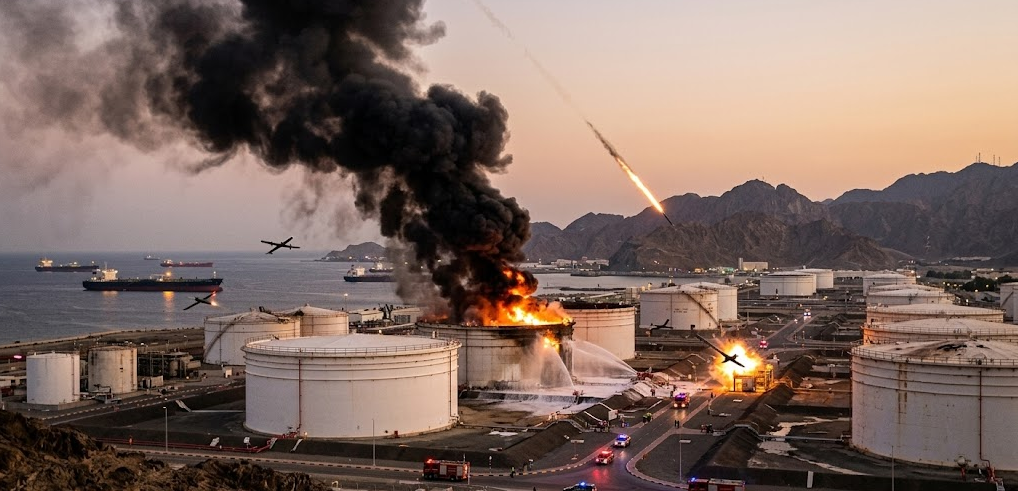
Following the drone and missile attacks on oil installations in Fujairah (UAE), Prime Minister Narendra Modi has issued a strong condemnation of the strikes. The incident, which resulted in injuries to three Indian nationals, marks a significant escalation in the ongoing West Asia conflict and has prompted a shift in India’s diplomatic tone.
Background: The 2026 West Asia Crisis
- The Outbreak: The conflict intensified on February 28, 2026, following military strikes by the U.S. and Israel.
- The Ceasefire: A temporary cessation of hostilities was achieved on April 8 through the “Islamabad Talks” in Pakistan.
- The Breach: The ceasefire was shattered on May 4 after the U.S. launched “Project Freedom” to forcibly open the Strait of Hormuz, which had been blockaded by Iran. This led to an “asymmetric” retaliatory strike by Iran on UAE infrastructure.
India’s Evolving Diplomatic Stance
Historically, India has maintained a policy of Strategic Autonomy, avoiding direct criticism of specific actors in West Asia. However, the Fujairah attack has led to a recalibration:
| Feature | Earlier Stance | Current Shift (May 2026) |
| Naming Actors | Avoided naming the U.S., Israel, or Iran. | Explicitly “strongly condemned” Iranian-led attacks on civilian hubs. |
| Red Lines | General calls for peace. | Injury to Indian nationals and targeting of civilian infrastructure acts as a “Red Line.” |
| Solidarity | Balanced relations with all sides. | Firm “solidarity” with the UAE, underscored by PM Modi’s upcoming visit on May 15. |
Strategic Importance of the Region to India
The instability in the Gulf directly impacts India’s national interests across three primary pillars:
- The Indian Diaspora:
- Approximately 10 million Indians live and work in the Gulf.
- UAE hosts the largest community (4.3 million), making up one-third of its population.
- Economic Remittances:
- The region contributes over $40 billion annually in remittances.
- UAE alone accounts for more than half of these inflows.
- Energy Security & Trade:
- Strait of Hormuz: A critical chokepoint for global oil; the blockade has caused oil prices to rise by over 60%.
- Fujairah: Vital as an oil export hub that allows for bypassing the Strait of Hormuz.
Geography in Focus: The Strait of Hormuz
- Location: Connects the Persian Gulf with the Gulf of Oman and the Arabian Sea.
- Significance: It is the world’s most important oil transit chokepoint.
- “Dual Blockade”: The current situation is described as a dual blockade, where the U.S. Navy blockades Iranian ports while Iran restricts transit through the Strait.
Key Concept: Asymmetric Warfare
Iran’s response to U.S./Israeli conventional strikes involves “asymmetric” tactics—using drones and missiles to target the civilian and energy infrastructure of regional allies (like the UAE) to increase the economic cost of the war for the international community.
Way Forward
- Dialogue and Diplomacy: India continues to advocate for a “peaceful resolution” through engagement rather than military escalation.
- Protection of Nationals: Strengthening the “Standard Operating Procedures” (SOPs) for the evacuation or safety of the 10 million-strong diaspora remains a priority.
- Energy Diversification: The 60% surge in oil prices necessitates India accelerating its transition to alternative energy and strengthening Strategic Petroleum Reserves (SPRs).
PRELIMS PRACTICE QUESTIONS (PT)
Q1. With reference to the geography of West Asia, consider the following statements:
- The Strait of Hormuz connects the Red Sea to the Gulf of Aden.
- Fujairah is a strategic port in the UAE that provides access to the Indian Ocean without passing through the Strait of Hormuz.
- The Persian Gulf is bordered by both Iran and Saudi Arabia.
Which of the statements given above is/are correct?
A) 1 and 2 only
B) 2 and 3 only
C) 1 and 3 only
D) 1, 2, and 3