Table of Contents
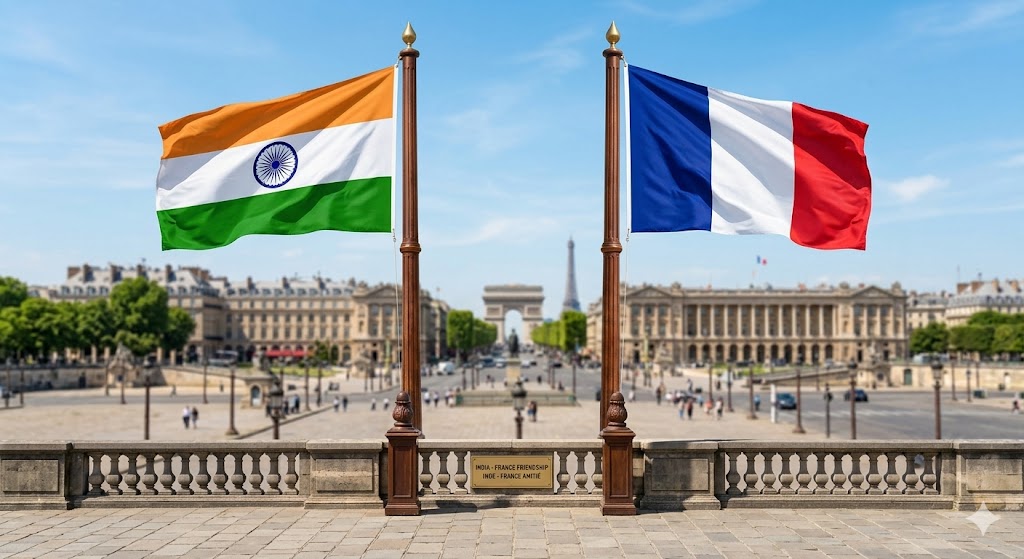
During recent bilateral talks in Nice (June 2026), Prime Minister Narendra Modi and French President Emmanuel Macron adopted the ‘Innovation Roadmap 2030’ and established a ‘Dialogue on Economic Security’. Earlier in 2026, the bilateral ties were officially elevated to the level of a ‘Special Global Strategic Partnership’.
Key Outcomes of the Recent Bilateral Meet
- Innovation Roadmap 2030: Adopted to provide long-term direction in deep-tech, semiconductors, and renewable energy. A Joint India-France AI Working Group was created to expand cooperation in Artificial Intelligence governance and research.
- Dialogue on Economic Security: Established to strengthen supply chain resilience, particularly focusing on critical minerals and cybersecurity, aiming to shield both economies from global geopolitical shocks.
- Trade and Investment Targets: The leaders agreed to set up a High-Level Mechanism to double bilateral trade in five years (from the current ~$16 billion). They also pushed for the early implementation of the newly signed India-EU Free Trade Agreement (FTA).
- Nuclear & Space Cooperation: Discussions highlighted the implications of India’s newly introduced SHANTI Act (legislation governing the nuclear sector), opening doors for French companies to participate directly or via joint ventures in building advanced Small Modular Reactors (SMRs). Collaboration in human spaceflight and private space sector expansion was also prioritized.
- People-to-People Ties & Digital Infrastructure: The expansion of India’s Unified Payments Interface (UPI) to Paris and Nice airports was highlighted. Furthermore, France fast-tracked visa-free transit for Indians, and PM Modi invited French universities to open campuses in India under the National Education Policy (NEP) 2020.
India-France Relationship: History
The India-France relationship is founded on shared democratic values, a belief in multipolarity, and mutual respect for strategic autonomy. France has consistently stood by India during critical international junctures, acting as a reliable Western ally.
Strategic Partnership Established: 1998
France became the first Western country with which India established a Strategic Partnership, recognizing India’s strategic autonomy post-Pokhran-II without imposing sanctions.
Civil Nuclear Agreement: 2008
France was the first country to sign a civil nuclear pact with India following the Nuclear Suppliers Group (NSG) waiver.
Horizon 2047 Roadmap: 2023
Both nations adopted the ‘Horizon 2047’ roadmap to chart the course of bilateral ties for the next 25 years, marking the upcoming centenary of India’s independence.
Special Global Strategic Partnership: 2026
The relationship was elevated to a ‘Special Global Strategic Partnership’, expanding the focus from traditional defence and space into deep-tech, AI, and economic security.
Significance of the Relationship
- Strategic Autonomy & Multipolarity: Both nations share a vision of a multipolar world, acting as a counterbalance to bipolar hegemonic structures. France vocally supports India’s bid for permanent membership in the UN Security Council.
- Defence and Security: France is a pivotal defence partner (supplying Scorpene submarines and Rafale jets) and actively supports India’s ‘Make in India’ initiative through technology transfers and the co-design of defence platforms.
- Indo-Pacific Stability: France, as a resident power in the Indo-Pacific (via territories like Reunion Island), collaborates closely with India to ensure maritime security, counter piracy, and maintain freedom of navigation.
- Climate Change Leadership: The joint launch of the International Solar Alliance (ISA) established both nations as frontrunners in global climate diplomacy.
Challenges
- Trade Deficit & Volume: Despite incredibly strong strategic ties, the bilateral trade volume remains relatively stagnant and heavily skewed, performing far below its actual potential compared to India’s trade with the US or Germany.
- Project Delays: Major collaborative projects, such as the Jaitapur Nuclear Power Plant in Maharashtra (planned for six EPR reactors by French giant EDF), have been stalled for over 15 years due to unresolved issues regarding civil liability, cost of power, and technological pricing.
- Geopolitical Divergences: While both nations respect each other’s autonomy, nuanced differences exist in their approaches to global crises. The diplomatic phrasing regarding conflicts in West Asia and Ukraine often requires careful circumspection to align both nations’ public stances.
Way Forward
To realize the full potential of the ‘Special Global Strategic Partnership’, both nations must transition from government-to-government (G2G) reliance to robust business-to-business (B2B) engagements.
- Fast-tracking Stalled Projects: Resolving the liability and cost-sharing bottlenecks in the Jaitapur nuclear project is critical to cementing long-term energy security cooperation.
- Leveraging the India-EU FTA: The rapid operationalization of the India-EU FTA will structurally remove non-tariff barriers, acting as the primary catalyst to double bilateral trade.
- Expanding the Tech Frontier: Execution of the ‘Innovation Roadmap 2030’ must be prioritized by facilitating easier cross-border investments for deep-tech startups and scaling up the joint AI working group’s deliverables.
UPSC Prelims Practice Question
Q. With reference to the bilateral relationship between India and France, consider the following statements:
- The ‘Innovation Roadmap 2030’ focuses exclusively on the co-production of conventional defence equipment and naval submarines.
- France was the first country to sign a civil nuclear agreement with India following the Nuclear Suppliers Group (NSG) waiver in 2008.
- The recently established ‘Dialogue on Economic Security’ between the two nations aims to strengthen supply chain resilience in critical minerals.
Which of the statements given above is/are correct?
(a) 1 and 2 only
(b) 2 and 3 only
(c) 1 and 3 only
(d) 1, 2 and 3
Correct Answer: (b)
- Statement 1 is incorrect: The ‘Innovation Roadmap 2030’ is primarily designed to deepen cooperation in critical and emerging technologies, artificial intelligence, startups, and innovation ecosystems, rather than conventional military hardware.
- Statement 2 is correct: France was indeed the first country to sign a civil nuclear pact with India in September 2008, recognizing India’s impeccable non-proliferation record.
- Statement 3 is correct: The Dialogue on Economic Security focuses on strategic sectors such as critical minerals, semiconductors, and cybersecurity to enhance economic resilience.
UPSC Mains Practice Question
Q. “The elevation of the India-France relationship to a ‘Special Global Strategic Partnership’ reflects a shift from traditional defence collaboration to deep-tech and economic security.” Analyze this statement in the context of the recent bilateral outcomes like the Innovation Roadmap 2030. (150 words, 10 marks)
Brief Approach for Mains:
- Introduction: Briefly mention the historical foundation of the India-France relationship (1998 strategic partnership) and state the recent elevation to a ‘Special Global Strategic Partnership’ in 2026.
- Traditional Pillars: Briefly acknowledge that defence (Rafale, Scorpene) and space (ISRO-CNES) have historically anchored the ties.
- The Shift to Deep-Tech & Economic Security:
- Innovation Roadmap 2030: Establishment of the Joint AI Working group, startup incubation (Bharat Innovates), and digital public infrastructure export (UPI in Europe).
- Dialogue on Economic Security: Moving beyond military security to protect supply chains, secure critical minerals, and safeguard data in an increasingly volatile global market.
- Nuclear Innovation: Shift from just large-scale traditional reactors to potential collaboration on Small Modular Reactors (SMRs) enabled by India’s SHANTI Act.
- Conclusion: Conclude that this diversification ensures the partnership remains resilient and highly relevant in an era dominated by geoeconomics and the Fourth Industrial Revolution.