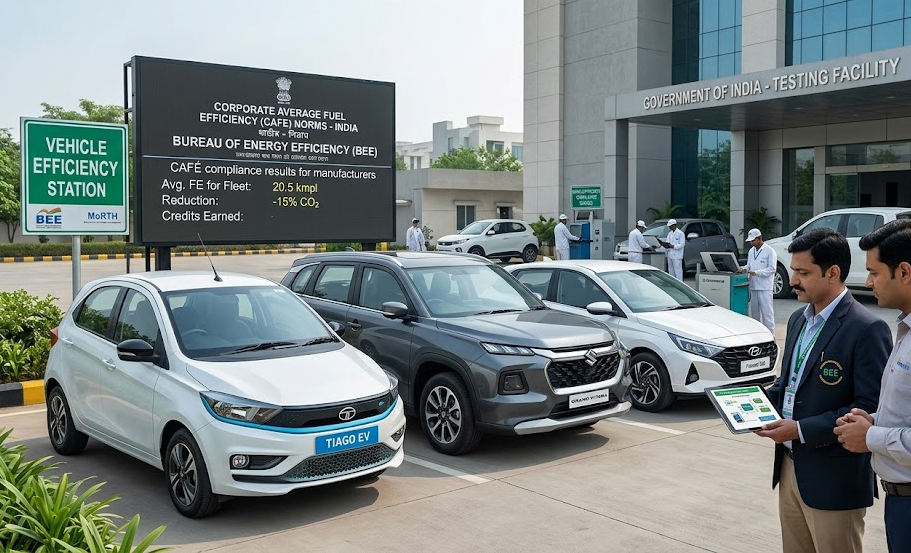
Recently Ministry of Power circulated the Draft Corporate Average Fuel Economy 2027 Norms (CAFE-III) for stakeholder consultation. The norms are proposed to be applicable to M1 category passenger vehicles manufactured or imported for sale in India during 2027-28 to 2031-32.
The Corporate Average Fuel Efficiency (CAFE) III has brought by ministry at a time when the global automobile industry transitions from Internal Combustion Engines (ICE) to electrified powertrains. The final framework will dictate India’s technology choices, investment trajectory, and energy security for decades.
Understanding CAFE Norms
Definition: CAFE norms set annual sales-weighted average fuel-efficiency targets for a manufacturer’s entire passenger vehicle fleet, rather than for individual models.
They are regulatory standards imposed on automobile manufacturers to lower the average fuel consumption and reduce carbon dioxide ( ) emissions of their passenger vehicle fleets.
Fleet-Wide Average: Unlike standard emission regulations (like BS-VI or Euro 6) that apply to each individual vehicle model, CAFE norms apply to an automaker’s entire fleet of vehicles sold within a fiscal year, weighted by sales volume.
Balancing Portfolio: If a manufacturer sells heavy, fuel-inefficient models (such as large SUVs), it must offset those emissions by selling sufficient numbers of highly fuel-efficient or zero-emission vehicles (such as EVs, hybrids, or compact cars) to stay within the overall target limit.
Target: Aims to reduce average emissions from approximately 113 gCO2/km to 77 gCO2/km by FY2031-32.
Removal of Exemptions: An earlier proposal exempting lighter small cars from full stringency has been removed.
Primary Objectives
Energy Security: Reduces overall crude oil consumption, helping countries curb expensive fuel imports and protect their economies from global oil price shocks.
Environmental Impact: Directly targets  emissions—a major driver of climate change—rather than just local air pollutants.
Accelerating Innovation: Compels automakers to shift investment toward clean technologies, including Battery Electric Vehicles (BEVs), Strong Hybrids, and Flex-Fuel powertrains.
CAFE Norms in India
In India, CAFE standards are overseen by the Ministry of Power (via the Bureau of Energy Efficiency – BEE) and implemented by the Ministry of Road Transport and Highways (MoRTH).
CAFE I (2017–2022): Set initial fuel-consumption targets across manufacturers’ fleets.
CAFE II (Enforced April 2022): Tightened target average fleet emissions down to approximately 113 g /km.
CAFE III (Proposed): Aims to further lower target fleet emissions down to 77 g /km by FY 2031–32.
Penalties: Under the Energy Conservation Act, vehicle manufacturers that fail to meet these fleet average targets face severe financial penalties per non-compliant vehicle sold.
Global Precedent
1975 (USA): CAFE standards were first introduced in the United States following the 1973 Arab oil embargo to protect consumers from soaring fuel prices and improve energy independence.
1990s–Present: The focus shifted globally to climate change. Major markets including the European Union, Japan, and India adopted similar fleet-wide efficiency targets.
China: China transitioned from basic CAFC standards to a stringent Dual Credit System.
Automakers must meet both fuel consumption standards and New Energy Vehicle (NEV) credit requirements.
Failing NEV targets forces companies (even those with efficient ICE cars) to buy credits from EV makers, driving massive EV adoption (55% EV sales share projected for 2025).
Concerns
Carbon Neutrality Factor: Offers compliance benefits for vehicles compatible with higher ethanol blends. Issue: The government’s long-term policy beyond E20 blending is uncertain, and ethanol has lower energy density (lower mileage) than petrol.
Super Credits: Clean tech (Battery EVs, Plug-in Hybrids, Strong Hybrids, Flex-fuel) gets additional weight in fleet calculations. Issue: This means fewer actual low-emission vehicles need to be sold to offset highly polluting models. Strong hybrids get super-credits despite relying primarily on ICEs.
Trading and Buying Credits: Allows underperforming manufacturers to buy credits from outperforming ones. Issue: The draft allows companies to buy credits directly from the Bureau of Energy Efficiency (BEE) at fixed prices (₹2,500/gCO2/km in FY2028), making BEE a seller of last resort. This price is less than half the penalty threshold prescribed by the Energy Conservation Act, allowing laggards an easy “buyout” instead of upgrading technology.
Block Assessments: Compliance is assessed over multi-year blocks (three-year, then two-year) rather than annually, allowing companies to offset poor performance in one year with another.
Macroeconomic & Strategic Implications
Underwhelming Ambition: Automakers have already voluntarily committed to an average of 20% EV share by 2030.
The CAFE III regulation effectively aims for less than what the industry is already prepared to do.
Energy Security: India’s heavy reliance on imported crude exposes the economy to geopolitical shocks, imported inflation, and currency depreciation.
Strong CAFE norms are not just environmental rules; they are crucial industrial and macroeconomic policies.
Missed Opportunity: Regulation should shape markets (as seen with the rapid adoption of CNG when policy aligned), not merely accommodate them.
UPSC Prelims Practice Question
Question: With reference to the proposed Corporate Average Fuel Efficiency (CAFE) III norms in India, consider the following statements:
1. CAFE norms set fuel-efficiency targets for each individual vehicle model produced by a manufacturer, rather than the fleet average.
2. Under the proposed CAFE III framework, manufacturers can buy compliance credits directly from the Bureau of Energy Efficiency (BEE) at administratively fixed prices.
3. The CAFE III framework provides “Super Credits” only to fully Battery Electric Vehicles (BEVs), excluding hybrid vehicles from this benefit.
Which of the statements given above is/are correct?
(a) 1 and 2 only
(b) 2 only
(c) 2 and 3 only
(d) 1, 2 and 3
Answer: (b) 2 only
Explanation:
Statement 1 is incorrect: CAFE norms set annual sales-weighted average fuel-efficiency targets for a manufacturer’s entire passenger vehicle fleet, not individual models.
Statement 2 is correct: The draft allows companies to buy credits directly from the BEE at fixed prices if deficits remain after trading.
Statement 3 is incorrect: Super credits are awarded to Battery EVs, plug-in hybrids, strong hybrids, and flex-fuel vehicles.
UPSC Mains Practice Question
Question: “Environmental regulations like the CAFE III norms should aim to shape markets and drive technological transformation, rather than merely accommodating prevailing industry preferences.” In light of this statement, critically analyze the proposed flexibilities in India’s CAFE III framework and their impact on India’s transition to low-carbon mobility and energy security. (250 words)
Approach to the Answer:
Introduction: Define CAFE norms and briefly state the objective of CAFE III (reducing emissions to 77 gCO2/km by FY32). Connect it to India’s broader goals (Panchamrit targets/energy security).
Body Paragraph 1 (The Need for Transformation): Explain why strict norms are needed—to reduce crude oil import dependency (macroeconomic stability) and transition toward EVs, drawing a brief parallel to China’s successful Dual Credit System.
Body Paragraph 2 (Analysis of Flexibilities/Criticism): Detail how the proposed framework dilutes stringency:
Super Credits allowing ICE models to hide behind a few hybrids/EVs.
BEE as a seller of last resort at low fixed buyout prices, disincentivizing actual R&D.
Multi-year block assessments delaying immediate compliance.
Carbon Neutrality Factor promoting ethanol despite uncertain long-term policy and lower mileage issues.
Body Paragraph 3 (Impact on Mobility and Security): Discuss how these loopholes prioritize short-term compliance over long-term transformation, lagging behind even the industry’s voluntary EV commitments.
Conclusion: Conclude that CAFE III must be tightened to act as an industrial policy that forces innovation, ensuring India becomes a leader in the global EV transition rather than remaining dependent on fossil fuels.