Subject: Polity and Governance (General Studies Paper-II)
Table of Contents
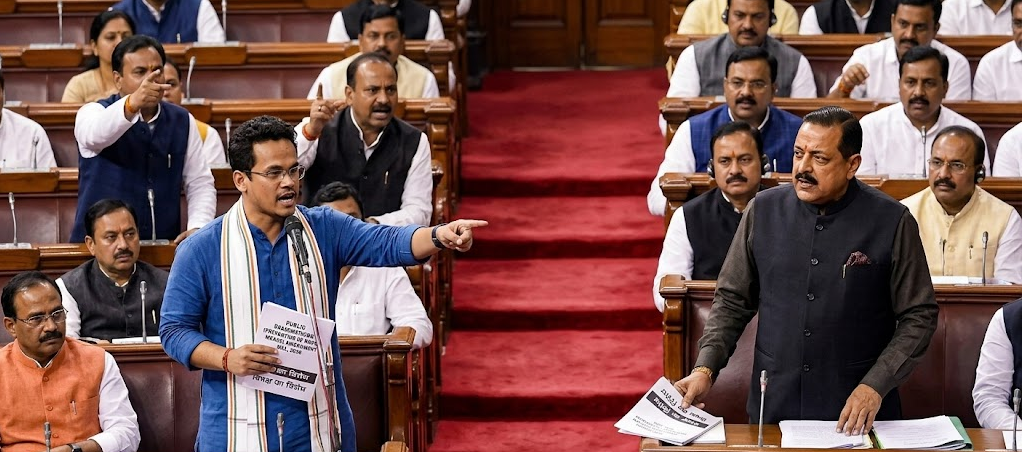
Recently the government introduced the Public Examinations (Prevention of Unfair Means) Amendment Bill, 2026 in Lokshabha. The government hailed it as a “milestone” legislation to secure the future of the youth, while the Opposition termed it a “cosmetic exercise” and an admission of the failure of the original 2024 anti-paper leak law.
Key Provisions of the 2026 Amendment Bill
- Enhanced Penalties: The amendment seeks to make the law significantly more stringent by proposing imprisonment of up to 10 years and a fine of up to ₹50 lakh for examination-related crimes.
- Speedy Justice Mechanism:
- Special Fast Track Courts: The Bill mandates the establishment of dedicated fast-track courts to exclusively deal with public examination offences.
- Time-Bound Process: It specifically requires investigations to be completed within two months and trials to be concluded within three months from the date of filing the chargesheet.
- Special Task Force (STF): The Central government is empowered to refer the investigation of offences under this Act to a specially constituted Task Force.
Concerns and Criticisms
- Failure of the 2024 Act: The Opposition argued that amending a law labeled “historic” just two years ago (in 2024) exposes the government’s inability to protect the sanctity of exams. Furthermore, it was highlighted that 44 out of 45 accused in the 2024 NEET-UG paper leak case had easily secured bail.
- Lack of Structural Reforms: Harsher punishments alone are insufficient without overhauling the systemic and structural flaws in the education and examination systems.
- Issues with the NTA (National Testing Agency):
- Questions were raised regarding the staffing and functioning of the NTA (e.g., claims of 47 officials being removed when the sanctioned strength is only 34).
- The fate of the structural recommendations made by the K. Radhakrishnan Committee (constituted in 2024) remains unclear.
- Police Action: Concerns were raised over the heavy-handed police action against students protesting these irregularities.
A Look Back: Paper Leaks Over the Last 20 Years
The menace of paper leaks is not a recent phenomenon but a chronic systemic failure that has plagued India’s examination system over the last two decades.
- The Magnitude of the Issue: According to various reports, in the last 5-7 years alone, over 40 major paper leaks have occurred across 15 states, disrupting the lives of more than 1.5 crore (15 million) students.
- Major Historical Scams:
- Vyapam Scam (Madhya Pradesh, 2013): One of the largest organized recruitment and admission scams involving politicians, senior officials, and businessmen, utilizing impersonators (Munnabhais) to write exams.
- SSC CGL Scam (2017): Massive protests erupted in Delhi after the Staff Selection Commission (SSC) question papers were allegedly leaked, exposing vulnerabilities in Computer-Based Tests (CBTs).
- CBSE Board Exams (2018): Class 10 Mathematics and Class 12 Economics papers were leaked on WhatsApp, forcing nationwide re-examinations.
- State-Level Recruitment Leaks: Continuous leaks in state exams, such as the REET (Rajasthan, 2021), UP Police Constable Exam, TSPSC (Telangana, 2023), and BPSC (Bihar).
- Recent Catastrophes (2024-2025): The massive controversies surrounding the NEET-UG (medical entrance) and UGC-NET, which severely damaged the credibility of the National Testing Agency (NTA).
- Impact: These leaks lead to immense psychological and financial trauma for students, age-bar expirations for job seekers, and a severe erosion of public trust in state machinery and the concept of meritocracy.
Steps Taken by the Government to Resolve the Issue
- Legislative Measures:
- Enactment of the Public Examinations (Prevention of Unfair Means) Act, 2024, which for the first time created a central legal framework specifically targeting organized exam crimes.
- Introduction of the Amendment Bill, 2026, which enhances the punishment (up to 10 years in jail and ₹50 lakh fine) and introduces Special Fast Track Courts for time-bound justice (2 months for investigation, 3 months for trial).
- Institutional Restructuring:
- Establishment of the National Testing Agency (NTA) in 2018 to professionalize, standardize, and centralize the testing process, shifting away from CBSE and other bodies.
- Formation of the K. Radhakrishnan Committee (2024) to suggest comprehensive structural reforms in the NTA, exam center auditing, and data security protocols.
- Administrative clean-ups, including the removal/transfer of tainted officials within testing bodies (e.g., the removal of 47 NTA officials).
- Technological & Operational Shifts:
- A massive shift from OMR/Pen-and-Paper modes to Computer-Based Testing (CBT).
- Introduction of biometric authentication (iris/fingerprint scanning), facial recognition, and CCTV surveillance at exam centers.
- Implementation of “jumbling” of questions and options to prevent mass cheating.
Way Forward
While stringent laws like the 2026 Amendment Bill provide a strong deterrent, they must be supplemented with proactive, structural, and technological reforms:
- Technological Fortification:
- End-to-End Encryption: Question papers must remain encrypted and should only be decrypted digitally at the exam center 15–30 minutes before the exam, removing human intermediaries from the printing and transport phases.
- AI & Blockchain: Utilize AI-driven proctoring to detect unusual behavioral patterns during CBTs. Use Blockchain technology to secure student data, question banks, and result generation to prevent post-exam tampering.
- Overhauling Exam Infrastructure:
- Stop relying on compromised private engineering colleges and internet cafes for exam centers. The government should build state-owned, secure testing infrastructure dedicated solely to public examinations.
- Conduct rigorous, third-party cyber-security audits of exam software and hardware before every major exam.
- Reforming the NTA:
- Implement the Radhakrishnan Committee recommendations in letter and spirit. The NTA must build its own permanent, highly qualified technical cadre rather than outsourcing critical IT and logistics operations to private vendors.
- Fixing ‘Command Responsibility’:
- Accountability should not be limited to ground-level staff or private vendors. Top officials and bureaucrats heading these agencies must be held accountable for security lapses.
- Student-Centric Relief Mechanisms:
- Establish a standard operating procedure (SOP) to ensure that if an exam is canceled due to a leak, a re-test is conducted within a strict timeline (e.g., 45 days), and candidates who cross the maximum age limit during this delay are granted automatic age relaxations.
UPSC Prelims Practice Question
Question: With reference to the Public Examinations (Prevention of Unfair Means) Amendment Bill, 2026, consider the following statements:
- It proposes a maximum punishment of up to 10 years of imprisonment and a fine of up to ₹50 lakh for examination-related offences.
- The Bill mandates the completion of the judicial trial within three months from the date the offence was committed.
- It empowers the Central Government to refer investigations of examination-related offences to a specially constituted Special Task Force (STF).
Which of the statements given above is/are correct?
(a) 1 and 2 only
(b) 1 and 3 only
(c) 2 and 3 only
(d) 1, 2 and 3
Answer: (b) 1 and 3 only
Explanation:
- Statement 1 is correct: The Bill increases the stringency of the 2024 act with up to 10 years in jail and a ₹50 lakh fine.
- Statement 2 is incorrect: The Bill envisages the completion of trials within three months from the date of filing of the chargesheet, not from the date the offence was committed. (It also allows two months for completing the investigation).
- Statement 3 is correct: The Bill empowers the Centre to refer investigations to an STF.
UPSC Mains Practice Question
Question: “Enacting stringent penal laws is a necessary but insufficient condition to ensure the sanctity of public examinations in India.” In the context of the Public Examinations (Prevention of Unfair Means) Amendment Bill, 2026, critically evaluate the need for structural and institutional reforms in testing bodies like the National Testing Agency (NTA). (250 words, 15 marks)
Approach to the Answer:
- Introduction: Mention the introduction of the 2026 Amendment Bill, its key provisions (10-year jail, fast-track courts, STF), and its context (recurring paper leaks like NEET-UG).
- Body Paragraph 1 (Why Penal Laws are Necessary): Briefly discuss how organized syndicates operate, necessitating strong deterrence (high fines, non-bailable clauses, fast-track justice) to break the nexus.
- Body Paragraph 2 (Why Penal Laws are Insufficient / The Root Causes): Explain that harsh laws don’t address systemic vulnerabilities—such as compromised printing presses, digital hacking, poorly staffed testing agencies, and the immense pressure of gatekeeping exams for limited formal jobs. Mention the criticism regarding bail provisions in previous cases.
- Body Paragraph 3 (Need for Institutional Reforms): Highlight the necessity of overhauling bodies like the NTA. Discuss the need to implement expert committee recommendations (like the K. Radhakrishnan Committee), ensuring adequate sanctioned staffing, robust technological infrastructure for paper delivery, decentralization of exam centers, and enhanced cybersecurity.
- Conclusion: Conclude that while the 2026 Amendment is a welcome step toward speedy justice, it must be complemented by capacity building, technological upgrades, and transparent grievance redressal mechanisms to truly safeguard the future of the youth.