Table of Contents
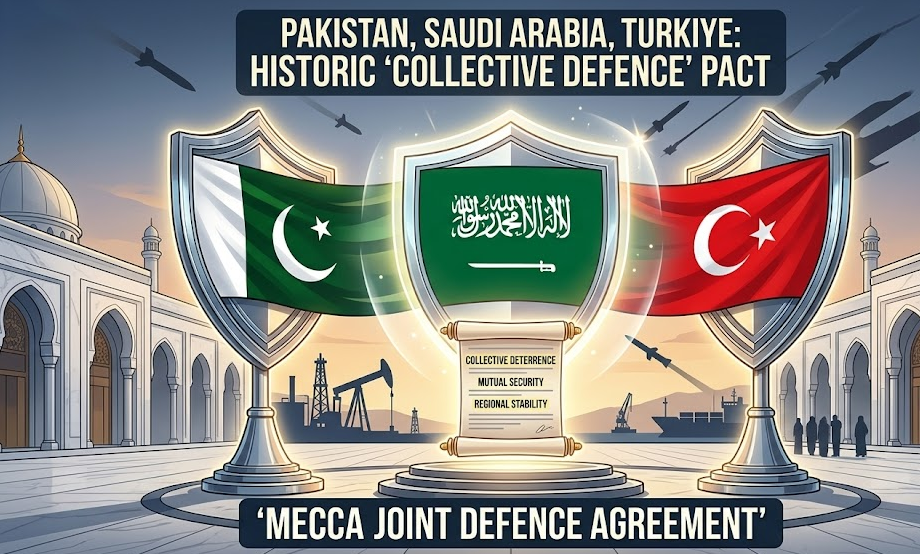
Pakistan, Saudi Arabia and Türkiye signed the Mecca Joint Defence Agreement. The signing comes as Saudi Arabia faces continuing strikes from Yemen’s Houthi movement, while the wider West Asian region remains gripped by the ongoing conflict pitting the United States and Israel against Iran.
- The agreement commits the three countries to:
- Collective defence
- Collective deterrence
- Treating an armed attack against one member as an attack against all.
- It was signed at the Mecca Al-Mukarramah Summit for Joint Defence in the presence of:
- Saudi Crown Prince Mohammed bin Salman
- Turkish President Recep Tayyip Erdoğan
- Pakistani Prime Minister Shehbaz Sharif
Key Features
- The pact is described as a defence-oriented partnership and not as an alliance directed against any particular country.
- It seeks to enhance:
- Defence cooperation
- Military coordination
- Burden-sharing
- Collective security
- Regional and global peace and stability
- The agreement covers “all aspects of defence cooperation” among the three states.
- It reflects increasing strategic coordination among three Muslim-majority countries:
- Saudi Arabia: oil-rich Gulf monarchy
- Pakistan: nuclear-armed South Asian state
- Türkiye: NATO member
Regional Background
- West Asia is facing a prolonged security crisis involving multiple actors.
- Saudi Arabia has faced attacks from:
- Iran
- Yemen-based Houthis or Ansar Allah
- The Houthis have targeted:
- Saudi oil facilities
- Red Sea ports
- Maritime trade and shipping routes
- The agreement comes amid tensions involving Iran, Israel, the United States and Arab Gulf countries.
- It also follows the 2025 Saudi-Pakistan Strategic Mutual Defence Agreement, which contained a similar collective-defence commitment.
Strategic Significance
For Saudi Arabia
- Provides additional security partnerships beyond traditional dependence on Western powers.
- Strengthens deterrence against attacks on its territory, oil infrastructure and maritime routes.
- Helps protect critical energy infrastructure and Red Sea connectivity.
For Pakistan
- Expands Pakistan’s strategic role in West Asia.
- Provides opportunities for defence diplomacy, military cooperation and economic engagement.
- Enhances Pakistan’s position as a security partner and potential mediator in regional conflicts.
- May increase its influence among Muslim-majority countries.
For Türkiye
- Supports its ambition to play a greater security role in West Asia.
- Expands its influence beyond its immediate neighbourhood.
- Provides an opportunity to combine NATO-related experience with regional partnerships.
For the Region
- Could promote burden-sharing and greater coordination among regional powers.
- May contribute to deterrence if backed by credible military capabilities.
- Could reshape the security architecture of the Gulf and wider West Asia.
Limitations and Concerns
- The actual operational scope of the agreement remains unclear.
- Similar mutual-defence commitments have not always resulted in military intervention.
- Saudi Arabia and Pakistan had earlier signed a strategic defence pact, but neither intervened militarily on behalf of the other during subsequent security crises.
- Differences in national interests may limit joint action:
- Saudi Arabia’s focus on Gulf and energy security
- Türkiye’s focus on West Asian strategic influence
- Pakistan’s concerns regarding Afghanistan, India and economic stability
- The pact could intensify rivalry with Iran, even though the signatories describe it as non-targeted.
- Divergent foreign-policy priorities may make consensus difficult during a crisis.
- Collective deterrence requires:
- Clear military commitments
- Joint command and communication mechanisms
- Intelligence-sharing
- Common rules of engagement
- Political willingness to act
India’s Perspective
Possible Opportunities
- Greater engagement with Saudi Arabia and Türkiye through diplomacy and economic channels.
- India can underline its role as a responsible regional power committed to:
- Freedom of navigation
- Energy security
- Counter-terrorism
- Regional stability
- India’s strong ties with Saudi Arabia may help it maintain strategic autonomy despite Pakistan’s participation in the pact.
- The agreement could create opportunities for India to deepen cooperation with Gulf countries in maritime security and infrastructure protection.
Possible Challenges
- Pakistan may attempt to use the arrangement to enhance its strategic and diplomatic position against India.
- Türkiye’s positions on several India-related issues may complicate bilateral relations.
- Any escalation involving Iran, Saudi Arabia or the wider Gulf could affect:
- Indian expatriates
- Energy supplies
- Remittances
- Shipping routes
- Trade and investment
- India must carefully balance relations with Saudi Arabia, Iran, Israel, Türkiye and the United States.
Important Terms
- Collective defence: An attack on one member is treated as an attack on all members.
- Collective deterrence: Joint capability and commitment intended to prevent aggression.
- Defence diplomacy: Use of military cooperation and strategic partnerships to advance foreign-policy objectives.
- Strategic autonomy: Ability to pursue independent foreign policy without becoming dependent on a particular power bloc.
- Regional security architecture: The network of alliances, partnerships and institutions governing security in a region.
- Burden-sharing: Distribution of financial, military and operational responsibilities among partner states.
Prelims Points
- Agreement: Mecca Joint Defence Agreement
- Signatories: Pakistan, Saudi Arabia and Türkiye
- Venue: Mecca
- Core principle: Collective defence and collective deterrence
- Türkiye is a NATO member.
- Pakistan is a nuclear-armed state.
- Saudi Arabia is a major oil-producing Gulf country.
- Houthis, also known as Ansar Allah, are based in Yemen.
- The agreement involves three Muslim-majority countries.
Prelims Practice Question
Question: With reference to the recently signed ‘Mecca Joint Defence Agreement’, consider the following statements:
- It is a trilateral mutual defence pact signed between Saudi Arabia, Pakistan, and Egypt.
- The agreement stipulates that an armed attack against one signatory nation will be considered an attack against all of them.
- One of the signatory nations to this agreement is a member of the North Atlantic Treaty Organization (NATO).
Which of the statements given above is/are correct?
(a) 1 and 2 only
(b) 2 and 3 only
(c) 1 and 3 only
(d) 1, 2, and 3
Answer: (b) 2 and 3 only Explanation:
Statement 3 is correct: Turkiye is a member of NATO.
Statement 1 is incorrect: The agreement is signed between Saudi Arabia, Pakistan, and Turkiye, not Egypt.
Statement 2 is correct: The pact commits to “collective defence,” meaning an attack on one is an attack on all.
Mains Question
Q. The Mecca Joint Defence Agreement may reshape the security architecture of West Asia, but its effectiveness will depend on political convergence and credible military commitments. Discuss.
Answer Framework
Introduction:
The Mecca Joint Defence Agreement between Pakistan, Saudi Arabia and Türkiye represents an attempt to strengthen collective security and deterrence amid growing instability in West Asia.
Significance:
- Enhances defence cooperation and military coordination.
- Provides Saudi Arabia with additional security partnerships.
- Expands Türkiye’s regional role.
- Increases Pakistan’s diplomatic and security relevance.
- Promotes burden-sharing among regional powers.
- May help protect energy infrastructure and maritime routes.
Challenges:
- Lack of clarity regarding automatic military intervention.
- Previous mutual-defence commitments have had limited operational impact.
- Divergent strategic priorities among the three countries.
- Possibility of intensifying Saudi-Iran and Türkiye-Iran tensions.
- Absence of clear mechanisms for joint command, intelligence-sharing and crisis response.
India’s approach:
- Maintain balanced relations with Saudi Arabia, Iran, Türkiye and Israel.
- Strengthen maritime and energy security cooperation with Gulf partners.
- Protect the interests of the Indian diaspora.
- Promote dialogue, de-escalation and freedom of navigation.
- Preserve strategic autonomy.