Table of Contents
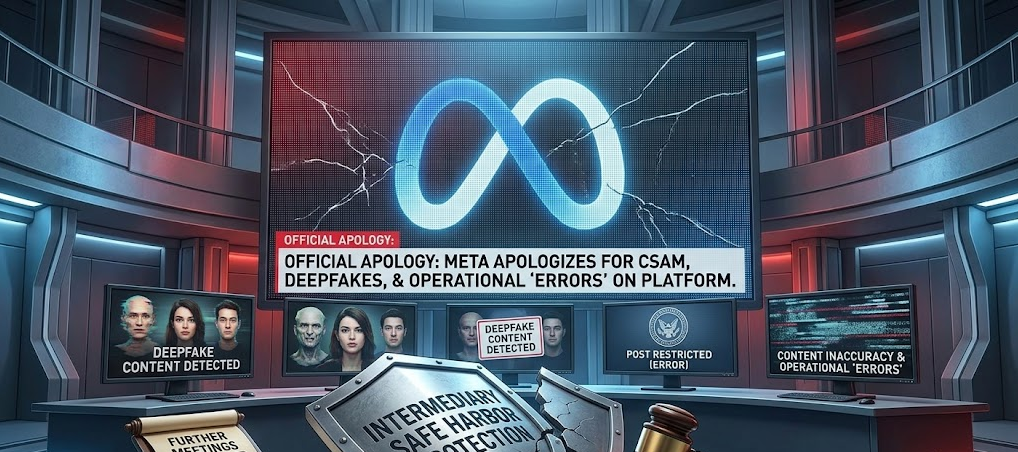
Meta CEO Mark Zuckerberg reportedly apologised to the Indian government over:
- The temporary restriction of Prime Minister Narendra Modi’s Facebook video posted on July 23.
- The presence and promotion of Child Sexual Abuse Material (CSAM) on Meta-owned platforms.
- Deepfake and AI-generated harmful content.
- Operational and content-moderation failures on Facebook and Instagram.
Meta’s Global Affairs head Joel Kaplan separately apologised to Union IT Minister Ashwini Vaishnaw for the erroneous restriction of the Prime Minister’s post. Meta reportedly attributed the incident to an error in its automated moderation system, after which the post was restored.
Key concepts
A. Intermediary
Under Section 2(1)(w) of the Information Technology Act, 2000, an intermediary is broadly a person who, on behalf of another person, receives, stores or transmits electronic records or provides services in relation to them.
Social-media platforms generally claim protection as intermediaries because they host or transmit third-party content rather than creating it themselves.
B. Safe harbour
Section 79(1) provides conditional protection from liability for third-party information hosted or transmitted through an intermediary. However, this protection is subject to the conditions in Sections 79(2) and 79(3).
Safe harbour is therefore not an absolute immunity. It can be lost where the platform:
- Initiates the transmission.
- Selects the receiver of the information.
- Selects or modifies the content.
- Conspires, aids, abets or induces an unlawful act.
- Fails to act after receiving legally recognised notice of unlawful content.
- Violates prescribed due-diligence obligations.
Important correction for UPSC: Section 79(3) does not independently “grant” safe harbour. Section 79(1) grants the exemption, while Section 79(3) specifies circumstances in which the exemption may not apply.
C. Platform versus publisher
The central legal question is not simply whether Meta hosts user content. It is whether its role remains passive or whether its algorithms and commercial systems:
- Select and recommend content.
- Determine the audience for particular content.
- Amplify content based on engagement.
- Monetise advertisements.
- Modify the visibility and reach of content.
The government’s reported position that Meta is “not covered under the intermediary definition” should be treated as a government assertion in the ongoing regulatory dispute, not as a final judicial determination. The legal issue would require examination of Meta’s actual functions, algorithmic systems and compliance with statutory conditions.openthemagazine+1
Legal and regulatory framework
Information Technology Act, 2000
| Provision | Relevance |
| Section 2(1)(w) | Defines “intermediary” |
| Section 69A | Enables blocking of public access to information in specified circumstances |
| Section 79(1) | Provides conditional safe harbour for third-party content |
| Section 79(2) | Lays down conditions for safe-harbour protection |
| Section 79(3) | Denies protection where the intermediary contributes to unlawful activity or fails to remove unlawful content after legally valid notice |
| Sections 67, 67A and 67B | Deal with obscene, sexually explicit and child sexual material in electronic form |
| Section 79 read with IT Rules, 2021 | Creates the broader platform due-diligence framework |
IT Rules, 2021
The Information Technology (Intermediary Guidelines and Digital Media Ethics Code) Rules, 2021 impose due-diligence obligations on intermediaries and additional obligations on Significant Social Media Intermediaries (SSMIs).
Important obligations include:
- Appointment of a Grievance Officer.
- Publication of rules, privacy policy and user agreement.
- Expeditious action against specified unlawful content.
- Mechanisms for user complaints and appeals.
- Preservation of removed content and relevant records.
- Appointment of a Chief Compliance Officer, Nodal Contact Person and Resident Grievance Officer by SSMIs.
- Compliance reports and transparency-related requirements.
- Technology-based measures to identify certain categories of harmful content.
- Traceability-related obligations for significant messaging platforms, subject to constitutional and judicial scrutiny.
The Rules also require quicker response in cases involving sexually explicit material, impersonation, nudity and material depicting private areas. This is particularly relevant to CSAM and AI-generated sexual abuse material.
Digital Personal Data Protection Act, 2023
The DPDP Act is not primarily a content-moderation law. However, it is relevant because it regulates the processing of children’s personal data.
A data fiduciary must obtain verifiable parental consent before processing the personal data of a child, subject to the framework prescribed under the law.
Thus, the issue has two distinct dimensions:
- Content safety: removal and prevention of CSAM and deepfakes.
- Data protection: preventing unlawful collection, profiling and exploitation of children’s personal data.
Constitutional dimensions
Article 19(1)(a): Freedom of speech and expression
Social-media platforms have become important spaces for:
- Political communication.
- Public debate.
- Election campaigns.
- Government outreach.
- Citizen journalism.
- Mobilisation and protest.
An erroneous takedown of a verified public figure’s post raises concerns about:
- Lack of procedural safeguards.
- Excessive dependence on automated moderation.
- Absence of meaningful explanation.
- Risk of arbitrary or politically selective moderation.
Article 19(2): Reasonable restrictions
Freedom of speech is not absolute. Restrictions may be imposed on grounds including:
- Sovereignty and integrity of India.
- Security of the State.
- Public order.
- Decency or morality.
- Defamation.
- Incitement to an offence.
- Friendly relations with foreign States.
CSAM, sexual exploitation, criminal intimidation, non-consensual intimate imagery and certain forms of incitement can legitimately attract restrictions. However, restrictions must satisfy legality, necessity, proportionality and procedural fairness.
Article 14: Non-arbitrariness
Automated moderation systems may produce inconsistent outcomes:
- Harmful content may remain online.
- Legitimate political content may be removed.
- Similar content may receive different treatment.
- Users may not receive adequate reasons or appeal mechanisms.
This raises concerns under Article 14 if moderation is arbitrary, opaque or discriminatory.
Article 21: Privacy, dignity and child protection
CSAM and deepfake sexual content directly threaten:
- Privacy.
- Dignity.
- Bodily autonomy.
- Reputation.
- Psychological well-being.
- The safety of children and vulnerable persons.
The State’s duty to protect citizens from serious digital harms must be balanced against the right to privacy and freedom of expression.
Core issues raised by the incident
1. Automated moderation and accountability
Meta reportedly explained that the Prime Minister’s post was mistakenly flagged by its internal AI-based moderation system. This highlights the problem of automation without accountability.
AI systems may incorrectly flag content because of:
- Sudden traffic spikes.
- Contextual misunderstanding.
- Misclassification of political speech.
- Inadequate training data.
- Over-reliance on visual or linguistic markers.
- Difficulty distinguishing satire, quotation, reporting and genuine misinformation.
The platform must therefore provide:
- Human review for high-impact takedowns.
- Priority escalation for verified public accounts.
- Reasons for removal.
- Time-bound appeals.
- Audit trails.
- Independent oversight of moderation systems.
2. Algorithmic amplification
The issue is not limited to whether a platform hosts unlawful content. Algorithms may determine:
- What users see.
- How frequently they see it.
- Which content becomes viral.
- Which advertisements receive greater reach.
- Whether harmful content is recommended to vulnerable users.
This transforms the debate from content hosting to content amplification.
A platform may claim that it is only an intermediary, while its recommendation systems actively shape the circulation and visibility of content. This creates a regulatory challenge because existing law was largely designed for passive intermediaries.
3. CSAM and online child safety
CSAM is not merely objectionable content; it is evidence of sexual exploitation and abuse of children.
Major concerns include:
- Paid advertisements promoting illegal content.
- Encrypted or closed groups.
- Repeated re-uploading after removal.
- Use of AI to generate synthetic child-abuse material.
- Monetisation of harmful content.
- Cross-border hosting and investigation difficulties.
- Failure to promptly report material to law-enforcement authorities.
A rights-based approach requires focusing on the protection and rehabilitation of victims rather than treating the issue only as a platform-compliance problem.
4. Deepfakes and synthetic media
Deepfakes can be used for:
- Political misinformation.
- Impersonation.
- Financial fraud.
- Communal mobilisation.
- Sexual exploitation.
- Reputation attacks.
- Manipulation of elections and public discourse.
The challenge is to distinguish between:
- Criminally deceptive deepfakes.
- Satire and parody.
- Artistic expression.
- Journalism and public-interest documentation.
- Legitimate use of synthetic media with disclosure.
A blanket prohibition can harm innovation and free speech. A better approach would combine labelling, provenance standards, rapid grievance redress, criminal investigation and platform accountability.
Parliamentary oversight and executive regulation
The Parliamentary Standing Committee’s reported warning reflects legislative scrutiny of large technology platforms. Parliamentary oversight can improve accountability, but it must operate within constitutional limits.
Potential concerns include:
- Whether a committee can directly impose legal consequences without statutory authority.
- Whether an apology is an adequate measure of accountability.
- Whether loss of safe harbour should follow a specific legal process.
- Whether regulatory pressure may lead to excessive content removal.
- Whether platforms receive notice, hearing and appeal opportunities.
The ideal system should combine parliamentary oversight with transparent statutory procedures and judicial review.
Shreya Singhal and due process
In Shreya Singhal v. Union of India (2015), the Supreme Court struck down Section 66A of the IT Act for violating freedom of speech. It upheld the constitutional validity of Section 79 subject to safeguards and read down the expression “actual knowledge” in the takedown context.indiankanoon+1
The judgment is important because it established that:
- Intermediaries should not be compelled to decide legality merely on the basis of private complaints.
- Takedown obligations must be linked to a court order or legally valid government notification.
- Content regulation must respect Article 19(1)(a) and Article 19(2).
- Vague and overbroad restrictions can produce a chilling effect on speech.
Application to the present issue
The judgment does not give platforms a licence to ignore CSAM or other criminal material. Rather, it requires a legally structured system in which:
- The State identifies unlawful content through proper authority.
- Platforms act expeditiously.
- Victims have effective remedies.
- Users receive procedural fairness.
- Regulatory action remains proportionate.
Stakeholder analysis
| Stakeholder | Main concern |
| Central Government | National security, public order, lawful takedown and platform compliance |
| Parliamentary committees | Accountability of powerful technology companies |
| Meta and other platforms | Legal certainty, operational feasibility and preservation of safe harbour |
| Users | Free speech, privacy, transparency and effective appeals |
| Children and victims | Protection from exploitation, abuse and re-victimisation |
| Law-enforcement agencies | Access to evidence, cross-border cooperation and timely reporting |
| Advertisers | Brand safety and prevention of illegal ad placement |
| Civil society | Protection from censorship, surveillance and arbitrary moderation |
| Judiciary | Constitutional balance, proportionality and due process |
Government’s position: strengths and concerns
Arguments supporting stricter action
- Platforms possess substantial technological and financial capacity.
- Their algorithms influence public discourse and social behaviour.
- CSAM and deepfakes cause severe and irreversible harm.
- Profit-driven recommendation systems may incentivise engagement over safety.
- Repeated operational failures cannot always be dismissed as isolated technical errors.
- Safe harbour should be conditional on meaningful compliance.
Concerns regarding excessive regulation
- Broad liability may encourage platforms to remove lawful speech.
- Political pressure can result in selective censorship.
- Automated systems may become even more conservative and error-prone.
- Smaller platforms may lack resources to meet expensive compliance requirements.
- Government demands must be supported by law and due process.
- Treating every platform as a publisher may undermine the functioning of the internet.
Way forward
A. Risk-based platform regulation
Platforms should be regulated according to:
- User base.
- Business model.
- Nature of service.
- Degree of algorithmic amplification.
- Risk posed to children and vulnerable users.
- Capacity to monetise or recommend content.
A small discussion forum and a globally dominant social-media platform should not face identical obligations.
B. Independent algorithmic audits
Large platforms should be required to conduct periodic audits of:
- Recommendation systems.
- Ad-review systems.
- Child-safety controls.
- Deepfake detection.
- Error rates in content moderation.
- Bias and disparate impact.
- Appeals and reinstatement decisions.
C. Human review for high-impact decisions
Content involving:
- Elected representatives.
- Public emergencies.
- Public-interest journalism.
- Verified institutional accounts.
- Political communication.
should receive expedited human review, without creating a special immunity for political actors.
D. Stronger child-safety architecture
Measures should include:
- Proactive detection of CSAM.
- Hash-matching systems for known illegal material.
- Rapid removal and re-upload prevention.
- Mandatory reporting to competent authorities.
- Stronger advertiser verification.
- Specialised child-safety teams in India.
- Victim-centric grievance and rehabilitation mechanisms.
E. Deepfake governance
India should develop:
- Clear legal definitions.
- Mandatory disclosure or labelling for synthetic media.
- Provenance and watermarking standards.
- Rapid takedown for demonstrably harmful impersonation.
- Criminal liability for intentional fraud, sexual exploitation and incitement.
- Safe space for satire, research, journalism and artistic expression.
F. Transparency and due process
Platforms should publish:
- Content-moderation rules.
- Government takedown requests.
- Number and category of removals.
- Error and reinstatement rates.
- Use of automated systems.
- Appeals outcomes.
- Advertiser verification practices.
The government should also publish legally sustainable reasons for major content restrictions.
G. International cooperation
Because platforms and harmful content operate across jurisdictions, India needs:
- Faster mutual legal assistance.
- Cooperation with Interpol and foreign law-enforcement agencies.
- Common standards for CSAM reporting.
- Cross-border evidence-sharing mechanisms.
- Collaboration with technology companies and child-protection organisations.
Prelims capsule
Important facts
- Section 79, IT Act, 2000: Conditional safe harbour for intermediaries.
- Section 79(3): Circumstances in which intermediary protection may not apply.
- Section 69A: Government power to block public access to information, subject to statutory safeguards.
- IT Rules, 2021: Due diligence and grievance-redress obligations for intermediaries.
- SSMI: Significant Social Media Intermediary with enhanced compliance obligations.
- CSAM: Child Sexual Abuse Material; it represents exploitation of a child and is distinct from ordinary obscene content.
- Shreya Singhal v. Union of India: Section 66A struck down; Section 79 upheld subject to safeguards.
- Article 19(1)(a): Freedom of speech and expression.
- Article 19(2): Grounds for reasonable restrictions.
- Article 14: Protection against arbitrariness.
- Article 21: Privacy, dignity and personal liberty.
- DPDP Act, 2023: Regulates processing of children’s personal data but is not a complete content-moderation statute.
PT statement-based question
Consider the following statements:
- Section 79 of the IT Act provides absolute immunity to social-media platforms for all user-generated content.
- The Supreme Court in Shreya Singhal struck down Section 66A of the IT Act.
- The IT Rules, 2021 impose additional obligations on Significant Social Media Intermediaries.
Which of the statements given above are correct?
(a) 1 and 2 only
(b) 1 and 3 only
(c) 2 and 3 only
(d) 1, 2 and 3
Answer: Only statements 2 and 3 are correct.
Mains-ready Question–answer
“The Meta–India dispute reflects the inadequacy of treating dominant social-media platforms as merely passive intermediaries.” Discuss.
Model answer
The recent dispute involving Meta’s apology over the temporary restriction of the Prime Minister’s video, CSAM and deepfake content has renewed the debate on intermediary liability and platform accountability. Meta attributed the takedown to an operational error in its automated moderation system, while the Indian government questioned the company’s compliance with its legal and safety obligations.
Under Section 79 of the Information Technology Act, intermediaries enjoy conditional safe harbour for third-party content. This protection is subject to due diligence and may not apply when a platform contributes to unlawful activity or fails to act after legally valid notice. The IT Rules, 2021 impose additional obligations on Significant Social Media Intermediaries, including grievance redress, compliance personnel, transparency and certain technology-based measures.
However, dominant platforms increasingly do more than passively host content. Their algorithms select, recommend, rank and amplify information. Advertising systems also monetise user attention. Therefore, platform responsibility cannot be assessed only on the basis of who created the original content. The risks become particularly serious in cases involving CSAM, synthetic media, political misinformation and targeted manipulation.
At the same time, converting platforms into publishers of every user post may lead to excessive censorship and undermine Article 19(1)(a). In Shreya Singhal, the Supreme Court emphasised that takedown obligations must be linked to constitutionally valid legal processes. Regulation must therefore satisfy legality, necessity, proportionality and procedural fairness.
India should adopt a risk-based framework involving independent algorithmic audits, human review of high-impact takedowns, transparent government requests, stronger child-safety systems, deepfake provenance standards and effective appeals. Safe harbour should remain available, but only for platforms that demonstrate genuine compliance and do not actively amplify unlawful content.
Thus, the objective should not be unrestricted platform control or unchecked state censorship. It should be a rights-respecting accountability framework that protects children, preserves free speech and makes powerful digital platforms answerable for the risks created by their systems.
Value addition for Essay and Interview
Useful keywords
- Conditional safe harbour
- Algorithmic amplification
- Platform accountability
- Synthetic media
- Digital constitutionalism
- Content moderation
- Notice-and-takedown
- Procedural fairness
- Child-centric internet governance
- Risk-based regulation
- Transparency by design
- Human-in-the-loop moderation
One-line conclusion
The central challenge is to ensure that technology platforms are not treated as publishers of everything users say, but are also not allowed to evade responsibility for what their algorithms recommend, amplify and monetise.