Table of Contents
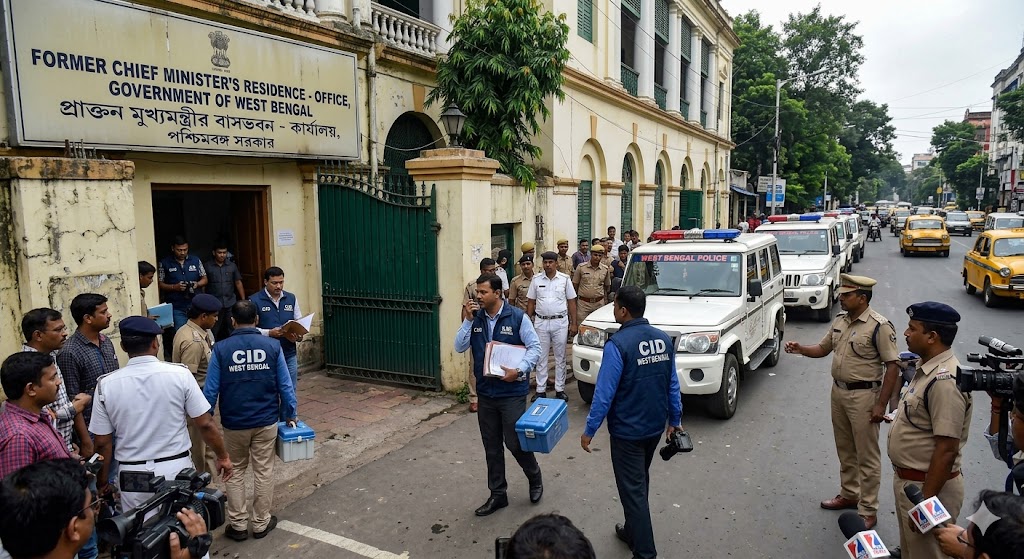
Recently, the Criminal Investigation Department (CID) of the West Bengal Police conducted a search operation at the residence-cum-party office of the former Chief Minister of West Bengal. The investigation pertains to an alleged case of forgery involving the signatures of two MLAs on a letter nominating the Leader of the Opposition (LoP) in the State Legislative Assembly.
This development has revived the constitutional and political debate surrounding the functional autonomy of state police agencies and the procedural sanctity of legislative appointments.
Key Issues Highlighted by the Incident
A. Alleged Weaponization of State Machinery
The frequent use of state investigative agencies (like the state CID or state police) immediately following shifts in political power raises serious concerns regarding institutional neutrality.
- Opposition parties often label such actions as “political vendetta,” which erodes public trust in law enforcement.
- It highlights a structural flaw where the police are vulnerable to serving the ruling executive’s political interests rather than maintaining strict adherence to rule-of-law principles.
B. Procedural Lacunae in Legislative Functions
The forgery of MLAs’ signatures to nominate a key legislative official like the LoP strikes at the heart of parliamentary democracy and internal party democracy.
- If political disputes inside a legislature transform into criminal cases handled by state police, it can lead to friction between the executive wing and the legislative wing of government.
Constitutional & Statutory Provisions
While the position of the Leader of the Opposition is foundational to a parliamentary democracy, its legal framework in India has a unique structure:
- No Explicit Constitutional Mention: The office of the Leader of the Opposition is not a constitutional post. The Constitution of India does not explicitly mention or define the Leader of the Opposition for either the Parliament or State Legislative Assemblies.
- A Statutory Creation: The post of LoP is a statutory post (not explicitly mentioned in the Constitution of India). In Parliament, it is defined under the Salary and Allowances of Leaders of Opposition in Parliament Act, 1977. In states, it is governed by respective state legislative rules and statutes.
- The 10% Rule (Mavalankar Rule): By long-standing parliamentary convention and the rules of most State Assemblies, the Speaker recognizes the leader of the largest opposition party as the Leader of the Opposition, provided that party has secured at least one-tenth (10%) of the total seats in the House (matching the quorum requirement).
- Status and Rank: Once officially recognized by the Speaker, the Leader of the Opposition is accorded the status, salary, and allowances equivalent to a Cabinet Minister of the state.
Duties and Functions of the Leader of the Opposition
The LoP acts as a critical institutional pivot, balancing the power of the ruling executive.
- Ensuring Executive Accountability: The primary duty is to challenge, scrutinize, and provide constructive criticism of government policies, fiscal expenditures, and legislative bills on the floor of the House.
- The “Government-in-Waiting”: In line with the Westminster model, the Leader of the Opposition represents the leader of an alternative government. In the event of a ruling government’s collapse or a successful no-confidence motion, the LoO is expected to be ready to form a stable administration.
- Appointments to Statutory Watchdogs: The Leader of the Opposition brings non-partisanship to key institutional appointments. They serve as a mandatory member of high-powered selection committees responsible for appointing heads of state integrity bodies:
- State Lokayukta (Anti-corruption ombudsman)
- State Information Commission (SIC)
- State Human Rights Commission (SHRC)
- State Vigilance Commission
- Financial Oversight: The Leader of the Opposition or a senior member nominated by the opposition traditionally chairs crucial financial committees like the Public Accounts Committee (PAC) to audit state expenditure.
Recent Trends
- Vacant Seats & Quorum Tussles: A major ongoing trend at the state level is the refusal by Speakers to recognize an official Leader of the Opposition when no single opposition party hits the 10% threshold. This has led to prolonged vacancies in the post across several assemblies.
- Bypassing the LoO in Selections: In instances where the Leader of the Opposition post is vacant or structurally denied, some states have amended appointment rules to allow selection panels to function without an Leader of the Opposition, enabling the ruling party to make unilateral appointments to state watchdog bodies.
- Legislative Fragmentation: The rise of loose regional coalitions and frequent floor-crossings (alliances shifting mid-term) has made identifying a stable, unified “largest opposition party” increasingly complex for Speakers.
- Disruption over Debate: Recent assembly sessions show a trend where the opposition relies heavily on floor disruptions, walkouts, and protests rather than utilizing the Leader of the Opposition’s office to lead structured legislative debates.
Way Forward: Institutional Reforms
- Implementing Prakash Singh Directives (2006): The Supreme Court’s landmark judgment on police reforms must be implemented in letter and spirit. This includes setting up a State Security Commission (SSC) to ensure that the state government does not exercise unwarranted influence or pressure on the police.
- Separation of Investigation and Law & Order: Separating the investigative wing of the police from the routine law-and-order duties will bring greater professionalism and reduce day-to-day political interference.
- Codifying Legislative Autonomy: Internal disputes regarding legislative nominations and signatures should ideally be subjected to strict scrutiny by a Privileges Committee or a dedicated internal legislative cell before invoking police intervention, preserving the separation of powers.
- Mandatory Statutory Recognition: State assembly rules should be legally amended to ensure that the leader of the single largest opposition party is automatically recognized as the LoO, removing the rigid and arbitrary 10% seat barrier.
- Institutionalizing Shadow Committees: Encouraging the creation of subject-specific opposition committees would allow the LoO to present a concrete, alternative policy agenda to the public, elevating the quality of state governance.
Criminal Investigation Department (CID)
- Origin: The CID was created following the recommendations of the Police Commission of 1902–03 during the British colonial administration to investigate specialized crimes (such as forgery, counterfeiting, and inter-state gangs).
- Jurisdiction: Unlike central agencies (such as the CBI or ED) which operate under central statutes, the CID is the premier investigative wing of the State Police. It operates strictly under the jurisdiction of the respective State Government and the State Police Act.
- Powers of Search and Seizure: Under Section 185 of the Bharatiya Nagarik Suraksha Sanhita (BNSS), 2023 (which replaced Section 165 of the CrPC), an investigating officer can conduct a search within their local jurisdiction without a warrant if they have reasonable grounds to believe that necessary evidence cannot be obtained otherwise without undue delay.
UPSC Exam Oriented Questions
Prelims Test Relevant Question
Q. Consider the following statements regarding the office of the Leader of the Opposition (LoP) in India:
- The office of the Leader of the Opposition finds an explicit mention in the Constitution of India.
- The LoP is a mandatory member of the selection committee for the appointment of the Central Information Commissioner (CIC).
- In a State Legislative Assembly, the Speaker has absolute, non-justiciable discretion to recognize the LoP, irrespective of the party’s numerical strength.
Which of the statements given above is/are correct?
A) 1 and 2 only
B) 2 only
C) 2 and 3 only
D) 1, 2 and 3
Correct Answer: B) 2 only
Explanation: Statement 1 is incorrect because the LoP is a statutory post, not a constitutional one. Statement 2 is correct; the LoP (or leader of the single largest opposition party) is part of the selection panel for the CIC. Statement 3 is incorrect; while the Speaker recognizes the LoP, the discretion is guided by established statutory rules and conventions (such as the 10% strength threshold), and arbitrary decisions can be subject to judicial review under specific conditions.
Mains Relevant Question
Q. “The perceived politicization of police and state investigative agencies undermines the foundational principles of federalism and the rule of law in India.” In light of recent controversies involving state police units, critically analyze the structural bottlenecks in Indian police functioning and suggest meaningful institutional reforms. (250 Words, 15 Marks)