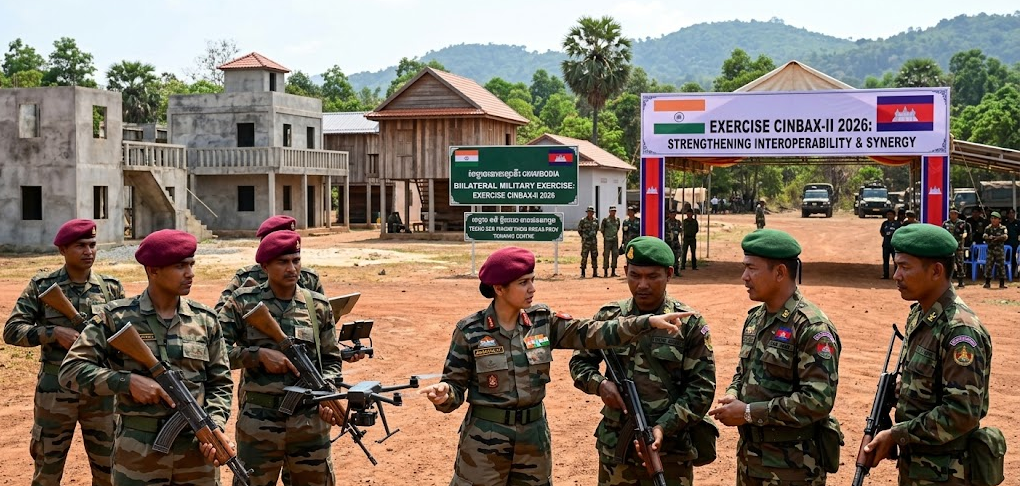
On May 4, 2026, a 120-member contingent of the Indian Army arrived in Kampong Speu Province, Cambodia, for the second edition of the India-Cambodia Joint Military Exercise, CINBAX-II. The 14-day exercise (May 4–17) underscores India’s deepening defense diplomacy in Southeast Asia under its ‘Act East’ policy.
Key Points of CINBAX-II 2026
- Location: Conducted at the Royal Cambodian Air Force Training Centre (Techo Sen Phnom Thom Mreas Training Centre).
- Participants:
- India: 120 personnel primarily from a battalion of the Maratha Light Infantry Regiment.
- Cambodia: 160 personnel from the Royal Cambodian Army.
- Operational Focus: The exercise is designed for a sub-conventional environment, specifically focusing on company-level joint operations.
- Specialized Training: Beyond traditional drills, the exercise includes training in Drone operations, Mortar handling, and Sniper tactics.
- Alignment: The drills are aligned with the current dynamics of Counter-Terrorism operations encountered by UN peacekeeping forces.
- Historical Context: The inaugural edition of CINBAX (Table Top Exercise) was held in Pune, India, in December 2024.
Understanding UN Charter: Chapter VII Mandate
The exercise is conducted under the framework of Chapter VII of the UN Charter, which is a frequent topic in UPSC International Relations.
- Action with Respect to Threats to Peace: Chapter VII provides the UN Security Council (UNSC) the power to maintain or restore international peace and security.
- Enforcement Powers: Unlike Chapter VI (which focuses on peaceful settlement of disputes), Chapter VII allows the UNSC to “determine the existence of any threat to the peace” and take military or non-military action (like sanctions or armed force).
- Significance in Exercises: When a military exercise is “aligned with Chapter VII,” it means the troops are practicing for enforcement missions—scenarios where peacekeepers must use force to protect civilians or restore order, rather than just acting as observers.
India-Cambodia Defense Relations: A Strategic Outlook
For UPSC aspirants, Cambodia is a vital partner in the ASEAN region.
- Historical Roots: India was the first democratic country to recognize the new Cambodian government after the fall of the Khmer Rouge in the 1980s.
- Defense Cooperation: India has been providing training to Cambodian personnel in demining (Cambodia is one of the most landmine-affected countries) and UN peacekeeping.
- Capacity Building: India recently gifted a shipment of military equipment and continues to offer ITEC (Indian Technical and Economic Cooperation) slots to Cambodian defense officials.
- Geopolitical Significance: Strengthening ties with Cambodia helps India balance regional influence in the Indo-Pacific and ensures a stable maritime neighborhood.
UPSC Practice Questions
Prelims (PT) Question
Q. With reference to the ‘CINBAX-II 2026’ military exercise, consider the following statements:
- It is a bilateral naval exercise conducted in the Gulf of Thailand.
- The Indian contingent for the 2026 edition is primarily drawn from the Maratha Light Infantry.
- The exercise is conducted under the framework of Chapter VII of the UN Charter.
Which of the statements given above are correct?
A) 1 and 2 only
B) 2 and 3 only
C) 1 and 3 only
D) 1, 2, and 3
Answer: B) 2 and 3 only
Explanation: Statement 1 is incorrect because CINBAX is a military (army) exercise conducted on land (Kampong Speu Province), not a naval exercise.
Mains Question
Q. “Joint military exercises like CINBAX-II are not merely tactical drills but essential tools of India’s soft power and strategic diplomacy in the Indo-Pacific.” Discuss in the context of India’s ‘Act East’ Policy. (250 words)