Table of Contents
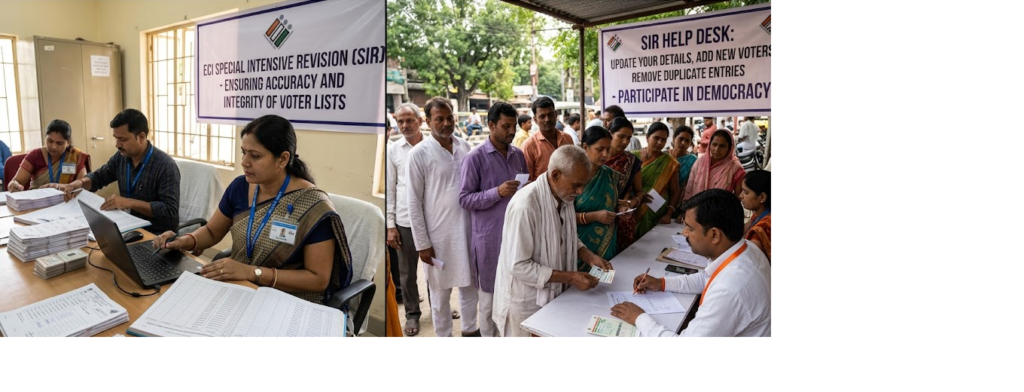
The Supreme Court recently affirmed the constitutionality of the Election Commission of India’s (ECI) Special Intensive Revision (SIR) of electoral rolls, starting with Bihar. The Court ruled that the exercise fulfills the ECI’s constitutional obligation to conduct free and fair elections.
Key Highlights of the Supreme Court Judgment
- Purity of Electoral Rolls: The Court emphasized that free and fair elections rely not just on the mechanics of polling, but fundamentally on the “integrity, accuracy, and purity” of the electoral roll.
- Scope of Article 324: The Bench ruled that the ECI’s supervisory authority under Article 324 is a “continuous wellspring of power.” The SIR breathes life into this mandate without supplanting the Representation of the People (RP) Act or the Registration of Electors Rules, 1960.
- Citizenship Verification vs. Screening:
- The Court dismissed allegations that the SIR was a backdoor citizenship screening mechanism.
- It clarified that since citizenship is a constitutional prerequisite for voting, the ECI is empowered to verify citizenship—but only to the limited extent of determining inclusion or exclusion from the electoral roll.
- Adjudication by the Centre: The ECI cannot be the final arbiter of citizenship. The Court directed the poll body to refer individuals purged from the 2003 rolls on non-citizenship grounds to the Centre. These cases must be adjudicated by a competent authority under the Citizenship Act before the next local or assembly elections.
- Judicial Recourse for Wrongful Deletion: Electors whose names were deleted on grounds of absence, death, shifting, or duplication retain the right to challenge the ECI’s decision in courts.
- Rationale for SIR (Empirical Foundation): The Court accepted the ECI’s “cogent justifications” for the revision, including rapid urbanization, massive migration, non-reporting of deaths, and duplication of entries over the two decades since the last intensive revision.
Safeguards Built into the SIR Process
To mitigate hardship and prevent arbitrary exclusion, the Court noted several active safeguards:
- Inclusion of Aadhaar as the 12th “indicative” document for citizenship verification.
- Mandatory publication of the complete list of excluded electors (e.g., approximately 65 lakh individuals in Bihar).
- Active grassroots assistance provided by Booth-Level Agents (BLAs) of political parties.
Current Status of the SIR Exercise
- Phase 1 (Bihar): The final electoral roll published on September 30, 2025, successfully removed defective entries, bringing the elector count down from 7.89 crore to 7.42 crore.
- Phase 2: Currently underway, covering over 51 crore voters across 12 States and Union Territories, including major states like West Bengal, Tamil Nadu, and Kerala.
ECI: Constitution & Evolution
The ECI is an autonomous, permanent constitutional body established directly by the Constitution to ensure free, fair, and impartial elections in the country. It was established on January 25, 1950 (celebrated as National Voters’ Day).
- Structure: It began as a single-member body. Following the Election Commissioner Amendment Act 1989, it became a multi-member body consisting of the Chief Election Commissioner (CEC) and other Election Commissioners (ECs).
- Parity: The CEC and ECs enjoy equal status, receive identical salaries, and possess equal voting power in decision-making.
- Appointment & Tenure: They are appointed by the President of India based on the recommendations of a selection committee. They hold office for a term of 6 years or until they attain the age of 65 years, whichever is earlier.
Powers of the ECI
The powers of the ECI can be broadly classified into three categories:
| Power Category | Key Mandates & Functions |
| Administrative | • Delimitation of constituencies nationwide. • Preparation, maintenance, and periodic revision of electoral rolls. • Granting recognition to political parties and allotting election symbols. |
| Advisory | • Advising the President or Governors on disqualifications of MPs and MLAs. • Advising the President on whether elections can be held in a state under President’s Rule. |
| Quasi-Judicial | • Resolving disputes regarding the recognition of political parties. • Acting as a court for settling disputes related to election symbols. |
Constitutional Provisions Related to the ECI
The constitutional framework governing elections is enshrined in Part XV of the Constitution:
- Article 324: Vests the superintendence, direction, and control of elections in the Election Commission. The Supreme Court has interpreted this as a “continuous wellspring of power,” meaning that where statutory law is silent, Article 324 empowers the ECI to act autonomously to ensure an election’s purity.
- Article 325: Mandates that no person shall be ineligible for inclusion in an electoral roll or claim special inclusion on grounds of religion, race, caste, or sex.
- Article 326: Guarantees Universal Adult Suffrage, establishing that elections to the Lok Sabha and State Legislative Assemblies shall be on the basis of adult suffrage (minimum age of 18).
- Article 327: Empowers Parliament to make provisions with respect to elections to Legislatures (the bedrock for the Representation of the People Acts of 1950 and 1951).
- Article 329: Bars courts from interfering in electoral matters, particularly regarding the delimitation of constituencies or allotment of seats, except through an election petition.
Role of ECI in Conducting Free and Fair Elections
The ECI transforms constitutional text into democratic reality through critical institutional mechanisms:
- Purification of Electoral Rolls: As seen with the validation of the Special Intensive Revision (SIR), the ECI ensures the foundation of the vote is accurate by cleansing rolls of duplication, dead voters, or entries resulting from rapid urbanization and migration.
- Enforcement of Model Code of Conduct (MCC): The ECI enforces the MCC to ensure a level playing field, preventing the ruling party from using state machinery for electoral gains and checking hate speech or communal campaigning.
- Management of Polling Logistics: Deploying Central Armed Police Forces (CAPF), establishing micro-observers, and implementing Electronic Voting Machines (EVMs) with Voter Verifiable Paper Audit Trails (VVPAT) to safeguard the physical vote.
- Capping Election Expenditure: Monitoring and regulating candidates’ expenses to curb the distorting influence of money in politics.
Challenges in Front of the ECI
Despite its formidable constitutional status, the ECI faces systemic challenges in contemporary electoral cycles:
- Weaponization of Misinformation & Deepfakes: The rapid rise of generative AI, deepfakes, and targeted micro-targeting on social media complicates the ECI’s ability to maintain a clean information ecosystem during campaigns.
- The Menace of “Black Money” & Illicit Funding: Despite strict expenditure monitoring, candidates frequently bypass spending caps through cash distributions, freebies, and opaque funding, diluting equal opportunity.
- Lack of Legislative Teeth: The MCC remains a moral and regulatory guidelines framework rather than a statutory law. The ECI lacks the direct power to deregister a political party for chronic violations.
- Mass Migration Dynamics: Managing massive internal migration and ensuring urban voters, seasonal laborers, and domestic migrants do not face structural disenfranchisement due to shifting residences.
- Perceptual Independence: Issues surrounding the appointment processes of commissioners and security of tenure for Election Commissioners (who do not enjoy the same removal safeguards as the CEC) occasionally draw structural scrutiny.
Way Forward
- Statutory Backing for Key Reforms: Granting the ECI statutory power to deregister non-compliant political parties and formalizing mechanisms to curb digital disinformation during the cooling-off period before polling.
- Technological Safeguards: Integrating advanced data science and collaborative verification tools (such as utilizing indicative secure documents like Aadhaar for roll purification, with strong privacy guardrails) to dynamically update dynamic demographic shifts.
- Institutional Parity: Ensuring equal constitutional protection and security of tenure for all three members of the Commission to insulate the multi-member body from external pressures.
- Combating Criminalization & Money Power: Implementing fast-track judicial resolution of election-related offenses and giving the ECI explicit power to countermand elections if systematic voter bribery is uncovered.
Prelims (PT) Question
Q. With reference to the preparation and revision of electoral rolls in India, consider the following statements:
- The Election Commission of India derives its power to conduct a Special Intensive Revision (SIR) of electoral rolls exclusively from the Citizenship Act, 1955.
- The Election Commission has the absolute and final authority to adjudicate the citizenship status of an individual during the preparation of electoral rolls.
- The electoral rolls in India are updated and maintained in accordance with the provisions of the Representation of the People Act, 1950 and the Registration of Electors Rules, 1960.
Which of the statements given above is/are correct?
(a) 1 and 2 only
(b) 3 only
(c) 2 and 3 only
(d) 1, 2 and 3
Answer: (b) Explanation:
- Statement 1 is incorrect: The power to conduct the SIR is derived fundamentally from Article 324 of the Constitution (superintendence, direction, and control of elections), not the Citizenship Act.
- Statement 2 is incorrect: As per the recent Supreme Court judgment, the ECI can only verify citizenship to the limited extent of enrolment. Final adjudication of disputed citizenship lies with the competent authority under the Centre via the Citizenship Act.
- Statement 3 is correct: The mechanics of electoral roll preparation are governed by the RP Act, 1950, and the Registration of Electors Rules, 1960.
Mains Question
Q. “Free and fair elections do not rest merely upon the mechanics of polling; they equally depend upon the integrity, accuracy, and purity of the electoral roll.”
In light of this statement, analyze the constitutional mandate of the Election Commission of India to conduct Special Intensive Revisions (SIR). How does the judiciary balance this mandate against the risks of arbitrary exclusion of legitimate voters? (250 words, 15 Marks)