Subject: Science & Technology (General Studies Paper-III)
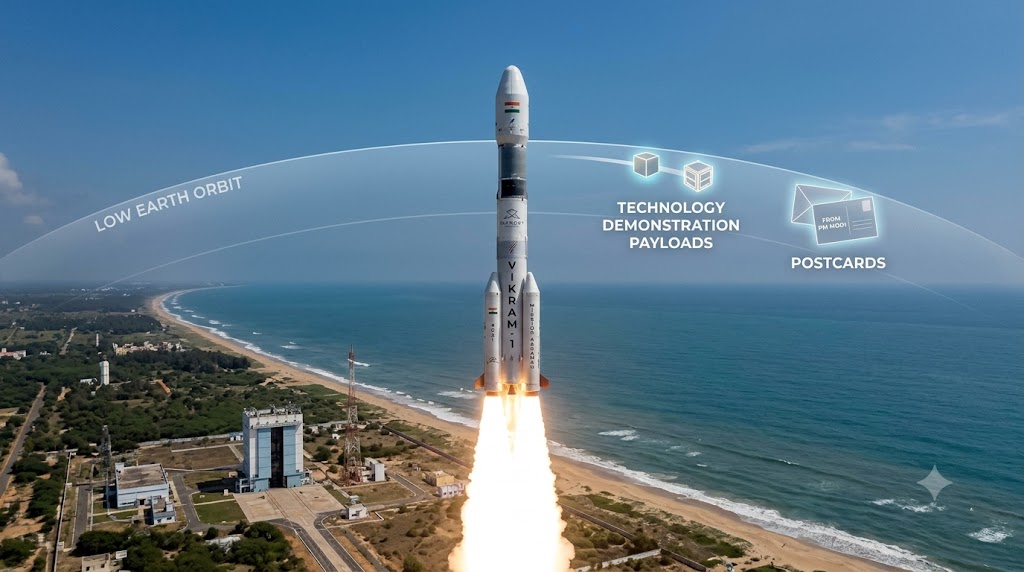
India achieved a historic milestone in its space journey with the successful launch of its first privately developed orbital rocket, Vikram-1, from the Satish Dhawan Space Centre in Sriharikota. Developed by the private space company Skyroot Aerospace, the launch placed multiple technology demonstration payloads into a low earth orbit (LEO).
Key Highlights
- ‘Mission Aagaman’ (Arrival):
- The successful launch, dubbed ‘Mission Aagaman’, marks India’s entry into an elite group.
- India has become only the third country in the world (after the US and China) to achieve an orbital launch through a privately developed vehicle.
- This comes 46 years after India’s first experimental satellite launch vehicle, SLV-3, which made India the sixth spacefaring nation in 1980.
About Vikram-1
- Structure: It is a seven-storey-tall, multi-stage orbital launch vehicle built with an all-carbon composite structure.
- Propulsion: Powered by in-house developed propulsion systems, featuring cutting-edge 3D-printed engines and high-thrust solid-fuel rocket boosters.
- Capacity: Designed to carry small satellites weighing up to 350 kg to low earth orbit (LEO).
Payloads Deployed
- The rocket successfully deployed six technology demonstration payloads from entities like Grahaa Space, Cosmoserve, DCubed, and Skyroot itself.
- It also carried unique cultural items, including Cosmos Diamonds’ artwork ‘Cosmic Bloom’, a micro-art piece, and postcards, including one from Prime Minister Narendra Modi.
- Significance of the Launch:
- Validation of Technology: The flight successfully validated the performance of Vikram-1’s propulsion, avionics, guidance, navigation, and control systems under true operational conditions.
- Boost to Private Sector: As emphasized by the Prime Minister and the IN-SPACe chairman, this achievement underscores the growing and capable participation of India’s private sector in space exploration, moving beyond ISRO’s monopoly.
- Data Generation: The wealth of in-flight data generated will be crucial for informing future Vikram missions and the evolution of Skyroot’s commercial launch programme.
Prelims Practice Question
Question: With reference to the recently launched ‘Vikram-1’ rocket, consider the following statements:
- It is India’s first privately developed orbital rocket, built by Skyroot Aerospace.
- The rocket utilizes an all-carbon composite structure and 3D-printed engines.
- It is designed to carry heavy communication satellites weighing more than 2000 kg to Geosynchronous Transfer Orbit (GTO).
Which of the statements given above is/are correct?
(a) 1 only
(b) 1 and 2 only
(c) 2 and 3 only
(d) 1, 2, and 3
Answer: (b) 1 and 2 only
Explanation: Statements 1 and 2 are correct. Statement 3 is incorrect because Vikram-1 is a small satellite launch vehicle designed to carry payloads weighing up to 350 kg to Low Earth Orbit (LEO), not heavy satellites to GTO.
Mains Practice Question
Question: “The successful launch of Vikram-1 under ‘Mission Aagaman’ marks a paradigm shift in India’s space ecosystem, transitioning from a state-led monopoly to a thriving public-private partnership.” Discuss the significance of private sector participation in the Indian space sector and the role of IN-SPACe in facilitating this transition. (250 words)
Approach for Mains Answer:
- Introduction: Begin by highlighting the historic launch of Vikram-1 by Skyroot Aerospace and its significance in making India the third country globally to achieve a private orbital launch.
- Body Paragraph 1 (Significance of Private Sector): Discuss how private players bring agility, cost-effectiveness, and innovation (like 3D printed engines and carbon composite structures). Explain how this allows ISRO to focus on deep space missions and R&D rather than routine commercial launches.
- Body Paragraph 2 (Role of IN-SPACe): Briefly explain the mandate of the Indian National Space Promotion and Authorisation Centre (IN-SPACe) as a single-window nodal agency. Mention how it provides a level playing field, facilitates access to ISRO’s infrastructure, and authorizes private space activities.
- Conclusion: Conclude on a forward-looking note, stating that the success of Vikram-1 will not only capture a larger share of the global commercial space market but also inspire the next generation of space entrepreneurs in India.