Topic: International Relations and Science & Technology (General Studies Paper-II and Paper-III)
Table of Contents
Recently, Chinese President Xi Jinping unveiled a new initiative on ‘Global AI Governance’ in Shanghai, focused primarily on the Global South and developing nations. Under this initiative, China, along with 29 other countries from Asia, Africa, and Latin America, has established the World Artificial Intelligence Cooperation Organisation (WAICO) based in Shanghai.
WAICO: Key Highlights
- Leadership and Participation: WAICO includes nations such as Brazil, Russia, South Africa, Indonesia, Kenya, Malaysia, and Pakistan.
- India’s Stance: India is the only founding member of BRICS that has not joined this organisation, despite having sent a Joint Secretary-level delegation to the Shanghai summit.
- Capacity Building: China has announced that it will provide developing countries with 5,000 opportunities in AI training and seminar programmes over the next five years.
- Joint Cooperation Centres: Joint AI application cooperation centres will be established with ASEAN, the League of Arab States, the African Union (AU), the Shanghai Cooperation Organisation (SCO), and BRICS.
Alternatives to Western AI Models and Security Concerns
- Strategic Autonomy: China considers over-reliance on Western-based AI models (such as OpenAI’s ChatGPT and Anthropic’s Claude) a threat to its national security and digital sovereignty.
- Open-Source Initiative: Chinese AI firms like Moonshot (with its Kimi K3 model) and DeepSeek are actively offering ‘open-source’ models. China believes this strategy will accelerate technology adoption in developing countries, giving Beijing a competitive edge.
What is ‘Global AI Governance’?
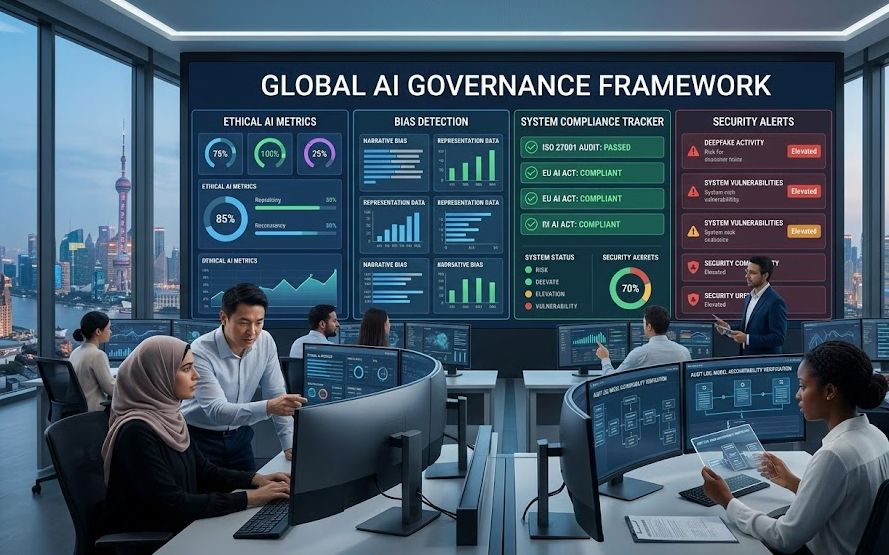
Definition: ‘Global AI Governance’ refers to an integrated framework of norms, policies, legal structures, and international agreements designed to regulate the development, deployment, and use of Artificial Intelligence (AI) at a global level. Its primary objective is to ensure that AI technologies are developed in a transparent, secure, ethical, and human-rights-compliant manner, mitigating risks like deepfakes and algorithmic bias while ensuring an equitable distribution of its benefits across humanity.
Why is ‘Global AI Governance’ Needed?
- Border-less Nature: AI technologies are not confined by geographical boundaries. A powerful AI model developed in one country can instantly impact any corner of the world, making fragmented national laws insufficient.
- Existential and Security Risks: A unified framework is critical to tackle threats such as deepfakes, advanced cyberattacks, bio-terrorism, and the development of ‘Lethal Autonomous Weapons Systems’ (LAWS).
- Algorithmic Bias and Ethics: AI systems can inherit racial, gender, or linguistic biases from their training data. Global ethical guidelines are necessary to ensure transparent and accountable AI.
- Tackling Tech Monopoly: A handful of multinational technology corporations (Big Tech) currently hold a monopoly over AI research and massive datasets. A global governance framework can check this severe power imbalance.
- Socio-Economic Impact: Universal guidelines help mitigate large-scale job displacement caused by AI automation and prevent a widening digital divide between developed and developing nations.
Key Global AI Governance Initiatives So Far
- EU AI Act (European Union): The world’s first comprehensive and legally binding AI legislation. It adopts a ‘risk-based approach’, categorising AI systems into unacceptable, high, medium, and low-risk tiers.
- Bletchley Declaration: Signed by 28 nations, including India, during the first Global AI Safety Summit in the UK (November 2023). It focuses on identifying and mitigating the shared risks of ‘Frontier AI’ (highly advanced AI models).
- Global Partnership on AI (GPAI): An international multi-stakeholder forum of 29 countries (with India as a founding member) that supports the responsible development of AI based on human rights and democratic values.
- United Nations (UN) Efforts: In March 2024, the UN General Assembly unanimously adopted its first resolution to promote safe, secure, and inclusive AI. Additionally, the UN has formed a ‘Global AI Advisory Body’.
- G7’s Hiroshima AI Process: An initiative aimed at establishing international guiding principles and a code of conduct for developers of advanced AI systems, specifically focusing on mitigating the risks of Generative AI.
Issues and Challenges
- Lack of Global Consensus: There is a stark contradiction in the approaches of major global players. The US prioritises an innovation-pro stance; the EU demands strict, legally binding regulation; while China emphasizes state-controlled, aligned AI models.
- Pace of Technology vs. Regulation: AI technology is evolving exponentially faster than the formulation of laws and international treaties, rendering policies obsolete very quickly.
- Neglect of the Global South: Most AI safety standards are being driven by developed, Western nations. The specific concerns of developing countries, such as linguistic diversity and the lack of basic digital infrastructure, fail to get adequate representation.
- Lack of Enforcement Mechanisms: Currently, most global initiatives (like GPAI or the Bletchley Declaration) are merely voluntary or declaratory. There is no binding international body to penalise countries or corporations that violate ethical rules.
Future Strategy
- Establishment of an International AI Agency: On the lines of the International Atomic Energy Agency (IAEA) for nuclear energy, a powerful ‘Global AI Agency’ should be formed for worldwide monitoring, standard-setting, and compliance auditing.
- Inclusive ‘Multi-stakeholder’ Approach: AI governance must not be a monopoly of governments alone. Policy-making should involve technology giants, civil society, academia, and ensure equal parity for the Global South (including India, Africa, and Latin America).
- Agile Regulation: To keep pace with rapid technological shifts, regulation must remain flexible. Governments should adopt a ‘Regulatory Sandbox’ approach to test advanced AI systems within controlled, real-world environments.
- Balancing Innovation and Safety: A universal framework should avoid micro-managing innovation but must draw clear red lines—such as enforcing strict bans on using deepfakes to manipulate elections or deploying human-rights-violating facial recognition systems.
Practice Question for Preliminary Examination
Q. With reference to the ‘World Artificial Intelligence Cooperation Organisation’ (WAICO), which has been in the news recently, consider the following statements:
- WAICO has been established primarily with the strategic cooperation of Western nations, such as the United States and the European Union.
- The headquarters of this organisation is located in Shanghai, China.
- India, despite being a founding member of BRICS, has chosen not to join WAICO.
Which of the statements given above is/are correct?
(a) 1 and 2 only
(b) 2 and 3 only
(c) 1 and 3 only
(d) 1, 2 and 3
Answer: (b) 2 and 3 only
- Explanation: Statement 1 is incorrect because WAICO has been established by China in collaboration with the developing countries of the Global South (across Asia, Africa, and Latin America), deliberately positioning it as an alternative to Western frameworks. Statements 2 and 3 are correct; its headquarters is based in Shanghai, and India has kept its distance from the initiative.
Practice Question for Mains Examination
Q. “The establishment of the World Artificial Intelligence Cooperation Organisation (WAICO) is part of China’s strategy to expand its influence in the Global South and establish technological sovereignty.” In light of this statement, analyze the emerging geopolitical rivalry in the field of Global AI Governance and discuss its implications for India. (250 words)
Approach for Mains Answer:
- Introduction: Mention the recent formation of WAICO in Shanghai by China alongside 29 developing nations, highlighting how it reflects Beijing’s global AI leadership ambitions and the fracturing of global tech governance.
- Body Part 1 (China’s Strategy and Significance of WAICO):
- Discuss China’s capacity-building outreach (e.g., offering 5,000 training opportunities) to build alliances across the Global South.
- Highlight the push for open-source alternatives (like DeepSeek and Moonshot) to counter reliance on Western models (ChatGPT, Claude) and bypass sanctions.
- Address the pushback against Western ideological alignment and the protection of cultural sovereignty.
- Body Part 2 (Emerging Geopolitical AI Rivalry): Explain how AI has transformed from a commercial technology into a core instrument of strategic competition between the US and China. Touch upon issues of technology containment, export controls, national security, and the race to set global technological standards to avoid ‘Data Colonialism’.
- Body Part 3 (Implications for India):
- Analyze why India stayed away from WAICO despite its BRICS ties (e.g., trust deficit and border disputes with China, coupled with data security concerns).
- Emphasize the need for India to consolidate its domestic framework via the ‘INDIAai’ mission and elevate its leadership status within democratic forums like GPAI.
- Conclusion: Conclude by asserting that AI governance should avoid polarization into separate power blocs and instead champion global public good. Highlight that India is uniquely positioned to bridge the gap by fostering a democratic, ethical, and inclusive global AI architecture.