Table of Contents
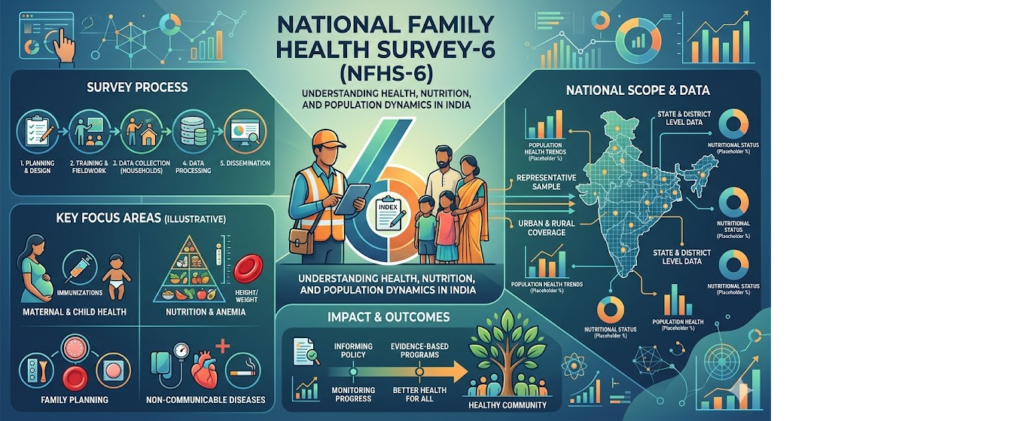
The Ministry of Health and Family Welfare recently released the data from the National Family Health Survey-6 (NFHS-6). Conducted in 2023-2024 by the Health Ministry in collaboration with the International Institute for Population Sciences (IIPS), it is the first comprehensive health survey conducted in India after the COVID-19 pandemic.
Key Highlights of the Survey
Child Health and Nutritional Indicators
The survey recorded significant improvements in tackling child malnutrition:
- Stunting (low height-for-age): Declined substantially from 35.5% (NFHS-5) to 29.3% among children under five years.
- Severe Wasting (low weight-for-height): Dropped from 7.7% to 5.2%.
- Underweight: Saw a marginal improvement, slipping from 32.1% to 31.8%.
- Disease Prevalence: Symptoms of acute respiratory infection (ARI) fell to 1.9%, and severe diarrhoea prevalence dropped to 0.5%.
- Breastfeeding: An impressive 95.6% of infants under six months were exclusively breastfed.
Maternal Health and Family Planning
- Total Fertility Rate (TFR): Held steady at 2.0, which is just below the demographic replacement threshold of 2.1, indicating population stabilization.
- Contraceptive Prevalence Rate (CPR): Increased from 66.7% to 69.1%.
- Antenatal Care (ANC): 95.9% of pregnant women received ANC. First-trimester ANC coverage rose to 76.2%, and mothers receiving at least four ANC visits increased to 65.2%.
- Institutional Deliveries: Increased to 90.6% (up from 88.6%).
- Maternal Nutrition: Consumption of iron-folic acid (IFA) supplements improved significantly—mothers consuming IFA for 100+ days rose to 54.9%, and for 180+ days to 37.8%.
Immunisation and Hygiene
- Universal Immunisation: Full vaccination coverage (children aged 12-23 months, based on cards) rose from 83.8% to 87.1%. The public health system facilitated 95.6% of these vaccinations.
- Specific Vaccines: Rotavirus coverage saw a massive jump (36.4% to 85.4%), and the second dose of the measles-containing vaccine increased to 71.8%.
- Menstrual Hygiene: Use of hygienic methods of menstrual protection among young women (15-24 years) improved to 79.2%.
Areas of Persistent Concern or Challenges Flagged
- The Caesarean Section (C-Section) Paradox: Despite better institutional deliveries, C-section rates have spiked to 27.2% (from 21.5%).
- In urban areas, it stands at an alarming 40%.
- This far exceeds the World Health Organization (WHO) optimal threshold of 10%-15%, indicating potential over-medicalization, especially in private healthcare facilities.
- The Dual Burden of Disease: The survey highlighted a persistent “dual burden” of undernutrition coexisting with increasing adult obesity.
- Lifestyle Diseases: A noticeable increase in non-communicable diseases (NCDs) and lifestyle-related health risks among adults.
Here are the structured, comprehensive notes on the National Family Health Survey (NFHS) and India’s global standing on child health and nutrition.
What Is the National Family Health Survey?
- The National Family Health Survey (NFHS) is a large-scale, multi-round survey conducted in a representative sample of households throughout India.
- It is the most comprehensive and reliable source of demographic and health data in the country.
Institutional Framework
- Nodal Ministry: The Ministry of Health and Family Welfare (MoHFW), Government of India, designates the coordinating agency.
- Coordinating Agency: The International Institute for Population Sciences (IIPS), Mumbai, acts as the nodal agency responsible for providing coordination and technical guidance for the survey.
- Collaborators & Funders: The survey is conducted with assistance from various field organizations and is often supported financially by international bodies like USAID, UNICEF, the Bill & Melinda Gates Foundation, and the UNFPA.
Core Objectives
- High-Quality Data: To provide high-quality data on health and family welfare needed by the MoHFW and other agencies for policy formulation and program evaluation.
- Tracking Indicators: To provide estimates of important indicators at the National, State, and District levels.
- Global Comparisons: To provide data on demographic and health parameters to facilitate cross-national comparisons and track progress toward the Sustainable Development Goals (SDGs).
Key Themes Covered
The survey captures data across a wide spectrum of health and social indicators:
- Fertility and family planning
- Maternal and child health (ANC, institutional deliveries, immunizations)
- Infant and child mortality
- Nutrition, infant feeding practices, and anemia
- Non-Communicable Diseases (NCDs) like hypertension and blood sugar
- Women’s empowerment and domestic violence
India’s Global Position on Child Health and Nutrition
Despite the domestic improvements recorded in recent surveys like NFHS-5 and NFHS-6, India’s global standing on child health and nutrition remains a critical area of concern. India continues to house a disproportionately large share of the world’s malnourished children.
1. Global Hunger Index (GHI) Standing
- India consistently ranks low on the Global Hunger Index (typically falling in the “serious” category). For context, in the 2023 GHI, India ranked 111th out of 125 countries, trailing behind neighboring nations like Sri Lanka, Nepal, and Bangladesh.
- Controversy: The Indian government frequently contests the GHI methodology, arguing it relies heavily on childhood indicators (stunting, wasting, mortality) rather than the entire population’s nutritional intake, and uses small sample opinion polls.
2. The Burden of “Severe Wasting”
- Highest Global Burden: According to UNICEF and WHO global nutrition reports, India consistently records the highest child wasting rate in the world (children whose weight is too low for their height).
- Even with the NFHS-6 drop to 5.2% for severe wasting, the absolute number of affected children remains in the millions due to India’s vast population size.
3. Stunting (Height-for-Age)
- While India has reduced stunting from 38.4% (NFHS-4) to 29.3% (NFHS-6), it still accounts for nearly one-third of the global burden of stunted children.
- Stunting is a marker of chronic undernutrition and directly impacts cognitive development, restricting the country’s ability to fully capitalize on its demographic dividend.
4. Hidden Hunger (Micronutrient Deficiency)
- India faces a severe crisis of “hidden hunger,” particularly Anemia. Globally, India has one of the highest prevalences of anemia among women of reproductive age and children under five.
- This is driven by iron, folic acid, and Vitamin B12 deficiencies, exacerbated by a predominantly cereal-heavy diet that lacks dietary diversity (inadequate intake of proteins, fruits, and vegetables).
5. Infant and Under-5 Mortality
- India has made remarkable strides globally in reducing its Infant Mortality Rate (IMR) and Under-5 Mortality Rate (U5MR) over the last two decades.
- However, compared to developed nations and even middle-income BRICS peers (like China and Brazil), India’s absolute mortality figures remain high, heavily concentrated in specific states (e.g., UP, Bihar, MP) and marginalized communities.
Here are the comprehensive, Vision IAS-style notes detailing the key government interventions aimed at improving India’s health and family welfare indicators and boosting its global standing (particularly concerning the Sustainable Development Goals – SDGs).
Key Government Interventions: Health & Family Welfare
To improve its global standing, achieve universal health coverage (UHC), and meet the targets set by SDG 3 (Good Health and Well-being), the Government of India has launched a multi-pronged strategy. These interventions are categorized under major pillars of health and family welfare.
1. Universal Health Coverage (UHC) & Infrastructure
- Ayushman Bharat Scheme: The flagship umbrella scheme designed to shift the focus from sectoral, segmented care to a comprehensive, need-based approach. It has two components:
- Pradhan Mantri Jan Arogya Yojana (PM-JAY): The world’s largest health insurance scheme fully financed by the government. It provides a health cover of ₹5 lakhs per family per year for secondary and tertiary care hospitalization to over 12 crore vulnerable families.
- Ayushman Arogya Mandirs (formerly Health and Wellness Centres – HWCs): Upgrading existing sub-centers and primary health centers to deliver Comprehensive Primary Health Care (CPHC), including free essential drugs, diagnostic services, and maternal/child care, while significantly expanding the focus on Non-Communicable Diseases (NCDs).
- PM Ayushman Bharat Health Infrastructure Mission (PM-ABHIM): Launched post-COVID-19 to fill critical gaps in public health infrastructure. It focuses on developing critical care hospital blocks in every district and strengthening the network of public health labs for better disease surveillance and pandemic preparedness.
2. Maternal and Child Health (MCH)
- Janani Suraksha Yojana (JSY) & Janani Shishu Suraksha Karyakaram (JSSK): These schemes promote institutional deliveries by providing cash incentives (JSY) and entirely free, cashless delivery services, including free C-sections, drugs, and diet for pregnant women and sick infants (JSSK). Result: NFHS-6 shows institutional deliveries at 90.6%.
- Pradhan Mantri Matru Vandana Yojana (PMMVY): A maternity benefit program providing a direct cash transfer of ₹5,000 in three installments to pregnant women and lactating mothers for the first living child. It aims to provide partial compensation for wage loss and improve nutritional-seeking behavior.
- Surakshit Matritva Aashwasan (SUMAN): Aims to provide assured, dignified, respectful, and free healthcare at no cost to all pregnant women and newborns visiting public health facilities, targeting zero preventable maternal and newborn deaths.
3. Immunization and Disease Control
- Mission Indradhanush (MI) & Intensified Mission Indradhanush (IMI): Launched to rapidly increase full immunization coverage of children and pregnant women to 90%+. It specifically targets marginalized populations, nomadic tribes, and urban slums who missed out on the routine Universal Immunization Programme (UIP).
- National Tuberculosis Elimination Programme (NTEP): India aims to eliminate TB by 2025, five years ahead of the global SDG target of 2030. The Ni-kshay Poshan Yojana provides ₹500/month for nutritional support to TB patients.
4. Nutrition and Combating “Hidden Hunger”
- Saksham Anganwadi and POSHAN 2.0: An integrated nutrition support program that converges various schemes to address malnutrition in children, adolescent girls, pregnant women, and lactating mothers. It heavily emphasizes the first 1,000 days of a child’s life.
- Anaemia Mukt Bharat (AMB): Utilizes a 6x6x6 strategy (6 target beneficiary groups, 6 interventions, and 6 institutional mechanisms) to accelerate the decline in anemia prevalence, a major global concern for India. It includes the mass provision of Iron and Folic Acid (IFA) supplements and deworming.
- Food Fortification: The mandatory fortification of staples like rice, wheat, oil, and milk with critical micronutrients (Iron, Folic Acid, Vitamin B12) distributed through the Public Distribution System (PDS) and PM-POSHAN (Mid-Day Meal) scheme.
5. Family Planning and Population Stabilization
- Mission Parivar Vikas: Launched to significantly increase access to contraceptives and family planning services in 146 high-fertility districts across 7 high-focus states (which had a Total Fertility Rate of 3 or more).
- Expansion of Contraceptive Choices: Introduction of new reversible spacing methods, such as Injectable Contraceptives (Antara program) and Centchroman (Chhaya pills), ensuring reproductive rights and spacing between children. Result: NFHS-6 notes TFR has stabilized at 2.0.
6. Digital Health Revolution
- Ayushman Bharat Digital Mission (ABDM): Aims to develop the backbone necessary to support the integrated digital health infrastructure of the country. It creates seamless online platforms through the provision of a unique ABHA (Ayushman Bharat Health Account) ID for citizens, enabling voluntary sharing of digital health records across healthcare providers.
Way Forward (For Mains Value Addition)
While these interventions have catalyzed structural improvements (as seen in the latest NFHS-6 data), India’s global standing requires a pivot towards Quality of Care. Moving forward, India must:
- Increase Health Financing: Enhance public health expenditure to 2.5% of GDP as envisioned in the National Health Policy 2017 (currently hovering around 1.3 – 1.9%).
- Address the Urban-Rural Divide: Strengthen urban primary health infrastructure to manage the rising dual burden of undernutrition and urban lifestyle diseases (NCDs).
- Regulate Private Healthcare: Strict implementation of the Clinical Establishments Act to curb the over-medicalization of care, such as the alarming rise in private-facility C-sections noted in NFHS-6.
Prelims Oriented Question
Q. Consider the following statements with reference to the findings of the National Family Health Survey-6 (NFHS-6):
- The Total Fertility Rate (TFR) at the national level has now dropped below the replacement level of 2.1.
- The rate of Caesarean section deliveries in urban India is well within the optimal threshold recommended by the World Health Organization (WHO).
- The International Institute for Population Sciences (IIPS) acts as the nodal agency for conducting the NFHS.
How many of the statements given above are correct?
(a) Only one
(b) Only two
(c) All three
(d) None
Answer: (b) Only two
- Statement 1 is correct: NFHS-6 data shows the TFR holding steady at 2.0, which is under the replacement threshold of 2.1.
- Statement 2 is incorrect: The C-section rate in urban areas is 40%, which far exceeds the WHO optimal threshold of 10%-15%.
- Statement 3 is correct: The Health Ministry conducts the survey along with the International Institute for Population Sciences (IIPS).
Mains Oriented Question
Q. While the National Family Health Survey-6 (NFHS-6) highlights India’s decisive victory over several maternal and child health challenges, it also exposes the growing “dual burden” of disease and the over-medicalization of maternal care. Analyze this statement in light of the survey’s findings. (250 words, 15 Marks)
Approach to the Answer:
- Introduction: Briefly introduce NFHS-6 as the first post-pandemic health survey. State its overarching theme: success in traditional health metrics but emergence of modern health paradoxes.
- Body Paragraph 1 (The Victories – Maternal & Child Health): Highlight data points showing progress. Mention the drop in stunting (29.3%) and wasting, near-universal institutional deliveries (90.6%), improvements in ANC visits, and the massive jump in Rotavirus vaccination (85.4%). Connect this to effective public health interventions.
- Body Paragraph 2 (The Dual Burden of Disease): Explain the transition from communicable to non-communicable diseases (NCDs). Discuss the survey’s finding of undernutrition existing alongside rising adult obesity and lifestyle risks, complicating public health policy.
- Body Paragraph 3 (Over-medicalization of Care): Address the sharp rise in Caesarean sections (27.2% overall, 40% in urban areas). Contrast this with the WHO’s 10-15% threshold. Briefly mention the factors driving this (private healthcare commercialization, urban lifestyle changes) and the financial/health risks it poses to mothers.
- Conclusion: Summarize that India’s public health strategy must now pivot. While sustaining momentum on immunization and rural maternal care, policies must urgently address NCD prevention, regulate private healthcare practices (especially unnecessary C-sections), and promote holistic nutrition.