Table of Contents
Nepal’s newly elected Prime Minister, Balendra Shah, recently made an unprecedented statement in Parliament acknowledging that Nepal, alongside India, has encroached upon Indian territories in various places.
Key Highlights of the Development
- The Statement: While responding to questions regarding the disputed Kalapani region, PM Shah stated publicly for the first time by a Nepali head of government that territorial encroachment has been a two-way occurrence.
- Recent Trigger: The historical dispute resurfaced recently following India’s announcement of the revival of the Kailash Manasarovar Yatra pilgrimage via the Lipulekh route.
- Diplomatic Fallout: In response to the Kailash Yatra route development, Nepal had issued formal diplomatic protest notes to both India and China.
- Domestic Backlash: The remarks caused uproar in the Nepali Parliament. Lawmakers from the Nepali Congress and the Nepali Communist Party demanded clarity on the specific locations and sought the expunging of the remarks from parliamentary records, citing threats to national integrity.
- Political Context: This was PM Shah’s (belonging to the Rastriya Swatantra Party) first address to Parliament since assuming office in March, an election triggered by Gen Z protests in September of the previous year.
Boundary Disputes Between India and Nepal
While approximately 97% of the border is demarcated, two primary friction points remain unresolved.
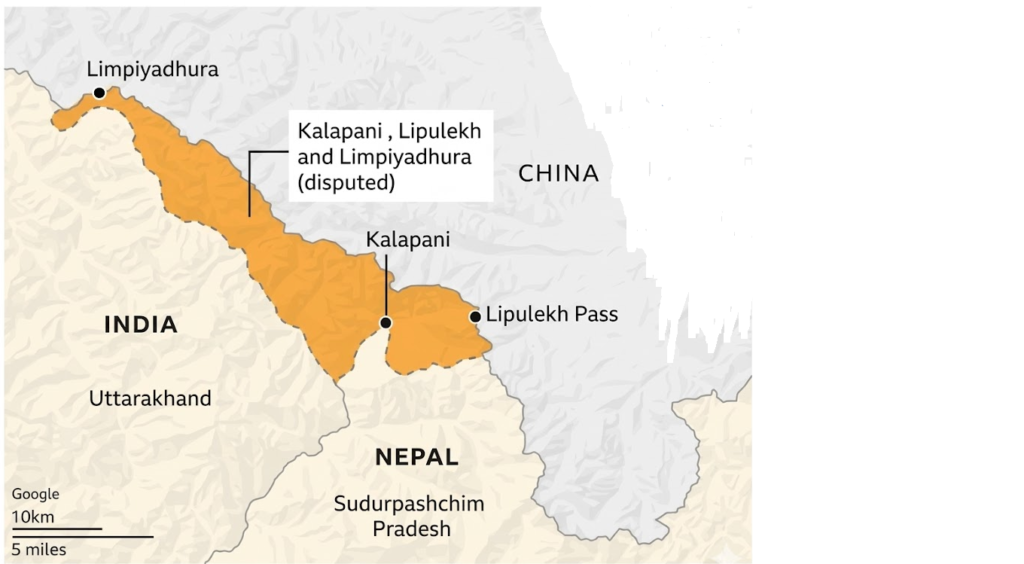
- The Western Sector (Kalapani, Lipulekh, and Limpiyadhura):
- The Core Issue: India administers this region as part of the Pithoragarh district in Uttarakhand. Nepal claims the territory based on the 1816 Sugauli Treaty, arguing that the Mahakali River originates at Limpiyadhura (placing the territory in Nepal), whereas India argues the river originates further east at Kalapani.
- Strategic Importance: The Lipulekh Pass is a vital tri-junction with China (Tibet) and is the traditional route for Indian pilgrims undertaking the Kailash Mansarovar Yatra.
- The Eastern Sector (Susta): Located in Bihar. The dispute here is largely topographical, arising from the shifting course of the Gandak River over the decades, which has altered the natural boundary.
India-Nepal Relationship: History
India and Nepal share a unique “Roti-Beti” (food and marriage) relationship, characterized by an open border of 1,751 km and deep civilizational, cultural, and religious ties.
The Treaty of Sugauli: 1816
Signed after the Anglo-Nepalese War, establishing the Mahakali River as Nepal’s western boundary. Differing interpretations of this treaty form the root of today’s territorial disputes.
Treaty of Peace and Friendship: 1950
The bedrock of modern relations. It granted Nepalese citizens “national treatment” in India, allowing them to live, work, and own property freely, while providing mutual security guarantees.
Democratic Transition & Realignment: 1990-2015
India shifted from supporting the monarchy (the ‘Twin Pillar’ policy) to facilitating a secular, multi-party federal republic.
Constitutional Crisis & Economic Blockade: 2015
The promulgation of Nepal’s new Constitution led to Madhesi protests and an “informal blockade” at the Indian border, triggering a surge in Nepali ultra-nationalism and a pivot toward China.
Cartographic Dispute & Political Reset: 2020-2026
Tensions flared over the Lipulekh pass in 2020 (leading to Nepal’s revised political map) and resurfaced during the 2025/2026 Kailash Mansarovar Yatra developments, amidst a major generational political shift in Kathmandu.
Recent Developments
The bilateral relationship has entered a dynamic phase following the Gen Z-led political protests in Nepal (late 2025) and the subsequent election of Prime Minister Balendra Shah in early 2026. His recent parliamentary remarks—suggesting that border encroachment might be a two-way issue—have brought renewed focus to the historical boundary disputes between the two nations.
Effect of the Boundary Dispute on the Relationship
Border frictions do not exist in a vacuum; they create ripple effects across the entire bilateral spectrum:
- Rise of Ultra-Nationalism: Boundary issues are heavily politicized in Nepal’s domestic elections. Anti-India rhetoric is frequently used to consolidate domestic vote banks, hardening diplomatic stances and reducing the room for compromise.
- The ‘China Card’: During periods of border tension or perceived blockades, Nepal has actively sought to diversify its transit and trade dependence away from India. This culminated in Nepal joining China’s Belt and Road Initiative (BRI) and seeking alternative transit agreements with Beijing.
- Project Delays & Trust Deficit: Diplomatic chills directly impact joint economic initiatives. Mega-projects like the Pancheshwar Multipurpose Project often face bureaucratic hurdles and delays when political trust wanes.
- Trade Disruptions: Border tensions occasionally lead to retaliatory non-tariff barriers, complicating the daily commerce and livelihoods of millions living along the porous border.
Treaties and Agreements to Enhance the Relationship
Despite political friction, structural cooperation remains robust through several key pacts:
| Treaty / Agreement | Sector | Key Feature |
| Treaty of Peace and Friendship (1950) | Strategic / Civil | National treatment for Nepalese citizens in India (jobs, property, movement). |
| Kosi (1954) & Gandak (1959) Agreements | Water Resources | Foundational frameworks for flood management and regional irrigation. |
| Mahakali Treaty (1996) | Water / Energy | Aimed at equitable sharing of the Mahakali river basin waters. |
| Power Trade Agreement (2014 & 2024) | Energy | Facilitates cross-border grid connectivity; Nepal aims to export 10,000 MW to India over a decade. |
| Digital Integration (2024-2025) | Technology | Integration of India’s UPI with Nepal’s FonePay, digitizing cross-border remittances and trade. |
Other Emerging Challenges
- Security Concerns of an Open Border: The porous border is occasionally exploited for organized crime, human trafficking, and the circulation of counterfeit currency.
- Agneepath Scheme & Gurkha Recruitment: India’s shift to the short-term Agnipath military recruitment model altered the traditional terms for Gurkha soldiers. In response, Nepal suspended new recruitment, freezing a historic military bond.
- Trade Deficit: India is Nepal’s largest trading partner (accounting for ~70% of its trade), but the massive trade imbalance causes economic anxiety in Kathmandu.
- China’s Expanding Footprint: Beijing has moved beyond infrastructure investments (FDI) into political funding and ideological training, attempting to influence Nepal’s domestic politics and elections.
Way Forward
To navigate the evolving political landscape and maintain its status as Nepal’s partner of choice, India must calibrate its approach:
- Shift to ‘Quiet Diplomacy’: India must definitively abandon any perceived “Big Brother” paternalism. Engaging with Nepal’s new Gen-Z political leadership requires pragmatic, issue-based diplomacy that respects their mandate.
- Reactivate Boundary Mechanisms: The Susta and Kalapani disputes should be decoupled from mainstream political rhetoric and handed back to the technical Boundary Working Group (BWG) to be resolved based on historical and hydrological evidence.
- Focus on HICDPs: Instead of solely pushing delayed mega-projects, India should aggressively execute High-Impact Community Development Projects (HICDPs)—schools, hospitals, and rural electrification—that win grassroots goodwill.
- Deepen Economic Integration: Fast-tracking the 10,000 MW hydropower import agreement will help offset Nepal’s trade deficit. Simultaneously, expanding the UPI-Nepal payment corridor will secure long-term digital interdependence.
- Modernize the 1950 Treaty: India should express an open willingness to review and update the 1950 Treaty of Peace and Friendship through the Eminent Persons Group (EPG), ensuring it reflects the realities of a modern, aspirational Nepal.
UPSC Prelims (PT) Practice Question
Q. Consider the following statements with reference to the territorial disputes and geographical regions concerning India and Nepal:
- The regions of Kalapani, Limpiyadhura, and Lipulekh are administered by India as part of the state of Uttarakhand.
- The Lipulekh route is utilized by Indian pilgrims undertaking the Kailash Manasarovar Yatra.
- The modern boundary delineation between India and Nepal is primarily based on the Treaty of Yandabo.
Which of the statements given above is/are correct?
(a) 1 and 2 only
(b) 2 and 3 only
(c) 1 only
(d) 1, 2 and 3
Correct Answer: (a)
- Statement 1 is correct: India maintains and administers Kalapani, Limpiyadhura, and Lipulekh as part of the Pithoragarh district in Uttarakhand.
- Statement 2 is correct: The Lipulekh pass route is a traditional and vital corridor for pilgrims traveling to Mount Kailash and Lake Manasarovar in Tibet.
- Statement 3 is incorrect: The India-Nepal boundary was largely defined by the Treaty of Sugauli (1816), not the Treaty of Yandabo (which was signed in 1826 after the First Anglo-Burmese War to define boundaries with Myanmar/Burma).
UPSC Mains Practice Question
Q. “Despite deep-rooted historical and cultural ties, unresolved border disputes periodically threaten to derail the India-Nepal bilateral relationship.” In the context of the Kalapani-Lipulekh dispute, examine the causes of recurring friction and suggest diplomatic measures to build mutual trust. (150 words, 10 marks)
Brief Approach for Mains:
- Introduction: Briefly outline the “Roti-Beti” (special) relationship between India and Nepal. Introduce the Kalapani-Lipulekh-Limpiyadhura dispute as a key contemporary irritant.
- Causes of Recurring Friction:
- Historical Ambiguity: Differing cartographic interpretations of the Mahakali River’s origin under the 1816 Treaty of Sugauli.
- Strategic Infrastructure: India’s imperative to build roads (like the Lipulekh pass road) for border security and the Kailash Yatra, which triggers sovereignty anxieties in Nepal.
- Domestic Politics: The politicization of the border issue within Nepal’s domestic electoral landscape (hyper-nationalism vs. acknowledging ground realities).
- Diplomatic Measures/Way Forward:
- Reactivating bilateral boundary working groups (like the Boundary Working Group established in 2014) to rely on historical, cartographic, and hydrological evidence.
- Quiet diplomacy over megaphone diplomacy to prevent public posturing.
- Focusing on regional connectivity, economic integration, and people-to-people ties to prevent single-point border disputes from holding the entire bilateral agenda hostage.
- Conclusion: Conclude with the need for mature neighborhood diplomacy, echoing the ethos of the “Neighbourhood First” policy.