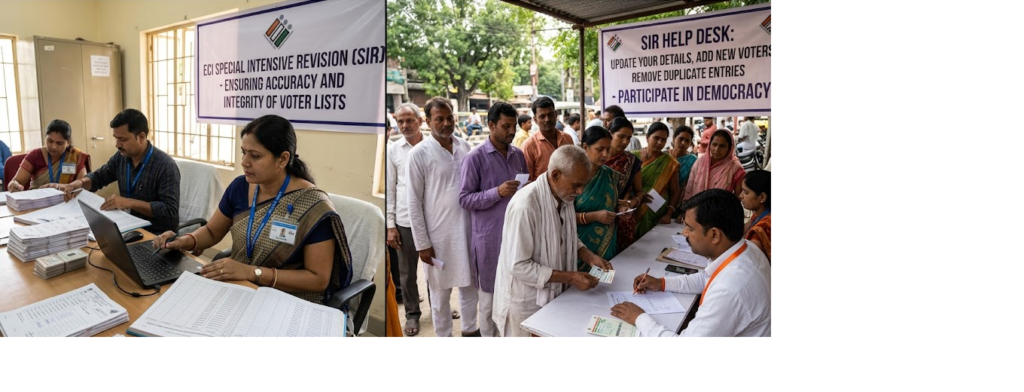
The Election Commission of India (ECI) has officially commenced the enumeration phase of the third round of the Special Intensive Revision (SIR) of electoral rolls in Odisha, Mizoram, Sikkim, and Manipur.
Key Highlights of the SIR Exercise
- Objective: The primary goal of the SIR is to create a defect-free electoral roll, ensuring that no eligible citizen is left out while simultaneously ensuring that no ineligible person is included.
- Phased Implementation:
- The ECI has already completed the SIR in 10 States and 3 Union Territories (UTs) across two phases, alongside a special revision in Assam.
- Phase 3 Scope: It is being conducted in a staggered manner across 16 States and 3 UTs (comprising a combined voter base of 36.73 crore).
- Geographical Exceptions: Once the third phase is complete, the SIR exercise will have covered the entire country except Himachal Pradesh, Jammu and Kashmir, and Ladakh.
- Eligibility Criteria for Voters: As per the ECI, an individual is entitled to be registered in the electoral roll if they are:
- A citizen of India.
- Not less than 18 years of age on the qualifying date.
- Not otherwise disqualified under any prevailing law.
Procedural Mechanics (Voter Registration)
- Draft Electoral Roll Inclusion: Eligible electors whose enumeration forms reach the Electoral Registration Officer by June 28 will be featured in the draft electoral rolls.
- Form 6: Voters who miss the initial enumeration deadline can still apply using Form 6 (the standard form designated for the inclusion of new voters). This must be submitted along with a prescribed declaration form during the designated “claims and objections” period.
💡 Value Addition for UPSC
- Constitutional Provision: Article 326 of the Constitution provides for universal adult suffrage, mandating that elections to the Lok Sabha and State Legislative Assemblies be based on adult franchise (lowered from 21 to 18 years via the 61st Amendment Act, 1988).
- Statutory Backing: The preparation, revision, and updating of electoral rolls are governed by the Representation of the People Act (RPA), 1950.
UPSC Prelims (PT) Practice Question
Q. With reference to the preparation and revision of Electoral Rolls in India, consider the following statements:
- A person who is a citizen of India and is not less than 18 years of age on the qualifying date is strictly entitled to be registered in the electoral roll without any exceptions.
- Under Election Commission guidelines, Form 6 is utilized specifically for the inclusion of names of new voters in the electoral roll.
- The Election Commission of India derives its power to superintend, direct, and control the preparation of electoral rolls directly from the Representation of the People Act, 1951.
Which of the statements given above is/are correct?
(a) 1 and 2 only
(b) 2 only
(c) 2 and 3 only
(d) 1, 2 and 3
Correct Answer: (b)
- Statement 1 is incorrect: While an 18-year-old citizen is generally eligible, they are subject to disqualification under specific laws (e.g., corrupt practices, unsoundness of mind). It is not an absolute right “without any exceptions.”
- Statement 2 is correct: Form 6 is explicitly meant for the registration of new voters.
- Statement 3 is incorrect: The ECI derives its constitutional power for the preparation of electoral rolls from Article 324, while the specific statutory mechanics for electoral rolls are outlined in the RPA, 1950 (not RPA, 1951, which deals with the actual conduct of elections).
UPSC Mains Practice Question
Q. “A robust and defect-free electoral roll is the bedrock of a functioning democracy.” In light of this statement, evaluate the significance of the Special Intensive Revision (SIR) exercises conducted by the Election Commission of India. What are the key challenges in maintaining an updated electoral roll? (150 words, 10 marks)
Brief Approach for Mains:
- Introduction: Define what an electoral roll is and quote Article 324/Article 326. State why a pure electoral roll is essential for free and fair elections.
- Significance of SIR:
- Prevents disenfranchisement (no eligible voter left behind).
- Prevents proxy voting and electoral fraud (removal of dead/duplicate/ineligible entries).
- Accommodates demographic shifts (migration, newly eligible 18-year-olds).
- Challenges:
- High internal migration leading to duplicate entries or disenfranchisement.
- Apathy among urban and young voters in filling out forms (like Form 6) or responding during the claims/objections period.
- Logistical hurdles in remote areas.
- Conclusion: Briefly mention recent reforms (e.g., linking Aadhaar with Voter ID voluntarily, multiple qualifying dates introduced recently) to keep the rolls updated dynamically.