Table of Contents
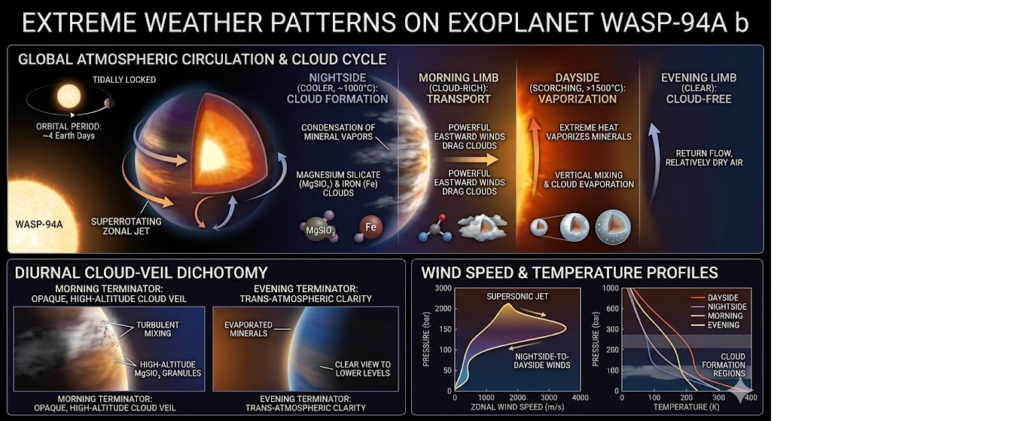
Astronomers have successfully deciphered the extreme weather patterns of an exoplanet located nearly 700 light-years away using NASA’s James Webb Space Telescope (JWST). The study, published in the journal Science, revealed a dynamic weather cycle of cloudy mornings and clear evenings on a distant gas giant.
Key Highlights of the Discovery
- Target Exoplanet (WASP-94A b): It is a gas giant classified as a ‘Hot Jupiter’. It is nearly twice the size of Jupiter but contains only half its mass.
- Tidally Locked Orbit: The planet orbits extremely close to its parent star, completing a revolution in just four days. It is tidally locked, meaning its rotation is synchronized with its revolution (the same side always faces the star, much like Earth’s Moon).
- Dayside: A scorching desert capable of melting rock.
- Nightside: Perennially dark and frozen, with temperatures approaching absolute zero.
- The Weather Cycle: The planet exhibits an extreme weather dichotomy:
- Mornings: Blanketed in thick clouds composed of magnesium silicate, iron, and magnesium sulphide.
- Evenings: Feature clear, cloud-free skies.
- Mechanism: Clouds form on the cooler nightside, are swept across the globe by extremely fast winds to the morning limb, and eventually vaporize as they reach the intensely hot dayside.
Methodology: How Was It Studied?
- Transit Method: The discovery was made by observing the planet as it passed (transited) slowly in front of its host star. Because the transit was slow, astronomers could scan different segments of the atmosphere at different times, isolating the morning and evening signals.
- Transmission Spectroscopy: As starlight passes through the exoplanet’s atmosphere, specific molecules absorb specific wavelengths of light. This creates gaps in the light spectrum (a chemical fingerprint) recorded by the spectrometer, allowing scientists to identify the atmospheric composition.
Significance of the Study
- Removing Data Bias: Clouds often obscure underlying chemical signatures. By isolating the clear evening side from the cloudy morning side, scientists proved that assuming a uniform atmosphere can severely bias estimates of an exoplanet’s true composition.
- Planetary Evolution: Measuring the exact composition of such planets helps scientists reconstruct the conditions of protoplanetary disks (gas and dust around young stars) from 4.6 billion years ago. It helps answer whether planets formed from solid material or gas, and whether the same processes could create small, rocky planets like Earth.
- Future Prospects: This proof of concept sets the stage for next-generation facilities like the Extremely Large Telescope (ELT) (currently being built in Chile) to discover exoplanet nurseries and potentially locate true Earth-twins.
Value Addition for UPSC
- James Webb Space Telescope (JWST): Launched in December 2021, it is a premier infrared space observatory. Its unprecedented sensitivity—capable of discerning details on a small coin from 50 km away—allows it to peer through cosmic dust to study galaxy formation and exoplanet atmospheres.
- Bizarre Exoplanet Weather: Beyond WASP-94A b, astronomers have found extreme exoplanets where conditions cause rain made of molten metal, vaporized rock, molten glass (pushed by supersonic winds), or even crystallized carbon (diamonds).
UPSC Prelims (PT) Practice Question
Q. With reference to the observation of exoplanets and their characteristics, consider the following statements:
- ‘Hot Jupiters’ are a class of gas giant exoplanets characterized by their close proximity to their host stars and exceedingly high surface temperatures.
- When a planet is ‘tidally locked’ to its host star, its rotation period matches its orbital period, resulting in one hemisphere constantly facing the star.
- In the transit method of exoplanet detection, scientists measure the slight wobble of a host star caused by the gravitational pull of an orbiting planet.
Which of the statements given above is/are correct?
(a) 1 and 2 only
(b) 2 and 3 only
(c) 1 and 3 only
(d) 1, 2 and 3
Correct Answer: (a)
- Statement 1 is correct: Hot Jupiters are massive gas giants that orbit very close to their parent stars, resulting in scorching atmospheric temperatures.
- Statement 2 is correct: Tidal locking synchronizes the rotation and revolution periods, keeping one face of the planet permanently pointed at the star (like Earth and its Moon).
- Statement 3 is incorrect: The transit method involves detecting a temporary dip in a star’s brightness when a planet passes in front of it. Measuring the “wobble” of a star caused by gravitational pull is known as the Radial Velocity method (or Doppler spectroscopy).
UPSC Mains Practice Question
Q. “The James Webb Space Telescope (JWST) has ushered in a new era of exoplanetary meteorology.” Discuss how the study of extreme weather patterns on distant exoplanets aids in our understanding of planetary formation and the origins of our own Solar System. (150 words, 10 marks)
Brief Approach for Mains:
- Introduction: Briefly define exoplanets and highlight JWST’s recent success in mapping the morning/evening weather cycle of the Hot Jupiter WASP-94A b.
- Role of JWST & Spectroscopy: Explain how high-resolution transmission spectroscopy during planetary transits allows scientists to bypass obscuring clouds and accurately map atmospheric chemicals (like magnesium silicate or water vapor).
- Aiding Planetary Formation Theories:
- Tracing the Protoplanetary Disk: Atmospheric composition reveals whether a planet formed primarily from solid ice/dust or gas, and at what distance from the host star.
- Comparative Planetology: Understanding the extremes (like tidally locked Hot Jupiters) helps refine the models of how our Solar System’s gas giants (Jupiter, Saturn) and rocky planets (Earth) formed from the same primordial dust 4.6 billion years ago.
- Correcting Biases: Differentiating between clear and cloudy hemispheres prevents skewed data regarding a planet’s actual carbon and oxygen budget.
- Conclusion: Conclude that decoding these extreme distant worlds is a crucial stepping stone toward the ultimate astronomical goal: identifying habitable, Earth-like planets using upcoming observatories like the Extremely Large Telescope.