Table of Contents
The Ministry of Power recently reported that India’s peak electricity demand reached an all-time high of nearly 271 GW amid intense heatwaves. While the government highlighted this as a testament to the strength and preparedness of India’s electricity system, reports of extensive localized power cuts and load shedding continue to emerge across various states.
Key Highlights of the Power Demand Surge
- Surge in Peak Demand: The peak electricity demand of 271 GW is driven by unprecedented heat stresses and a sharp rise in the use of cooling appliances.
- Reported vs. Actual Deficit: The officially reported peak power deficit was around 1.7 GW according to Grid-India. However, experts argue the actual deficit is significantly higher because localized outages are often excluded from official figures.
- Demand Forecasting: Forecast error margins reported by Grid-India are quite narrow (4% for day-ahead and ~1% for real-time), indicating that the peak electricity demand is highly predictable but places immense stress on the existing infrastructure.
Why are Power Cuts Happening Despite “Sufficient” Capacity?
On paper, India’s total peak electricity demand is roughly equal to its installed thermal and hydroelectric capacity. However, several structural and operational bottlenecks lead to power outages:
The Disconnect in Data and Unreported Outages
- Macro vs. Micro Monitoring: Modern SCADA (Supervisory Control and Data Acquisition) systems monitor electricity demand and route electricity at the macro grid level. However, local disruptions often remain unrecorded.
- Deliberate Load Shedding: Distribution companies (Discoms) operating independently in silos often deliberately disconnect local areas to manage load, meaning this suppressed demand never enters the official public domain.
Weak Distribution Infrastructure
- Financial Distress of Discoms: State-owned Discoms struggle financially as a large share of consumers cannot afford higher, cost-reflective tariffs. The privatization of only the profitable segments has further weakened them.
- Lack of Upgrades: Without sufficient funds, Discoms are unable to boost or maintain local infrastructure. Consequently, local outages are frequently caused by transformer tripping, weather-related faults, and maintenance shutdowns rather than a nationwide generation deficit.
Transmission Bottlenecks
- Even though India operates as “One Nation, One Grid,” regional transmission bottlenecks and local grid constraints prevent the seamless flow of electricity from power-surplus regions to deficit areas.
Challenges in Renewable Energy Integration
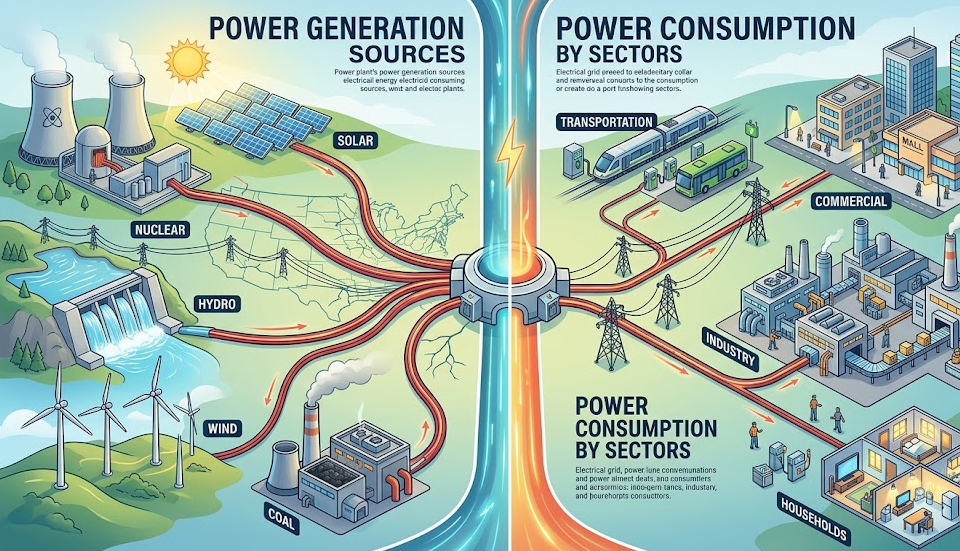
- Grid Intermittency: Renewables currently account for 17% of India’s electricity generation (compared to Thermal: 72%, Hydro: 9%, Nuclear: 2%). Sudden weather changes, like cloud cover, can abruptly knock a large chunk of solar power out of the grid.
- The Evening Peak: The most severe strain happens during the evening. Peak demands often persist even after solar generation winds down, meaning evening power cuts are largely driven by a lack of flexible, non-solar baseload supply rather than solar instability itself.
Government Schemes for Power Distribution Companies (Discoms)
Revamped Distribution Sector Scheme (RDSS)
Launched in 2021 (active till FY 2025-26) with an outlay of over ₹3.03 lakh crore, RDSS is currently the apex umbrella scheme for Discom reforms. Unlike previous bailout schemes, RDSS is Reforms-based and Results-linked. Central funding is strictly contingent on Discoms meeting pre-qualifying criteria and achieving annual performance benchmarks.
- Key Targets:
- Reduce pan-India AT&C losses to 12-15%.
- Reduce the ACS-ARR gap to Zero.
- Major Interventions:
- Smart Metering: Funding for 25 crore prepaid smart meters for consumers, system metering at feeders, and Distribution Transformers (DTs) to eliminate billing inefficiencies and track electricity theft.
- Loss Reduction Infrastructure: Upgradation of sub-stations, replacement of old conductors with Aerial Bunched Cables, and implementation of SCADA systems for real-time grid monitoring.
- Segregation of Agricultural Feeders: Physically separating agricultural power lines to accurately measure farm consumption and facilitate solarization.
Liquidity and Payment Discipline Initiatives
The government has instituted strict financial mechanisms to prevent Discoms from defaulting on their payments to power generators (Gencos).
- Electricity (Late Payment Surcharge & Related Matters) Rules, 2022:
- Mandates strict payment discipline. Under these rules, Discoms’ legacy dues (which stood at a massive ₹1.39 lakh crore in 2022) were rescheduled into equated monthly installments (EMIs).
- Impact: By 2026, legacy dues have drastically reduced to near ₹3,300 crore, ensuring financial liquidity for power generators.
- Additional Borrowing Space: State governments are allowed an additional borrowing space of 0.5% of their Gross State Domestic Product (GSDP) exclusively tied to implementing power sector reforms (e.g., timely subsidy transfer to Discoms).
Emerging Regulatory Frameworks (2025-2026)
- Draft National Electricity Policy (NEP) 2026 & Electricity (Amendment) Bill 2025:
- Aims to rationalise cross-subsidies (where high-paying industrial consumers subsidize residential/agricultural consumers), ensuring competitive tariffs for industries.
- Introduces competition by unbundling the distribution sector and allowing multiple supply franchises in the same area.
- Mandates accurate and timely subsidy accounting by State Governments to Discoms.
Indirect Support & Allied Schemes
Several broader energy transition schemes directly aid Discoms by reducing their subsidy burden and lowering peak demand.
- PM-KUSUM (Pradhan Mantri Kisan Urja Suraksha evam Utthaan Mahabhiyan): By solarizing agricultural pumps, this scheme drastically reduces the Discoms’ burden of supplying highly subsidized/free power to farmers during peak daytime hours.
- PM Surya Ghar: Muft Bijli Yojana: By subsidizing residential rooftop solar installations, it reduces domestic load on the grid, helping Discoms lower their power procurement costs and manage residential subsidies better.
- Capacity Building for DSM (Bureau of Energy Efficiency): Provides technical assistance to Discoms to implement Demand Side Management (DSM)—shifting electricity load to off-peak hours and promoting energy-efficient appliances.
Legacy Schemes (The Evolution of Reforms)
Understanding past schemes is essential to appreciate the shift in the government’s approach from ‘financial bailouts’ to ‘operational discipline’.
- UDAY (Ujwal DISCOM Assurance Yojana – 2015): A financial turnaround scheme where State governments took over 75% of Discom debts and issued bonds. While it provided temporary relief, it failed to curb operational losses (AT&C).
- DDUGJY (Deen Dayal Upadhyaya Gram Jyoti Yojana – 2014): Focused on rural electrification and the initial separation of agricultural and non-agricultural feeders.
- IPDS (Integrated Power Development Scheme – 2014): Aimed at strengthening urban sub-transmission, metering, and IT enablement of the distribution sector.
Government Schemes for Efficient Power Consumption
Standards & Labeling (Star Rating) Program
Run by the Bureau of Energy Efficiency (BEE), this is the most visible energy-efficiency initiative for the common man.
- What it is: Appliances are rated on a scale of 1 to 5 stars based on their energy efficiency. A 5-star appliance consumes significantly less electricity than a 1-star appliance.
- Covered Appliances: It covers 38 appliances (10 mandatory and 28 voluntary), including air conditioners, refrigerators, ceiling fans, televisions, washing machines, and water heaters (geysers).
- Benefit: Helps consumers make informed decisions while purchasing appliances, resulting in lower monthly electricity bills.
UJALA (Unnat Jyoti by Affordable LEDs for All)
Spearheaded by Energy Efficiency Services Limited (EESL), this has been one of the world’s largest lighting replacement programs.
- What it is: The scheme provides highly subsidized LED bulbs, LED tube lights, and energy-efficient ceiling fans to domestic consumers.
- Benefit: LED bulbs consume up to 80% less electricity than traditional incandescent bulbs and last much longer, drastically reducing the lighting load on a household’s power bill.
PM Surya Ghar: Muft Bijli Yojana
Launched in February 2024, this scheme targets residential consumers to generate their own power and reduce grid dependence.
- What it is: A massive subsidy scheme for the installation of rooftop solar panels. It aims to cover 1 crore households.
- Benefit: Households can get up to 300 units of free electricity per month. It drastically cuts down or completely eliminates electricity bills. Excess power generated can also be sold back to the local DISCOM (distribution company) for additional income.
National Efficient Fans Programme (NEFP)
Launched recently by EESL, this scheme targets the cooling needs of Indian households.
- What it is: The program promotes the deployment of BLDC (Brushless Direct Current) fans.
- Benefit: A traditional ceiling fan consumes around 70-80 watts, whereas a 5-star rated BLDC fan consumes only 28-35 watts. Replacing old fans with BLDC fans can cut a household’s ceiling fan electricity consumption by more than half.
National Efficient Cooking Programme (NECP)
- What it is: An initiative by EESL to distribute energy-efficient induction cookstoves to Indian households.
- Benefit: Induction cooking is highly energy-efficient because it transfers heat directly to the cookware with minimal heat loss. It offers a cost-effective and safer alternative to traditional gas (LPG) and standard electric heaters.
Eco Niwas Samhita (Energy Conservation Building Code for Residential Buildings)
While mostly targeted at builders and architects, it indirectly benefits the common man.
- What it is: It sets standards for building energy-efficient homes, focusing on building materials, natural ventilation, and daylighting.
- Benefit: Homes built under these guidelines require less artificial lighting and less air conditioning/heating, naturally keeping the home cooler in summer and warmer in winter, thereby keeping electricity consumption permanently low.
Way Forward
- Capitalizing and Modernizing Discoms: To resolve localized outages, state distribution infrastructure must be urgently upgraded to handle higher cooling loads. Initiatives like the Revamped Distribution Sector Scheme (RDSS) must focus strictly on smart metering, reducing AT&C losses, and upgrading local transformers.
- Investing in Energy Storage Systems: To combat the “evening peak” when solar energy is unavailable, India must accelerate investments in Battery Energy Storage Systems (BESS) and Pumped Storage Hydro Projects. This allows daytime solar surplus to be dispatched at night.
- Deploying Advanced Forecasting: Adopting advanced AI/ML-based weather and demand forecasting technologies (similar to those successfully deployed in high-renewable nations like Germany) will help grid managers better integrate fluctuating solar and wind power.
- Enhancing Transmission Grids: Upgrading inter-regional and intra-state transmission corridors is essential to ensure that localized spikes in demand can be met seamlessly by surplus generation from other parts of the country.
UPSC Practice Questions
Prelims (PT) Question
Q. Consider the following statements regarding the electricity sector in India:
- Thermal power continues to constitute the largest share of India’s total electricity generation mix.
- The Supervisory Control and Data Acquisition (SCADA) system is utilized by dispatch centres to monitor demand and maintain grid stability.
- The official power deficit figures consistently capture all deliberate load shedding undertaken by local distribution companies.
Which of the statements given above is/are correct?
(a) 1 and 2 only
(b) 2 and 3 only
(c) 1 and 3 only
(d) 1, 2, and 3
Answer: (a) 1 and 2 only
Explanation: Statement 3 is incorrect. According to experts, local outages and deliberately curtailed demand by distribution companies often remain unrecorded and are excluded from the official power deficit figures. Statements 1 and 2 are correct.
Mains Question
Q. “Despite possessing an installed power generation capacity that theoretically matches its peak demand, India continues to grapple with localized power outages during extreme summers.” Analyze the structural and operational bottlenecks responsible for this paradox and suggest measures to ensure reliable 24×7 power supply. (250 words)
Hints for Mains Answer:
- Introduction: Briefly mention the recent surge in peak power demand to a record 271 GW and state the core paradox: macro-level grid capacity is sufficient, but micro-level distribution frequently fails.
- Bottlenecks:
- Distribution Failures: Highlight the financial weakness of State-owned Discoms, lack of capital for infrastructure upgrades, and transformer tripping.
- Data Disconnect: Explain how deliberate local load-shedding is masked and excluded from official SCADA monitoring.
- Grid and Transmission Issues: Mention intra-state transmission bottlenecks.
- Renewable Variability: Discuss the “evening peak” challenge—high demand continuing after solar generation dips, putting pressure on thermal/hydro reserves.
- Way Forward:
- Focus on financial viability and infrastructure modernization for Discoms.
- Integrate massive utility-scale battery storage to shift solar power to evening hours.
- Adopt advanced weather forecasting for better renewable integration.
- Conclusion: Conclude that achieving true energy security requires shifting focus from mere generation capacity addition to building resilient, decentralized, and financially viable distribution networks.