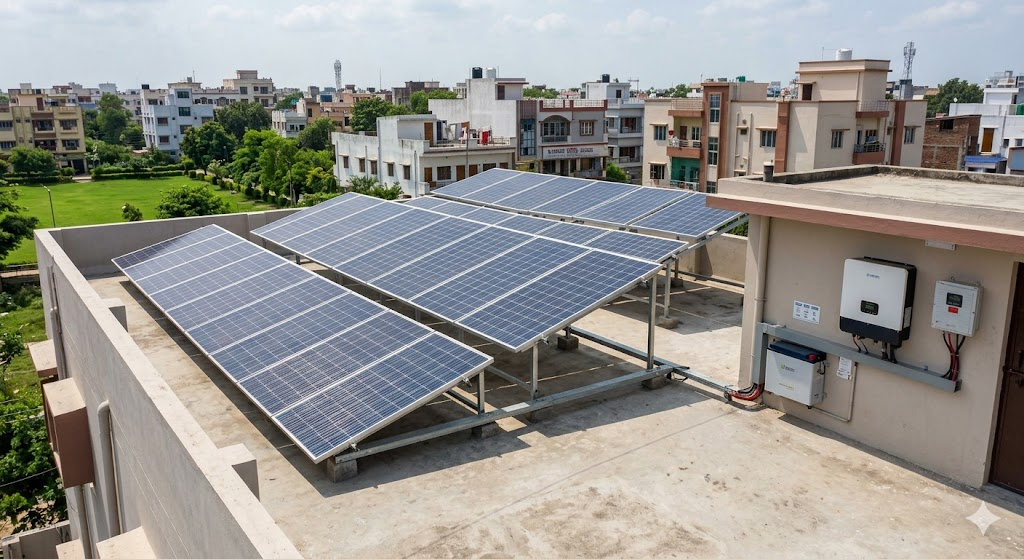
India’s rooftop solar capacity witnessed a massive surge, reaching 20.8 GW in 2025 after adding a record 7.1 GW of new installations (a 123% year-on-year increase). Recently, in May 2026, the Utility-Led Aggregation model gained major traction with approvals for over 1.3 million systems across various states.
Key Trends in Rooftop Solar Adoption
- Residential Sector Dominance: The residential segment drove the boom, accounting for 76% of all annual rooftop solar installations in 2025.
- Leading States (2025 Deployments): The top contributors to new deployments were:
- Maharashtra: ~16%
- Gujarat: ~16%
- Uttar Pradesh: ~15%
- Primary Catalyst: The Union government’s flagship PM Surya Ghar: Muft Bijli Yojana served as the main policy support driving this segmental growth.
Understanding Rooftop Solar
- Definition: It refers to photovoltaic (PV) systems installed on the roofs of residential, commercial, institutional, and industrial buildings to generate electricity.
- Integration: These systems are either integrated directly with the local electricity grid (often using net-metering) or linked to standalone battery storage systems.
PM Surya Ghar: Muft Bijli Yojana
- Approval & Outlay: Approved by the Union Cabinet on 29 February 2024 with a massive financial outlay of ₹75,021 crore.
- Core Targets:
- Facilitate rooftop solar installations in 1 crore (10 million) households by FY 2026-27.
- Provide up to 300 units of free electricity per month to participating households.
- Implementation Status: As of December 2025, over 1.94 million systems were installed, covering 2.43 million households (with states like Assam recording over 63,000 installations).
The Utility-Led Aggregation (ULA) Model
To accelerate deployment, especially among households facing barriers to independent installation, the ULA model is being rapidly expanded.
- What is it? A top-down implementation model where the state distribution utility (DISCOM) or a state agency aggregates household demand and executes the rooftop solar installations on their behalf.
- Recent Approvals (May 2026): Over 1.3 million systems were approved under this model across 10 States and Union Territories.
- Implementing States: Rollouts have actively begun in Odisha, Andhra Pradesh, Telangana, and Dadra and Nagar Haveli and Daman and Diu.
- Pipeline States: Bihar, Kerala, Jammu and Kashmir, and Rajasthan submitted proposals to join the ULA programme in May 2026.
- Significance: It shifts the burden of vendor management and financing away from individual consumers, making solar adoption more scalable and inclusive.
Practice Questions
Prelims (PT) Question
Q. With reference to the PM Surya Ghar: Muft Bijli Yojana and India’s rooftop solar sector, consider the following statements:
- The scheme aims to install rooftop solar systems in one crore households and provide up to 300 units of free electricity per month.
- The commercial and industrial sectors accounted for the majority of new rooftop solar installations in India during 2025.
- Under the Utility-Led Aggregation model, individual consumers are solely responsible for procuring, financing, and installing their solar panels.
Which of the statements given above is/are correct?
(a) 1 only
(b) 1 and 2 only
(c) 2 and 3 only
(d) 1, 2, and 3
Answer: (a)
- Statement 1 is correct: The scheme targets 1 crore households by FY 2026-27, providing up to 300 units of free electricity.
- Statement 2 is incorrect: According to 2025 data, the residential sector accounted for the vast majority (76%) of annual installations, not the commercial/industrial sectors.
- Statement 3 is incorrect: Under the Utility-Led Aggregation (ULA) model, the DISCOM or state agency aggregates demand and installs the systems on behalf of the households, removing the burden from the individual consumer.
Mains Practice Question
Q. “Despite the immense potential of distributed renewable energy, the widespread adoption of rooftop solar in India previously faced significant hurdles at the household level.” Discuss how the PM Surya Ghar: Muft Bijli Yojana, particularly through innovations like the Utility-Led Aggregation model, attempts to address these challenges. (150 words, 10 Marks)