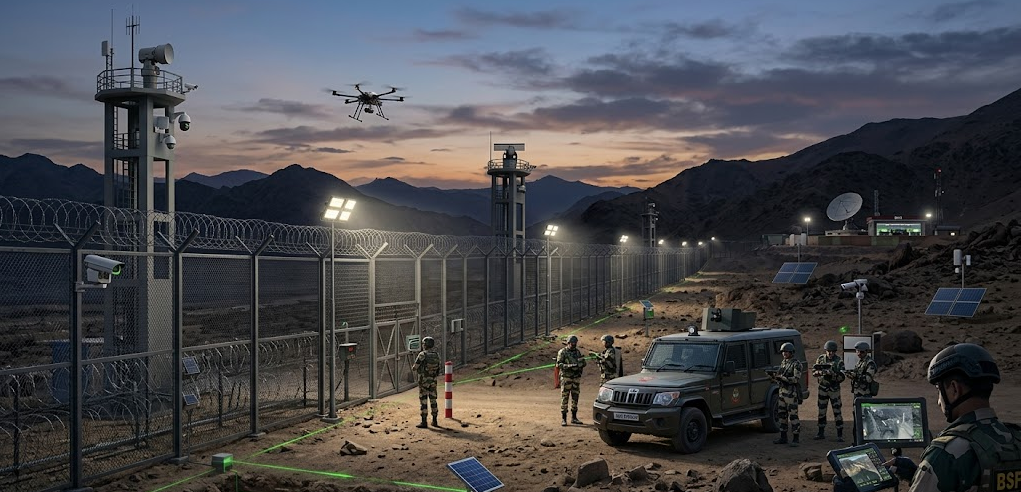
The Union Home Ministry has recently outlined a major technological and operational push to secure India’s international boundaries. Addressing the Border Security Force (BSF) Investiture Ceremony and the annual Rustamji Memorial Lecture, the Union Home Minister announced the Smart Border Project and a high-powered Demography Mission aimed at sealing the frontiers with Pakistan and Bangladesh and reversing artificial demographic changes caused by infiltration.
Key Initiatives Announced
The Smart Border Project
- Technological Integration: The project will deploy an impenetrable security grid powered by advanced technology — including drones, radars, smart surveillance cameras, and sensor networks — to upgrade purely physical and traditional guarding methods.
- Coverage Scope: It primarily targets the highly vulnerable borders with Pakistan (approx. 3,323 km) and Bangladesh (approx. 4,096 km), making roughly 6,000 km of operational fronts “impregnable.”
- Timeline: The project is slated to be rolled out within the next year, which coincides with the 60th year of the raising of the BSF.
High-Powered Demography Mission
- Objective: Originally declared by the Prime Minister in 2025, this upcoming mission aims to identify and plug infiltration routes, detect illegal immigrants, and expel them to prevent “unnatural artificial demographic changes” in border states and the hinterland.
- Protecting Local Interests: The mission seeks to safeguard local livelihoods, land rights, and national security from the long-term pressures of illegal cross-border migration.
Paradigm Shift to “Territorial Responsibility”
- Beyond the Fenceline: Border guarding forces have been instructed to look beyond standard perimeter defense. BSF personnel must engage directly with local revenue officials (patwaris), district magistrates, and local police to gather ground-level intelligence on infiltrators and smuggling routes.
- Centre-State Synergy: The strategy relies heavily on policy alignment with border states. With the current state administrations in West Bengal, Assam, and Tripura committed to a zero-tolerance policy against infiltration, the Ministry of Home Affairs is prioritizing a unified, coordinated approach to border management.
Why is a “Smart Border” Needed?
- Evolving Threat Matrix: Traditional fencing is inadequate against modern threats like drone-dropped weapons, narcotics smuggling, and hybrid warfare tactics frequently employed across the western border.
- Geographical Challenges: Riverine stretches, dense forests, and shifting topographies (especially along the India-Bangladesh border) make continuous physical fencing impossible or highly porous.
- Organized Crime Nexus: The borders face systemic issues such as cattle smuggling, fake Indian currency notes (FICN) circulation, and human trafficking, which require 24/7 technical surveillance to effectively dismantle.
Challenges in Implementation
- Technological Upkeep: Sustaining high-tech equipment like ground sensors and night-vision drones in harsh, varied weather conditions (extreme heat, heavy monsoons, and freezing temperatures) is logistically demanding.
- Inter-Agency Coordination: Sharing real-time intelligence seamlessly among the BSF, state police forces, intelligence agencies, and the Narcotics Control Bureau (NCB) remains a persistent operational hurdle.
- Diplomatic Sensitivity: Aggressive deportation and zero-tolerance measures necessitate careful diplomatic maneuvering, particularly with friendly neighbors like Bangladesh, to ensure bilateral ties remain stable.
Way Forward
To maximize the efficacy of the Smart Border concept, hardware deployment must be matched with capacity building for BSF personnel to handle complex tech grids. Establishing a centralized command-and-control center for real-time data fusion and ensuring swift judicial or administrative mechanisms for the deportation of identified infiltrators will be crucial in achieving the mission’s ultimate objectives.
Prelims Practice Question (PT)
Q. With reference to India’s border management, consider the following statements:
- The proposed ‘Smart Border Project’ relies heavily on scaling up physical fencing and troop deployment rather than technological surveillance to secure borders.
- The Border Security Force (BSF) is the primary central armed police force tasked with guarding the borders with both Pakistan and Bangladesh.
- India shares a longer international land boundary with Bangladesh than with Pakistan.
Which of the statements given above are correct?
(a) 1 and 2 only
(b) 2 and 3 only
(c) 1 and 3 only
(d) 1, 2, and 3
Correct Answer: (b) 2 and 3 only
- Statement 1 is incorrect: The ‘Smart Border Project’ marks a decisive shift away from traditional physical guarding. It aims to integrate technology such as drones, radars, and smart cameras to create an impenetrable, tech-driven security grid.
- Statement 2 is correct: The BSF is the designated border guarding force for both the India-Pakistan and India-Bangladesh frontiers.
- Statement 3 is correct: India’s border with Bangladesh is approximately 4,096.7 km long, whereas the border with Pakistan is about 3,323 km long.
Mains Practice Question
Q. “The complexity of modern cross-border threats demands a transition from conventional border guarding to an integrated, tech-driven security grid.” In the light of the proposed ‘Smart Border Project’, discuss the evolving security challenges along the India-Pakistan and India-Bangladesh borders and evaluate the measures required for effective border management. (15 Marks, 250 Words)
- Introduction: Briefly define the transition from physical to ‘smart’ borders. Mention the recent announcement of the Smart Border Project and the Demography Mission by the Union Home Ministry.
- Body Paragraph 1 (Evolving Challenges): Detail the modern threats — the use of drones for narco-terror (dropping drugs/weapons from Pakistan), cattle and fake currency smuggling, human trafficking, and demographic alterations via continuous illegal infiltration across the porous and riverine Bangladesh border.
- Body Paragraph 2 (Role of Smart Border Project): Explain how technological solutions (drones, thermal imagers, radars, sensors) overcome topographical limitations and provide 24/7 surveillance, reducing human error and troop fatigue.
- Body Paragraph 3 (Required Measures/Way Forward): Emphasize the need for “territorial responsibility” — synergy between the BSF, state police, intelligence bodies, and local civil administration (e.g., patwaris). Highlight the necessity of maintaining diplomatic equilibrium, building technical capacity, and enabling seamless, real-time data sharing.
- Conclusion: Conclude by affirming that a holistic approach integrating advanced technology, robust center-state cooperation, and proactive demographic protection is essential for ensuring impenetrable national security.