Table of Contents
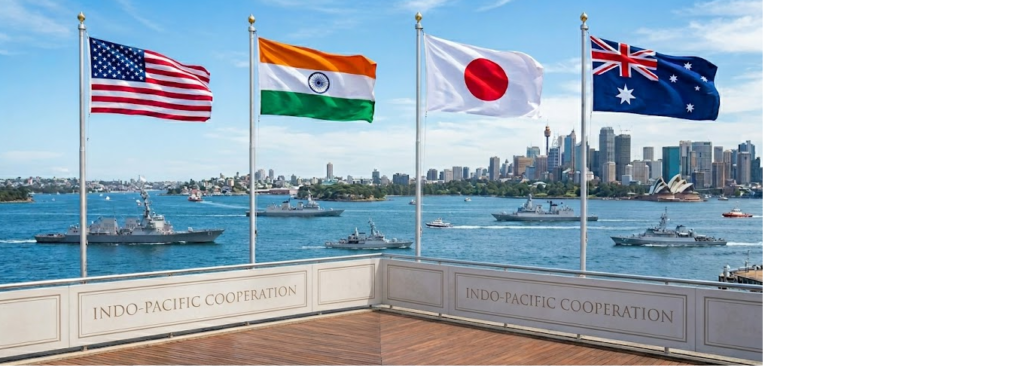
The Quad Foreign Ministers’ Meeting is being hosted in New Delhi, bringing together the foreign ministers of India, Japan, the US, and Australia. The meeting aims to revitalise the grouping, address regional geopolitical shocks—specifically the West Asia conflict and the Strait of Hormuz blockade—and set the agenda for the upcoming Quad Summit (which has been stalled since 2024).
Strategic Cooperation: Critical Minerals and Energy Resilience
- Top Priority on Critical Minerals: Cooperation over critical minerals essential for green energy transition and high-technology manufacturing is at the top of the Quad agenda.
- Japan-India Collaboration: Japan is actively developing critical mineral projects in India. However, optimizing this requires India to improve infrastructure, offer more competitive tax subsidies, and strengthen intellectual property rights (IPR) protection.
- The POWERR Asia Initiative: In response to the global energy crisis stemming from the Iran conflict, Japan proposed the “Partnership On Wide Energy and Resources Resilience (POWERR Asia)”. This mechanism will coordinate oil, gas, and renewables procurement, financing, and storage across Asian supply chains.
- Supply Chain Vulnerability: The ongoing conflict in West Asia and the blockade of the Strait of Hormuz directly impact Asian economies that depend on uninterrupted maritime energy transit.
- Maritime Stability vs. Aggressive Actions: Tensions have heightened following specific military escalations, such as the targeting of the Iranian vessel IRIS Dena in the Indian Ocean. While the Quad maintains a mandate for a “Free and Open Indo-Pacific” (FOIP), individual member nations balance varying degrees of direct military involvement and diplomatic caution.
What is the Quad?
- Definition: The Quadrilateral Security Dialogue (Quad) is an informal strategic diplomatic and security forum comprising four democratic nations: India, the United States, Japan, and Australia.
- Genesis and Evolution: It traces its roots to the joint disaster relief efforts following the 2004 Indian Ocean Tsunami. It was formalized in 2007 by Japanese PM Shinzo Abe, subsequently withered, and was actively resuscitated in 2017 to counter changing geopolitical dynamics in the Indo-Pacific.
- Core Vision: The foundational pillar of the Quad is ensuring a “Free, Open, and Inclusive Indo-Pacific” (FOIP), anchored by a rules-based international order, freedom of navigation, and peaceful dispute resolution.
- Expanding Mandate: Originally viewed through a security prism, the Quad has expanded its agenda to include global public goods, focusing on critical and emerging technologies, climate change, critical minerals, and the Indo-Pacific Maritime Domain Awareness (IPMDA) partnership.
Challenges in Front of the Quad
- Strategic Coherence and Multialignment: Members often have divergent approaches to global crises outside the Indo-Pacific. For instance, India’s strategic autonomy and its ongoing energy ties with Russia and Iran occasionally clash with the broader foreign policy objectives of the US and Japan.
- Summit Stagnation: The grouping recently faced a diplomatic lull, failing to convene a leader-level summit in 2025. This delay sparked global debates regarding a potential loss of momentum and raised questions about Washington’s long-term commitment amid its domestic political transitions.
- Economic Friction and Protectionism: Protectionist trade policies, such as sudden tariff impositions by the US administration or complex regulatory environments in India, create roadblocks to achieving deep economic integration among member states.
- Proliferation of Parallel Minilaterals: The rise of heavily security-oriented pacts like AUKUS (Australia, UK, US) and the “Squad” (Philippines, Japan, Australia, US) creates overlapping security architectures, leading to questions about whether the Quad is being sidelined in hard-security matters.
Relevance in Present Time
- Countering Supply Chain Shocks: Amid the ongoing West Asia conflicts and disruptions in vital chokepoints like the Strait of Hormuz, the Quad’s focus on securing Sea Lines of Communication (SLOCs) and maintaining uninterrupted maritime commerce is critical for Asian economic stability.
- Energy and Resource Resilience: The grouping is pivoting toward concrete resource security. Initiatives discussed within Quad frameworks, such as Japan’s POWERR Asia proposal, are highly relevant for coordinating oil, gas, and renewables procurement to insulate against geopolitical shocks.
- Critical Minerals & Technology: The Quad remains highly relevant as a bloc aimed at de-risking supply chains from single-nation dependencies (particularly China). Coordinating on semiconductor resilience, AI regulations, and critical mineral extraction forms the backbone of its modern relevance.
- Operational Maritime Delivery: Despite political lulls, the Quad has demonstrated quiet operational success through the Indo-Pacific Maritime Domain Awareness (IPMDA) initiative, helping regional coast guards combat illegal fishing and respond to humanitarian disasters.
Way Forward
- Regularize Leadership Engagement: To dispel narratives of a “diplomatic nadir,” the Quad must urgently finalize and hold its overdue Leader-level summit later this year. Consistent top-tier engagement is necessary to provide strategic direction.
- Deliver on Economic and Tech Pledges: The group must translate its working group discussions into tangible economic outcomes. This includes streamlining cross-border investments for critical mineral projects in India and finalizing robust frameworks for secure telecommunications.
- Reaffirm ASEAN Centrality: To maintain legitimacy across the broader region, the Quad must continuously align its initiatives with the needs of Southeast Asian nations, ensuring that it is not perceived as an exclusive bloc bypassing ASEAN architecture.
- Expand the Security-Development Nexus: The Quad should focus heavily on the Quad Indo-Pacific Logistics Network and Humanitarian Assistance and Disaster Relief (HADR) frameworks, proving that it acts as a net provider of regional security and developmental infrastructure.
PRELIMS PRACTICE QUESTION (PT)
Q. Consider the following statements regarding the “Partnership On Wide Energy and Resources Resilience (POWERR Asia)” initiative, recently seen in the news:
- It is a multilateral framework proposed by India to coordinate clean energy transitions across South Asia.
- It aims to streamline oil, gas, and renewable energy procurement, financing, and storage mechanisms to mitigate supply chain disruptions.
Which of the statements given above is/are correct? (a) 1 only
(b) 2 only
(c) Both 1 and 2
(d) Neither 1 nor 2
Answer: (b) 2 only Explanation: Statement 1 is incorrect because POWERR Asia was proposed by Japan (under PM Sanae Takaichi), not India, though India is a key participant. Statement 2 is correct as its primary mandate is to coordinate oil, gas, and renewables procurement, financing, and storage to counter energy crises like those emerging from the West Asian conflicts.
MAINS PRACTICE QUESTION
Q. Critics argue that the Quad is losing its strategic coherence amidst shifting national priorities and prolonged delays in holding its leadership summits. In light of the recent Quad Foreign Ministers’ Meeting, evaluate how the focus on economic security and initiatives like critical mineral partnerships can help the grouping retain its relevance. (15 Marks, 250 words)
Brief Framework for Answer:
- Introduction: Highlight the context of the New Delhi Quad Foreign Ministers’ Meeting and mention the challenges to its relevance (lack of summit since 2024, minimal mentions in national strategy documents).
- Body Paragraph 1 (Sustaining Relevance via Economic Security): Discuss how moving from purely security-centric geometry to practical economic deliverables (Critical Minerals cooperation, high-tech supply chain resilience) provides tangible value to member nations.
- Body Paragraph 2 (Addressing Regional Shocks): Explain the significance of the energy security pillar (e.g., POWERR Asia) in insulating Indo-Pacific supply chains from external geopolitical disruptions like the West Asian and Strait of Hormuz blockades.
- Conclusion: Conclude that while military alignment within the Quad faces diplomatic constraints, a robust focus on economic geostrategy and technical cooperation ensures the grouping remains an indispensable pillar for a Free and Open Indo-Pacific.